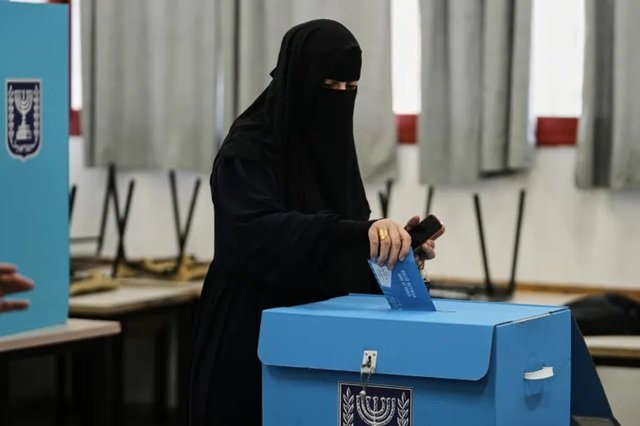
Israel’s parliamentary election has strengthened the political position of Arab parties while leaving Prime Minister Benjamin Netanyahu’s governing bloc facing the prospect of losing its parliamentary majority. The emerging results could force opposition leaders to consider cooperation with Israeli-Arab parties, creating new opportunities for political change but also exposing disagreements over Israel’s identity, security and the conditions for coalition government.
Speaking to German newspaper Die Zeit while votes were still being counted, Daniel Gordis, an expert on Israeli history and contemporary politics, said the increased participation of Arab voters could fundamentally alter the country’s political direction if the trend continued.
“The fact that voter turnout among the Arab minority has increased so much could, if the trend continues, change the face of Israeli politics,” Gordis said.
The stronger performance of Arab parties represents a significant development in a political system in which Arab citizens have historically been underrepresented. Gordis said their increased participation was particularly important because previous political disengagement had limited their influence.
However, their electoral success also presents a challenge for Jewish political parties seeking to establish a governing coalition. Arab parties, like the ultra-Orthodox Haredim, do not belong to the Zionist mainstream, creating questions about whether their political priorities can be reconciled with those of parties representing Jewish voters.
Gordis said the typical Israeli voter was now confronting a substantial part of the population that did not necessarily support the continued existence of Israel as a Jewish and democratic state in the same way as the Zionist mainstream.
For Israelis in the political centre and on the left, he said, the development could create tension between their commitment to democracy and their understanding of Israel’s Jewish national identity.
“Under the aspect of democracy, it is a wonderful development,” Gordis said, noting that Arab Israelis had previously been politically underrepresented partly because they had chosen not to participate.
The question of whether Arab parties could become partners in a future coalition remains particularly sensitive. Gordis said their willingness to make statements acceptable to Jewish parties would be important if negotiations over government formation began.
He identified their position on Hamas as a significant obstacle.
According to Gordis, Arab political representatives had been only half-hearted in their condemnation of the organisation. Some continued to describe Hamas as a charitable organisation, while condemning violence against civilians without being willing to identify Hamas as a terrorist group.
That distinction, he suggested, could complicate efforts to establish political cooperation with Jewish parties, particularly those for whom security and the consequences of the October 7 attacks remain central considerations.
The election has also produced exceptionally high participation among Jewish Israelis, adding another dimension to the political outcome. Gordis said turnout had been extraordinary, reflecting the determination of voters to influence the country’s direction despite deep dissatisfaction with its political leadership.
The mobilisation, however, carries risks for the opposition. If the political camp seeking change ultimately fails to secure power, the disappointment could be particularly severe because of the scale of the effort invested in the election.
Gordis said supporters of political change had made extensive efforts, including bringing people from the United States and Europe to participate, yet could still find themselves unable to achieve their objective.
“If the camp that wants change ultimately loses, there will be enormous despair in the political centre,” he said.
Nevertheless, he regarded the high turnout as evidence of continued confidence in Israel’s democratic institutions, despite serious reasons for distrust.
He pointed to the controversial judicial reform, Netanyahu’s failure to accept responsibility for the October 7 attacks and serious indications that the prime minister had ignored warnings about the assault.
Despite those concerns, Israelis had continued to demonstrate confidence in the electoral system by voting in record numbers.
“That is very good news from the perspective of democracy,” Gordis said.
Netanyahu’s own party, Likud, has performed better than many expected, even as the governing bloc appears to have lost its parliamentary majority. Gordis said the reasons for the party’s performance would require further investigation, but suggested that security considerations might have influenced voters who were dissatisfied with the prime minister over October 7.
Some voters may have concluded that, at a time when Israel was being attacked on multiple fronts, Netanyahu remained the political leader best equipped to represent the country internationally.
Gordis said Netanyahu possessed particular advantages in dealing with the United States and presenting Israel’s position before international audiences.
“If you want someone who can go to Capitol Hill in Washington and stand there in front of the microphones, Netanyahu can do that much better than Eisenkot,” he said, referring to opposition figure Gadi Eisenkot.
The election’s implications for political polarisation will depend on the final parliamentary arithmetic. If Netanyahu’s bloc unexpectedly secures the 61 seats required for a majority, Gordis said the prime minister would probably pursue a sharp rightward course, including continuing his judicial reform programme.
Such an outcome, he warned, would intensify existing divisions.
If the competing political blocs instead found themselves compelled to cooperate, the resulting arrangements could produce a different direction for Israeli politics.
Gordis said the possibility of the two camps coming together in some form could create an opportunity for change, although the final election results would determine whether such cooperation became necessary.