


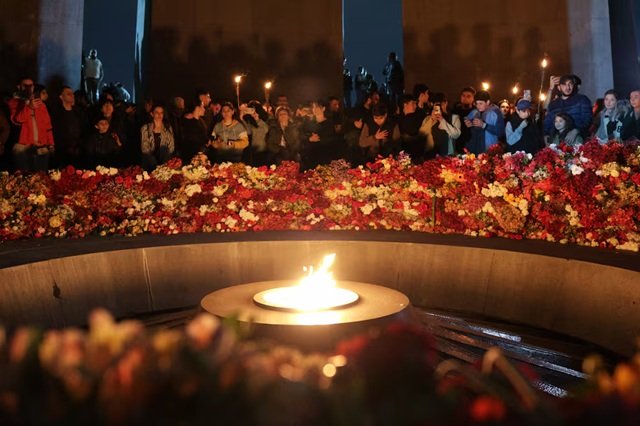
Israel’s decision to recognize the Armenian genocide has reignited a debate that extends far beyond the events of 1915, placing renewed attention on the relationship between historical memory and international diplomacy. More than a century after the mass deportations, killings, and forced displacement of Armenians under the Ottoman Empire, the move has been presented as a significant step toward acknowledging one of the twentieth century’s defining atrocities. Yet the announcement has also prompted questions about why such recognition arrives at particular political moments rather than simply as an act of historical remembrance.
The issue, explored in reporting and analysis published by El Pais, highlights a pattern that has shaped international responses to the Armenian genocide for decades. While survivors, historians, and the global Armenian diaspora have long documented and campaigned for recognition, governments have often acted only when diplomatic conditions made such decisions politically viable. The timing of official recognition, according to the report, has frequently reflected broader geopolitical calculations alongside historical considerations.
The Armenian genocide has remained a subject of international dispute for generations. Armenians and many historians have consistently described the events of 1915 as a systematic campaign of deportation and extermination carried out by the Ottoman Empire. Despite extensive historical research and decades of advocacy, many governments delayed formal recognition, mindful of the political and strategic consequences of confronting modern-day Turkey over its rejection of the genocide designation.
The experiences of the United States and Germany illustrate how diplomatic realities have intersected with historical acknowledgment. For many years, successive American administrations avoided officially describing the events of 1915 as genocide, reflecting Turkey’s strategic importance as a NATO ally. That position shifted in 2021, when then-President Joe Biden formally recognized the Armenian genocide. The decision came after relations between Washington and Ankara had deteriorated over issues including Turkey’s purchase of the Russian S-400 missile defense system, disagreements over Syria, and growing tensions surrounding the government of President Recep Tayyip Erdogan.
Germany followed a comparable path several years earlier. In 2016, the Bundestag adopted a symbolic resolution recognizing the Armenian genocide while also acknowledging the historical responsibility of the German Empire, which had been allied with the Ottoman Empire during the First World War. The move prompted Turkey to recall its ambassador, underscoring the diplomatic consequences that often accompany such recognitions. Although widely regarded as an important historical acknowledgment, the decision also reflected the broader political climate, as relations between Berlin and Ankara were strained during negotiations over the European Union’s refugee agreement with Turkey.
These cases demonstrate that recognition has rarely been driven by a single factor. The sustained efforts of Armenian communities, historians, researchers, and survivors have remained central to preserving historical memory and challenging denial. At the same time, the timing of official declarations has frequently coincided with periods in which governments judged the diplomatic costs of recognition to be more manageable.
Israel’s latest decision now fits into that wider historical pattern. For decades, the country, whose national identity is deeply shaped by the memory of the Holocaust, refrained from formally recognizing the Armenian genocide despite repeated calls from Armenian organizations and some Israeli public figures. The current announcement comes at a time when relations between Israel and Turkey have reached one of their lowest points, with Ankara sharply criticizing Prime Minister Benjamin Netanyahu over the conflict in Gaza.
The proposal, however, has not yet completed Israel’s legislative process. It must still pass through the Knesset before becoming a formal state recognition. That uncertainty has contributed to questions about the practical significance of the announcement and whether it will ultimately become official policy.
Among those expressing reservations is Stefan Ihrig, a historian at the University of Haifa specializing in Turkish and European history. While supporting recognition itself, Ihrig questioned the circumstances surrounding the announcement, arguing that the timing and political context risk shifting an issue of historical memory into the realm of diplomatic confrontation. He suggested that recognition should stand independently of contemporary disputes between governments rather than becoming part of broader geopolitical tensions.
Israeli Foreign Minister Gideon Saar described the decision as a moral and historical obligation. Yet the announcement coincides not only with deteriorating relations between Israel and Turkey but also with domestic political uncertainty, as Israel’s parliament faces the possibility of dissolution. According to Ihrig, those circumstances raise doubts about whether the initiative will ultimately produce lasting legislative change.
Vahram Ter-Matevosyan, a historian specializing in Turkey and the South Caucasus, offered a different perspective on the regional implications. He argued that recognition is unlikely to trigger a dramatic new rupture between Israel and Turkey because bilateral relations have already deteriorated substantially. Instead, he suggested that the move may become another symbolic point of contention in an already strained relationship, adding to existing disputes without fundamentally altering the diplomatic landscape.
The response from Armenia itself has been notably restrained. Prime Minister Nikol Pashinyan’s government avoided celebrating Israel’s announcement and instead emphasized the importance of preventing what it described as the instrumentalization of the Armenian genocide. Earlier, in March 2025, Pashinyan had indicated that securing additional international recognitions was no longer among the central priorities of Armenia’s foreign policy, reflecting his government’s broader strategy of pursuing normalization with neighboring states following the 2020 Nagorno-Karabakh war.
Ter-Matevosyan described that approach as a significant shift in Armenian foreign policy, suggesting that the government increasingly views itself as a small and vulnerable state focused on regional stability rather than serving primarily as the international advocate for historical recognition.
Israel’s decision has also revived memories of more recent conflicts affecting Armenians. Some point to Israel’s military cooperation with Azerbaijan during the 2020 Nagorno-Karabakh war and its limited public response following the displacement of more than 100,000 Armenians from the region after Azerbaijan’s 2023 offensive. Those developments continue to influence perceptions of Israel’s latest announcement within parts of the Armenian community.
In Jerusalem’s Armenian Quarter, where one of the world’s oldest Armenian communities continues to live, reactions have reflected both acknowledgment and caution. Levon Kalaydjian, an Armenian resident born and raised in the quarter, noted the historical importance of the area known as the Cow’s Garden, where survivors and orphans of the 1915 genocide found refuge after fleeing the Ottoman Empire. He said that history shapes how local Armenians interpret Israel’s recognition today.
Kalaydjian also expressed concern over what he described as increasing pressure on the Armenian community in Jerusalem, arguing that political conditions have left many residents feeling insufficiently protected. While recognizing the significance of Israel officially using the term genocide, he said many community members find it difficult to separate that symbolic act from their present-day experiences.
Ihrig echoed those concerns, arguing that historical recognition carries broader implications beyond official declarations. He said that acknowledging the suffering of Armenians should be accompanied by ensuring that Armenian communities living in Israel and Jerusalem feel secure.
As Israel’s proposal moves through an uncertain parliamentary process, the decision has once again placed the Armenian genocide at the center of international attention. More than a century after the events of 1915, the debate continues to encompass not only historical recognition but also the political circumstances in which governments choose to confront the past, a theme that remains central to the account presented by El Pais.









