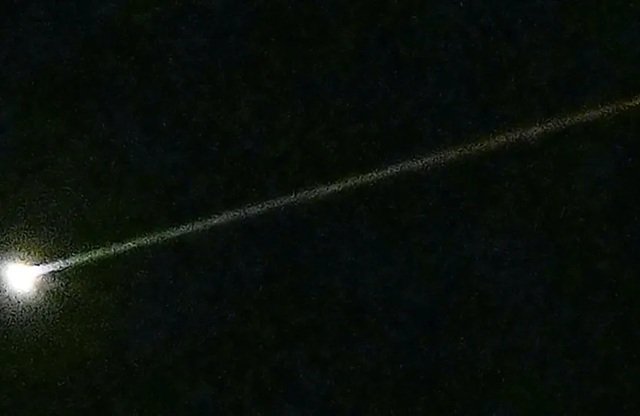
Japan has successfully completed a major test of technology that could one day help protect Earth from potentially dangerous asteroids, marking another significant step in the growing international effort to develop planetary defense capabilities. The Japan Aerospace Exploration Agency (JAXA) announced that its Hayabusa2 spacecraft successfully executed a precisely controlled flyby of the near-Earth asteroid Torifune, demonstrating the level of navigation accuracy that future asteroid-deflection missions may require.
The refrigerator-sized spacecraft traveled at a speed of more than 18,000 kilometers per hour as it approached the asteroid, passing within a planned distance of approximately 800 meters without making contact. The mission was designed not to collide with the asteroid but to test whether scientists could accurately guide the spacecraft during an extremely close encounter. According to JAXA, the flyby proceeded as planned, providing an important demonstration of precision navigation in deep space.
The successful maneuver represents a critical technological achievement because any future mission aimed at protecting Earth from a hazardous asteroid would require exceptional control over a spacecraft’s trajectory. A controlled collision intended to alter an asteroid’s course would depend on accurately targeting the object under challenging conditions, making navigation tests such as the Torifune flyby an essential part of future planetary defense planning.
If further analysis confirms that Hayabusa2 approached to within the intended distance of 800 meters, the maneuver would rank among the closest flybys ever conducted near a near-Earth asteroid. Such close approaches provide scientists with valuable opportunities to test spacecraft guidance systems while collecting detailed observations of asteroid surfaces.
During the encounter, cameras aboard Hayabusa2 gathered information about Torifune’s surface, including its geographical features, composition, and temperature. These observations are expected to contribute to scientific understanding of asteroid characteristics that could influence the outcome of future deflection missions.
Researchers emphasize that understanding the physical properties of an asteroid is as important as developing the technology needed to reach it. The way an asteroid responds to an impact depends heavily on its internal structure and composition. Patrick Michel of the European Space Agency noted that scientists need to know whether an asteroid behaves “like a sponge” or more like an extremely solid material before attempting to change its trajectory. Such knowledge helps determine how an object would react if struck by a spacecraft intended to divert it from a collision course with Earth.
Japan’s latest achievement comes four years after the United States demonstrated another milestone in planetary defense. In September 2022, NASA successfully carried out its Double Asteroid Redirection Test, or DART mission, deliberately crashing a spacecraft into the asteroid Dimorphos and successfully altering its orbit. That mission provided the first practical demonstration that the trajectory of an asteroid could be changed through a controlled impact.
Rather than repeating that approach, JAXA’s latest mission focused on the equally important challenge of spacecraft navigation. Before any impact mission can be attempted, engineers must be confident that they can guide a spacecraft with extraordinary precision toward its intended target. The Torifune flyby was designed to validate those capabilities without risking a collision.
The successful test also extends the remarkable career of Hayabusa2, one of Japan’s most accomplished deep-space missions. The spacecraft was launched in 2014 on a journey to the asteroid Ryugu, located approximately 300 million kilometers from Earth. After reaching the asteroid, it collected samples from the surface before returning to Earth’s vicinity in 2020, where it released a capsule containing the material for scientific analysis.
Rather than ending its mission after delivering those samples, Hayabusa2 continued its journey through space, allowing engineers and scientists to assign it additional objectives. The close encounter with Torifune demonstrates how the spacecraft continues to contribute to both scientific research and the development of technologies that may play a role in future planetary defense efforts.
The mission is expected to continue beyond the latest flyby. According to JAXA, Hayabusa2 is scheduled to undertake another asteroid mission in 2031, extending its operational life and providing further opportunities to test technologies and gather scientific data from additional celestial bodies.
The latest achievement highlights the increasing international focus on preparing for the possibility of hazardous asteroids approaching Earth. While such events are rare, space agencies have expanded research into methods of detecting, studying, and potentially diverting threatening objects before they can pose a danger. Precision navigation, detailed knowledge of asteroid composition, and successful spacecraft operations have become central components of those long-term preparations.
With the successful flyby of Torifune, Japan has added another important demonstration to the growing body of planetary defense research. As engineers continue analyzing data collected during the close encounter, the mission provides new evidence that spacecraft can be guided with the accuracy required for future asteroid protection missions, while also expanding scientific understanding of the small celestial bodies that travel through Earth’s cosmic neighborhood.