


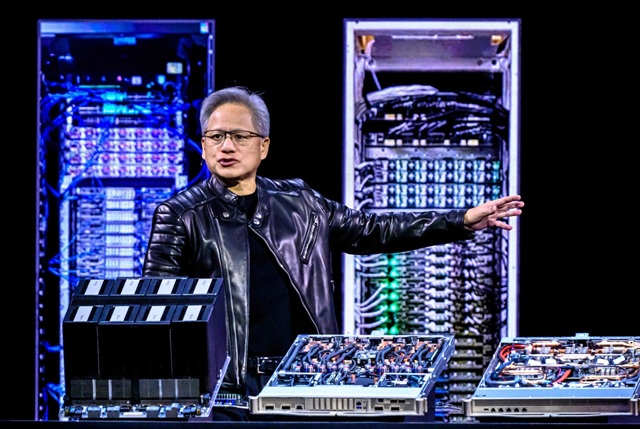
Jensen Huang, chief executive of Nvidia, is emerging as a global ambassador for artificial intelligence, combining corporate strategy with high-profile diplomacy to expand the chipmaker’s influence across governments and industries.
After attending a state banquet at Windsor Castle with US President Donald Trump and King Charles in September, Huang hosted a London event for tech entrepreneurs and venture capitalists, joined on stage by US commerce secretary Howard Lutnick and UK Prime Minister Sir Keir Starmer. Pledging £2 billion to UK-based AI start-ups, Huang personally announced investments in eight companies, underscoring his hands-on approach to promoting AI innovation.
According to the Financial Times, Huang’s public showmanship reflects a broader strategy: Nvidia is encouraging countries to develop “sovereign” AI systems while relying heavily on the company’s chips and technology. This dual role positions Huang as both a champion of national AI self-sufficiency and a promoter of American technological dominance.
Nvidia has invested heavily in the UK’s AI ecosystem, including a £500 million stake in London-based start-up Nscale, which has already reached a $3 billion valuation largely thanks to Nvidia’s support. The company is replicating this model across Europe, the Middle East, Japan, and Malaysia, forming partnerships with local firms to meet government demands for AI infrastructure.
Huang’s political engagement marks a significant shift for the co-founder of the world’s most valuable chipmaker, who had previously avoided public political involvement. He has met with more than a dozen heads of state in the past year, lobbying for national AI investments while simultaneously promoting Nvidia’s products. Analysts and executives interviewed by the Financial Times note that governments are increasingly dependent not only on Nvidia’s technology but also on Huang’s personal influence.
Nvidia’s approach has already influenced global AI policy. The company has been involved in more than 20 sovereign AI initiatives this year, ranging from North America to the Middle East and Asia. In Abu Dhabi and the UAE, for instance, governments are building large-scale AI campuses and funding private-public partnerships to secure access to high-performance chips, while countries like Germany, France, Sweden, and Japan have partnered with Nvidia on national AI projects.
Despite the push for “sovereign” AI, analysts caution that few nations—outside of China—have the capacity to develop fully independent AI hardware and software ecosystems. European start-ups such as Axelera AI are still at an early stage, and large-scale independence from US technology remains a distant goal.
Financially, Huang’s strategy is already paying dividends. Nvidia expects more than $20 billion in revenue from sovereign AI initiatives in 2025, double the 2024 figure, with projections suggesting the market could reach $50 billion in the coming years.
As Huang blends corporate ambition with global diplomacy, his influence shows how tech executives can shape both markets and government policy. In the words of US President Trump, speaking alongside Starmer in September: “You’re taking over the world, Jensen… all I can say is we both hope you’re right.”









