A troubling new pattern is emerging in the United States, one that has left investigators grasping for language and communities struggling to understand why acts of extreme violence keep occurring. As documented in an extensive investigation by the Washington Post, a growing number of attackers behind recent shootings, bombings and assassination plots appear to be driven not by politics, religion or race, but by a profound hostility toward society itself. Their message, as one attacker wrote bluntly, is that there is no message at all.
Over the past 18 months, the country has experienced a wave of high-profile violence that defies traditional categories. Some assailants have explicitly rejected political or ideological labels, declaring instead their desire to see civilization collapse. In manifestos and online posts, they describe humanity as irredeemable and existence itself as an affront. Federal prosecutors and law enforcement officials have increasingly referred to this phenomenon as nihilistic violent extremism, a modern incarnation of 19th-century nihilist philosophy revived and accelerated by the internet.
According to the Washington Post’s analysis of court documents, academic research and news reports, at least 17 attacks or plots between July 2024 and December 2025 involved perpetrators who left behind written explanations of their motives. While many of those incidents were rooted in familiar political grievances, six attackers fit a distinct pattern: they were motivated by a hatred of society at large rather than allegiance to any cause. Three others were driven by highly specific personal grievances that rarely surface in extremist violence.
Among the cases cited by the Post is a 15-year-old shooter in Madison, Wisconsin, who left a manifesto titled “War Against Humanity,” describing people as “filth.” Another involved a 24-year-old man accused of plotting a drone attack on Nashville’s power grid in an attempt to trigger the collapse of the globalized world. In California, a 25-year-old self-described anti-natalist blew himself up outside an IVF clinic, arguing that humans should never be brought into existence without consent. “I’m angry that I exist,” he said in a recording posted online.
By March 2025, federal prosecutors formally adopted the term nihilistic violent extremism, defining it as criminal conduct carried out in pursuit of political, social or religious goals that stem primarily from hatred of society and a desire to bring about its collapse through chaos and destruction. The first known use of the term appeared in the prosecution of a Wisconsin teenager accused of killing his parents to finance a plan to assassinate President Donald Trump and spark civil unrest.
“What we were seeing didn’t fit the existing definitions,” Cody Zoschak, a researcher with the Institute for Strategic Dialogue and a former NYPD counterterrorism analyst, told the Washington Post. Investigators, he said, were encountering perpetrators whose violence was untethered from coherent ideology.
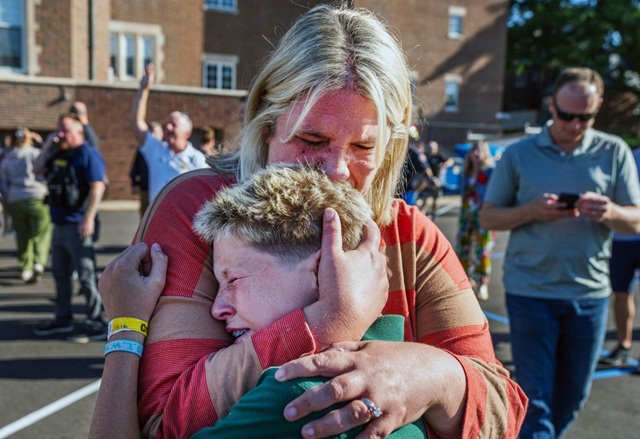
One of the most unsettling examples is the case of Natalie Rupnow, the 15-year-old who opened fire at Abundant Life Christian School in Madison in December 2024, killing two people and wounding six before killing herself. Early coverage focused on racist slurs and Nazi imagery in her online activity, but investigators soon concluded that these elements did not fully explain her actions. The target of her attack, a predominantly White Christian school, did not align with white supremacist logic.
As the Washington Post reported, Rupnow had spent years immersed in online forums that glorify mass killers. Within parts of the so-called true crime community, attackers are sometimes romanticized as misunderstood loners, elevated to near-mythical status. Rupnow referred to several past killers as “saints,” praising their acts precisely because they seemed meaningless. Her manifesto expressed sweeping contempt for humanity and an obsession with notoriety. “You will see us on the news,” she said in a recording later recovered by police.
Investigators found that Rupnow’s writings closely mirrored material circulating online, suggesting she was not inventing a worldview but absorbing and replicating one. Her planning was meticulous. In her bedroom, police found a map of the school, a cardboard model of the building and videos of her posing with a gun. She wanted to be remembered, to inspire others, and in that she succeeded.
Within weeks, a 17-year-old in Tennessee opened fire in his school cafeteria, killing one student before taking his own life. He referred to Rupnow as a “saint” in his online posts. Months later, a 16-year-old in Colorado carried out another school shooting after posting images of himself alongside Rupnow. In August, a man who killed two children at a Minneapolis church inscribed one of his guns with her name and wrote in a journal: “The message is there is no message.”
Experts interviewed by the Washington Post emphasized that the internet has transformed how such violence develops. In the past, extremists often relied on hierarchical organizations. Today, individuals can find technical instructions, ideological reinforcement and emotional validation online, even as they profess hatred for society. The Nashville plotter allegedly learned how to build an explosive drone through online videos. The IVF clinic bomber queried an AI application about detonation speeds. These attackers found community without belonging and guidance without leadership.
“What is scary now is we don’t know where the next threat might be coming from,” said Michael Jensen, director of research at American University’s Polarization and Extremism Research and Innovation Lab. The accessibility of information and the amplification of violent notoriety have made lone actors more dangerous and harder to detect.
The concept of nihilistic violent extremism is not without controversy. Some researchers warn that the label risks obscuring the role of racism, antisemitism and other longstanding hatreds that still appear in many cases. Wendy Via, chief executive of the Global Project Against Hate and Extremism, cautioned the Washington Post that collapsing diverse motivations into a single category could undermine efforts to address the root causes of violence. She noted that some accelerationist attackers, who seek societal collapse, overlap heavily with traditional hate movements.
Others argue that the broader social environment cannot be ignored. Shon Barnes, the former Madison police chief who oversaw the response to Rupnow’s attack, said the alienation visible in young attackers reflects the anger permeating public life. When leaders model division rather than compromise, he said, children absorb those cues.
“What example are we setting?” Barnes asked. “Our children are watching.”
As the Washington Post’s reporting makes clear, nihilistic violent extremism represents a profound challenge for law enforcement and society alike. It is violence without a clear demand, grievance or end state, fueled by online subcultures and a deep sense of meaninglessness. In confronting it, authorities are forced to grapple not just with security failures, but with a growing void at the center of public life — one that some attackers seek to fill with destruction.