


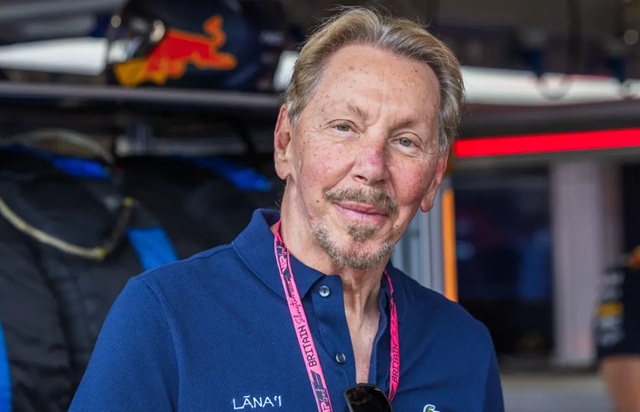
Updated: Elon Musk has once again secured his position as the world’s richest person after a brief setback on Wednesday when Oracle co-founder Larry Ellison overtook him. Ellison’s net worth skyrocketed by $89 billion to $383.2 billion following Oracle’s impressive earnings report, with a peak intraday gain of $101 billion—marking the largest single-day increase ever tracked by Bloomberg. Oracle’s stock surged by as much as 43%, closing 36% higher, driven by robust earnings and a bullish outlook on AI infrastructure demand. The company’s market capitalization jumped by around $244 billion to nearly $922 billion, propelling Oracle into the top 10 of the S&P 500 and surpassing major firms like Eli Lilly, Walmart, and JPMorgan Chase. Musk reclaimed the top spot as markets stabilized later in the day.
***
Larry Ellison’s ascent to the top of the billionaire ranks reads like a masterclass in quiet dominance. At 81 years old, far from the limelight and relentless self-promotion that defines Silicon Valley’s younger titans, Ellison has overtaken Elon Musk to become the world’s richest man. His fortune skyrocketed by over $100 billion in a single day, a surge powered by Oracle’s explosive growth in cloud computing as businesses pour resources into artificial intelligence infrastructure. Ellison’s total net worth now stands at an astonishing $393 billion, surpassing Musk’s $385 billion, signaling more than a simple shuffle of wealth—it’s a shift in influence from spectacle to systems.
Ellison’s journey from an adopted child in Chicago to the helm of one of the world’s largest software companies is a tale of resilience and sharp strategic thinking. He dropped out of the University of Illinois and the University of Chicago before moving to California, where he worked on a database project for the CIA—a project later branded “Oracle.” This early brush with intelligence work foreshadowed the disciplined, infrastructure-focused approach that would define his career. Oracle, which he co-founded in 1977, quietly transformed enterprise technology, eventually becoming the backbone of countless corporate operations. Unlike Musk, whose ventures invite headlines and controversy, Ellison built his empire through decades of patient investment in data management and enterprise solutions.
What few know is that Ellison’s influence extends far beyond software. He’s an avid collector of architecture and luxury assets, owning homes designed by Frank Lloyd Wright and one of the largest private islands in the United States—Lanai, purchased for $300 million in 2012. His passion for competition is no less pronounced; in 2019, he launched SailGP, a global sailing championship featuring cutting-edge foiling catamarans. “Speed, technology, and competition—that’s where I feel alive,” he once said, offering a glimpse into the drive that fuels his ventures outside technology. He is also known to weave philosophy into his leadership style, quoting Taoist principles and once telling a Stanford audience, “The best way to lead is to disappear and let the team find its way.”
Despite his lavish lifestyle and reputation for excess, Ellison remains a paradox—both fiercely ambitious and privately philanthropic. He has quietly donated millions to healthcare research and education without courting public approval, embodying a stewardship that contrasts sharply with Silicon Valley’s more performative generosity. In a rare interview, Ellison reflected on his values, stating, “I’ve always believed that the most important thing is to build something that lasts, not something that merely dazzles for a moment.” He once added, “It’s not about being the richest man in the world—it’s about being the most prepared,” capturing his ethos of foresight over flamboyance.
His personal life adds another layer to his complex persona. Recently, he married Jolin Zhu, a 33-year-old alumna from the University of Michigan, sparking debate and fascination about the billionaire’s unconventional choices. Meanwhile, his son David Ellison has carved his own path in media, taking over as CEO of Paramount after a high-stakes corporate battle, underscoring the generational reach of Ellison’s influence. Interestingly, Ellison also holds a 1.4% stake in Tesla, though he stepped down from the board in 2022. His ties to Musk’s world remain, but they are peripheral compared to his central role in powering the technological infrastructure Musk relies on.
What this shift reveals is profound. While Musk’s ventures are defined by bold promises, public theatrics, and a thirst for redefining space and energy, Ellison’s quiet grip over cloud computing and enterprise systems represents the unsung backbone of innovation. Oracle’s infrastructure is fueling the AI revolution, providing the data pipelines, storage, and security that make ambitious projects possible. Ellison’s victory underscores a truth often ignored: groundbreaking technology depends less on visionaries and more on the architects who build the platforms that sustain it.
The AI boom has created fortunes for a select few, and Ellison’s timing and preparation could not have been more perfect. “People want the spotlight, but I want the architecture,” he remarked at an industry event, revealing his preference for foundational strength over fleeting recognition. His success demonstrates that endurance, scalability, and strategic patience outlast hype and disruption.
Ellison’s triumph is both inspiring and uncomfortable. It forces us to question the cultural narrative that celebrates audacity over discipline, flash over function. He is a billionaire who doesn’t need to perform wealth; he needs only to build systems that endure. In a world entranced by Elon Musk’s bold dreams and Twitter wars, Larry Ellison’s quieter, calculated rise is a reminder that real power lies not in capturing attention, but in constructing the frameworks on which entire industries depend. As AI reshapes the future, it’s men like Ellison—architects of infrastructure, stewards of data, and masters of preparation—who hold the keys to the next chapter of technological civilization.









