


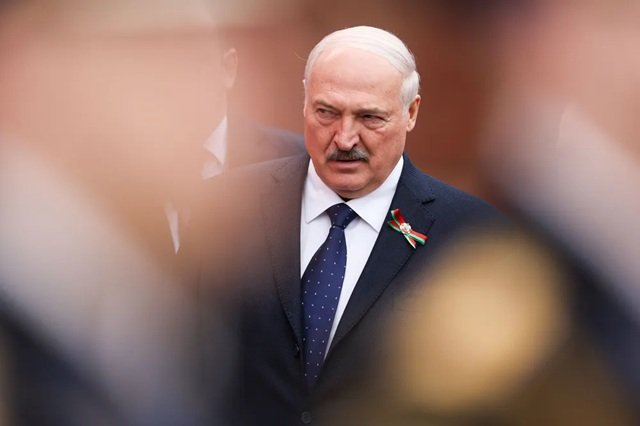
Belarusian President Alexander Lukashenko has repeatedly delivered the same public assurance in recent weeks: Belarus will not be drawn into Russia’s war against Ukraine. The message has become a consistent feature of his public appearances, from speeches before military graduates in Minsk to meetings with foreign diplomats and interviews with international media. Yet as the conflict continues and Russia searches for additional support, those repeated declarations have done little to ease concerns among European governments and Ukrainian officials that Belarus could face mounting pressure to play a more active military role.
According to reporting by Die Zeit, Lukashenko most recently told graduates of an officers’ academy in Minsk that he would not send them into what he described as “this slaughterhouse.” Similar statements have accompanied several of his appearances over recent weeks, including discussions with Russia’s ambassador, an interview with the Arabic-language broadcaster Al Arabiya, and multiple public events held in the Belarusian capital during June. Throughout those appearances, Lukashenko maintained that Belarus does not seek war.
Despite those assurances, officials across Europe continue to monitor developments closely. Several European government representatives told The Wall Street Journal that Russia has increased pressure on the Belarusian leader to become more actively involved in President Vladimir Putin’s military campaign against Ukraine. Those reports have reinforced concerns that Belarus could face difficult choices as Moscow looks for additional ways to strengthen its position.
Ukraine has also publicly signaled that it is preparing for the possibility of escalation. At the end of May, Ukrainian President Volodymyr Zelensky warned Lukashenko that Kyiv had already identified approximately 500 potential targets inside Belarus, including critical infrastructure, industrial facilities, and military installations. Zelensky said any Belarusian intervention in the war would trigger strikes capable of severely damaging the country’s economy.
The warning was followed by further diplomatic activity. French President Emmanuel Macron reportedly telephoned Lukashenko to caution him about the consequences of entering the war. Weeks later, the Belarusian leader traveled to Russia, where he spent two days meeting Putin at the Russian president’s residence near Lake Valdai before continuing his trip to China without publicly commenting on the discussions.
For Lukashenko, who has ruled Belarus for 31 years, the current situation presents one of the most complex political balancing acts of his presidency. Throughout his decades in power, he has maintained control through a combination of political maneuvering and force. His recent emphasis on peace, coupled with unannounced visits to Russia, has fueled speculation that he is attempting to manage growing external pressure while avoiding direct military involvement.
Belarus has already played an important supporting role in Russia’s war without committing its own forces to combat. In February 2022, Belarus allowed Russian troops to launch their advance toward Kyiv through Belarusian territory. Since then, Belarusian industries have supplied weapons and components for Russia’s defense sector, while more recently exporting gasoline to Russia as attacks on Russian refineries have disrupted domestic fuel supplies.
Even so, Belarusian troops have not joined the fighting. Russian combat aircraft and drones are not launched from Belarusian territory, according to the report. Instead, Russia uses Belarusian communications towers and signal amplifiers to improve the navigation of long-range drones during attacks on Ukraine.
As Russia’s battlefield campaign has become increasingly difficult, the strategic importance of Belarus has evolved. Although Russian forces have continued offensive operations despite heavy losses, progress on the front has remained limited. At the same time, Ukrainian long-range drone strikes have caused significant damage inside Russia. Under those conditions, additional Belarusian support could provide Moscow with military advantages even without Belarusian troops entering combat. The prospect of renewed threats from Belarusian territory alone could require Ukraine to station additional forces along its northern border, reducing the number of troops available for operations in the eastern Donbas region.
Domestic opinion inside Belarus, however, has remained an important constraint. According to Die Zeit, most Belarusians do not want their country to enter the war against Ukraine. Lukashenko appears to have recognized that reality early in the conflict. Since Russian forces withdrew from the outskirts of Kyiv in March 2022, he has increasingly portrayed himself domestically as a guarantor of peace who maintains relations with Moscow while preventing Belarus from becoming a battlefield.
Ukraine’s own approach toward Belarus has also shifted. During the early years of the war, Kyiv sought to avoid provoking Lukashenko, viewing the prevention of a second northern front as a strategic priority. Zelensky largely avoided engagement with Belarus’s exiled opposition movement following the government’s suppression of mass protests in 2020. As Ukraine stabilized its front lines and expanded production of long-range drones, however, the balance of leverage changed, giving Kyiv greater confidence in its ability to deter Belarusian involvement.
That evolving strategy has become increasingly visible in recent months. Rather than relying primarily on restraint, Ukraine has adopted a more explicit policy of deterrence. Beyond identifying hundreds of potential military and infrastructure targets, Zelensky publicly demanded that Belarus dismantle signal amplifiers used to assist Russian drones operating near the border. In an interview with the Ukrainian television channel 1+1, he warned that if Belarus failed to remove them, Ukrainian forces would do so themselves, arguing that the equipment enabled attacks against Ukrainian civilians.
Zelensky later broadened those warnings by stating that Ukraine had identified every Belarusian factory supplying components for Russian armored vehicles, missile systems, and fuel deliveries supporting Moscow’s military campaign. According to the Ukrainian president, such industrial cooperation drew Belarus further into the conflict.
Lukashenko has largely refrained from responding publicly to Zelensky’s increasingly direct statements. Instead, he acknowledged during his interview with Al Arabiya that Belarus remains highly vulnerable, saying Ukrainian forces had his country “on a silver platter.” He did not publicly address demands to remove the drone signal infrastructure. However, Ukrainian Commander-in-Chief Oleksandr Syrskyi claimed in a recent interview that only one of four such signal amplifiers remained operational.
While Russian officials strongly criticized Zelensky’s remarks, with the Russian Foreign Ministry describing them as unacceptable and the Kremlin expressing confidence that Belarus could defend itself, Lukashenko has continued to emphasize Belarus’s vulnerability rather than escalating his own rhetoric.
The legislative and diplomatic landscape surrounding Belarus remains closely tied to developments on the battlefield. As Russia continues seeking support for its campaign and Ukraine strengthens its deterrence posture, Lukashenko appears to be pursuing a narrow middle course, attempting to preserve Belarus’s existing role as a logistical and industrial partner for Moscow while avoiding direct military participation. According to Die Zeit, that balance may ultimately prove more valuable to Russia than pressing Belarus into a conflict that could expose the country itself to significant military risk.










