


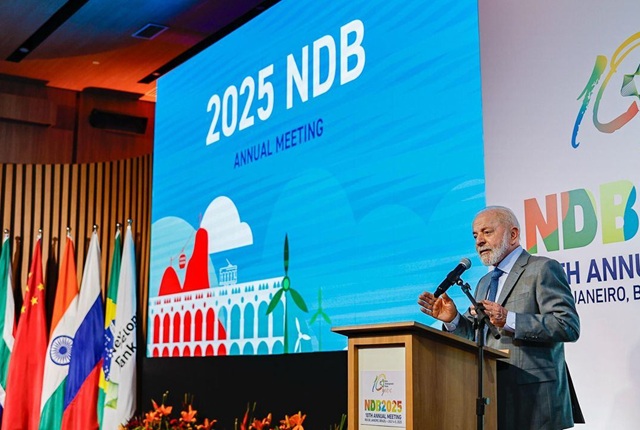
On July 5, 2025, President Luiz Inácio Lula da Silva addressed the opening of the BRICS Business Forum in Rio de Janeiro, setting a confident and ambitious tone ahead of the ongoing BRICS Summit. In a wide-ranging speech, he underscored BRICS’ rising economic weight, its capacity to drive global development, and its potential to lead in areas from food security to artificial intelligence and clean energy.
“The eleven full members of BRICS already exceed 40% of global GDP in purchasing power parity,” Lula stated. “In 2024, while the world grew 3.3%, we recorded an average expansion of 4% across BRICS countries.” This year, he said, that momentum is set to continue, boosted by the growing engagement of partner and guest countries, which are helping consolidate BRICS as a global hub of prosperous, dynamic economies.
Lula praised the role of the private sector in shaping the bloc’s future, calling the assembled entrepreneurs “the dynamic axis of the international economy.” He emphasized that bringing productive sectors closer together is a key pillar of the BRICS project and noted Brazil’s trade with BRICS reached $210 billion in 2024—more than double its trade with the European Union.
He reaffirmed BRICS’ critical contributions to the creation of the Global Alliance against Hunger and Poverty and highlighted ongoing efforts to strengthen food security through rural credit, low-carbon agriculture, and the restoration of degraded lands. “We have 33% of the world’s arable land and account for 42% of global agricultural production,” Lula noted. “We can lead a new development model based on sustainable agriculture, resilient infrastructure, and green industry.”
Another key focus was BRICS’ growing role in global health. Lula stressed the importance of strengthening the health industrial complex to ensure access to medicine and tackle diseases affecting the most vulnerable. He framed these initiatives as part of a broader vision for combating inequality, boosting investment, and creating fairer economic systems.
Turning to innovation, Lula stressed the need for multilateral governance of artificial intelligence, warning that in the absence of international standards, “models generated solely based on the experience of large technology companies will prevail.” He backed BRICS’ leadership in developing digital public infrastructures that empower startups and SMEs.
On climate, Lula underlined Brazil’s leadership ahead of COP30 later this year and reaffirmed his country’s emissions reduction target of 59–67%. BRICS, he noted, is already among the largest investors in renewable energy and holds vast reserves of strategic minerals key to the green transition. “We want to go beyond extraction,” he said, adding that BRICS must play a leading role in every stage of energy transition supply chains, supported by stable regulations, skilled labor, and clean energy.
President Lula also highlighted the growing impact of the New Development Bank (NDB), which has already approved $40 billion in funding for infrastructure and clean energy projects. He noted the NDB’s support for local currencies and BRICS central banks’ efforts to develop fast, secure cross-border payment systems, as well as the role of national development banks like Brazil’s BNDES, which has invested over $50 billion in green transformation projects since 2023.
Throughout his speech, Lula repeatedly tied peace to development, calling on world leaders to fill the global leadership vacuum and work to end escalating conflicts. “There will be no prosperity in a world in turmoil,” he said. “Instead of barriers, we promote integration. Against indifference, we build solidarity.”
He closed by congratulating the BRICS Business Council and the Women’s Business Alliance for advancing entrepreneurship and gender equality, stressing that expanding women’s participation in the economy boosts productivity and accelerates growth.
With the BRICS Summit now underway, Lula’s speech set a clear agenda: BRICS is not only an economic powerhouse but also a moral and strategic force aiming to shape a more equitable, sustainable, and peaceful world.









