President Emmanuel Macron will be granted a full state visit to the United Kingdom next month, several months before U.S. President Donald Trump is expected to visit, in a diplomatic move signaling Britain’s renewed focus on strengthening relations with Europe.
The French president, 47, has been invited by King Charles III, marking his first official state visit to the UK, despite having been in office for eight years. The timing and details of the visit remain closely guarded, though officials have confirmed that it will take place at the end of May and will be hosted at Windsor Castle due to ongoing renovations at Buckingham Palace.
The visit underscores the Starmer government’s efforts to rebuild ties with the European Union following Brexit. It comes as the UK and EU intensify negotiations over closer trading arrangements, including proposals to align British food and environmental standards with those of the bloc. Such alignment is seen as essential to boosting trade with the continent but may complicate concurrent talks with the United States, which is seeking broader market access for American agricultural products.
Meanwhile, Donald Trump, who recently returned to the White House after winning re-election, indicated that his own state visit to the UK is being planned for September. Speaking from the Oval Office last Thursday, Trump said, “It’s an honour… I’m a friend of Charles. I have great respect for King Charles and the family.” Despite tradition dictating that U.S. presidents are not granted state visits during second terms, the King’s invitation is seen as a diplomatic gesture of goodwill.
Downing Street is expected to emphasize that Trump received a full state visit during his first term, including a banquet at Buckingham Palace in 2019 with the late Queen Elizabeth II. His upcoming trip will likely take a more informal form, involving tea or lunch with the monarch at Windsor Castle.
Macron’s upcoming visit highlights a shifting geopolitical landscape, with Britain attempting to straddle strong relationships with both Washington and Brussels. Chancellor Rachel Reeves is in Washington this week to push forward a potential “mini-deal” with the U.S., aimed at easing the impact of trade tariffs. A deal is reportedly within reach, with American officials hopeful it could be signed in the coming weeks.
However, closer ties with the EU appear to be Starmer’s long-term strategic priority. An EU-UK summit is scheduled for May 19 in London, where leaders hope to finalize agreements on trade, defense cooperation, and youth mobility. The latter remains a sticking point: Brussels is seeking a broad youth exchange scheme, while the UK government favours a more limited version to avoid domestic backlash from Brexit supporters.
France has recently softened its stance on linking fisheries access with the UK’s participation in the EU’s new €125 billion defense fund, which could grant British arms manufacturers access to lucrative contracts. Macron’s cooperation is seen as key to advancing talks, especially ahead of the 2026 expiration of the current EU-UK fisheries agreement.
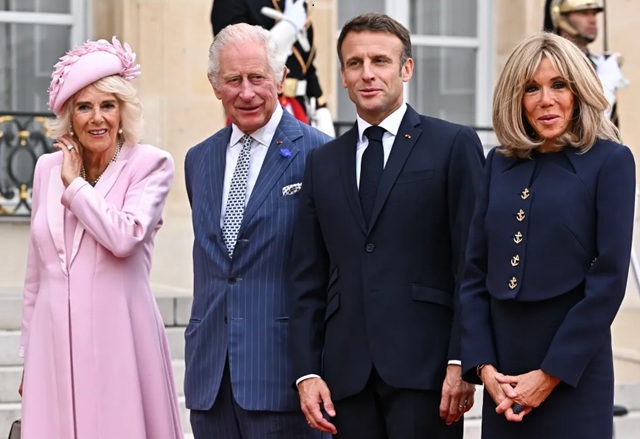
Macron’s relationship with the British royal family has been notably warm. He last visited London in March, where he met with Sir Keir Starmer and Ukrainian President Volodymyr Zelenskyy. In 2023, King Charles and Queen Camilla visited France, with Charles becoming the first British monarch to address the French Senate and praising Franco-British unity.
The upcoming visit is expected to include ceremonial events, a state banquet, and bilateral meetings. The Prince of Wales is likely to play a prominent role, having developed a friendly rapport with Macron. The Princess of Wales is also expected to participate in some events, marking her gradual return to public life following cancer treatment.
The symbolic significance of the Macron visit—preceding Trump’s return to Britain—has not gone unnoticed in diplomatic circles. As the UK seeks to redefine its global role post-Brexit, the optics suggest a tilt toward European cooperation over transatlantic populism.