


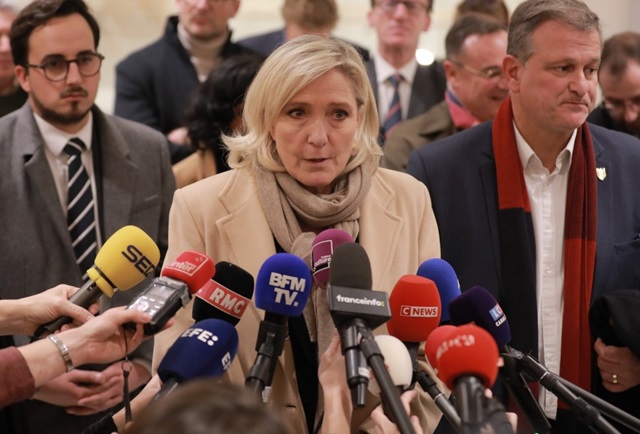
Marine Le Pen’s confirmed candidacy for France’s presidential election in April 2027 has firmly established her as the leading figure of the country’s far right, overshadowing rival nationalist candidates and strengthening the position of her National Rally (RN) party as campaigning begins for one of Europe’s most closely watched elections.
The campaign will enter a new phase on 27 August when French broadcaster LCI hosts the first major televised debate ahead of the presidential election. Scheduled eight months before the first round of voting, the debate is expected to feature seven declared candidates, including Le Pen, Jean-Luc Mélenchon of La France Insoumise and Édouard Philippe of the centrist Horizons party, all of whom are among the leading contenders in current opinion polls.
The debate will mark Le Pen’s first televised appearance as an officially declared presidential candidate since announcing on 7 July that she would contest the election despite being sentenced earlier the same day by the Paris Court of Appeal to three years in prison, one of which is to be served under electronic monitoring, after being convicted of misusing European Union funds. Following the ruling, Le Pen stated that she would appeal to France’s Supreme Court in an effort to avoid wearing the electronic monitoring device during the election campaign.
Opinion polls currently place Le Pen and National Rally ahead of their rivals, reinforcing her dominance within the far-right political space and reducing the already limited prospects of more radical movements. The principal challenger on the nationalist right remains Éric Zemmour, leader of Reconquête, although he is widely regarded as having little chance of reaching the presidential run-off scheduled for 2 May 2027.
Rather than criticising Le Pen’s decision to run, several prominent figures on the far right have welcomed her candidacy. Zemmour, whose political positions are generally considered more hard-line than those of National Rally, argued that it was appropriate for French voters, rather than the courts, to determine her political future. He said that political differences between himself and Le Pen were clear because she openly acknowledged and defended them, adding that the political debate should take place before the French public rather than through the judicial process.
Although Le Pen will participate in the opening televised debate, Zemmour is not expected to take part because he has yet to formally declare his candidacy. If confirmed, it would mark his second attempt to reach the Élysée Palace after finishing fourth in the first round of the 2022 presidential election with 7 per cent of the vote, behind Emmanuel Macron, Le Pen and Mélenchon. He subsequently endorsed Le Pen in the second round.
Le Pen’s candidacy has also received support from Marion Maréchal, her niece, despite previous political differences after Maréchal left National Rally to align herself with Zemmour. Maréchal described her aunt as the natural candidate to lead what she characterised as the broader coalition of the nationalist and far-right political camp, citing Le Pen’s experience, resilience and convictions as qualities suited to the current political climate. Le Pen, however, has consistently rejected the prospect of forming an electoral alliance with Zemmour.
Further backing has come from Éric Ciotti, leader of the Union of the Republican Right (UDR) and mayor of Nice, who described Le Pen’s candidacy as positive for French democracy. Ciotti, who broke away from the conservative Republicans party in the summer of 2024 to align himself with Le Pen, said her determination and political struggle inspired millions of French voters and would ultimately lead her to victory.
Le Pen’s decision to stand has also altered calculations within France’s traditional right. Some conservative figures had viewed National Rally president Jordan Bardella as a potentially less formidable opponent because of his relative lack of political experience, believing this could create opportunities to attract voters away from National Rally.
However, polling conducted by Elabe following confirmation of Le Pen’s candidacy suggests the party remains strongly united behind its long-time leader. While 35 per cent of respondents indicated they would have preferred Bardella to be the presidential candidate, compared with 17 per cent favouring Le Pen, seven in ten National Rally supporters approved her decision to stand. At the same time, 36 per cent believed Bardella, who has no criminal conviction, would be better positioned electorally, compared with 26 per cent who preferred Le Pen herself, highlighting continuing debate within the party over the electoral implications of her legal case.









