At four in the morning, Mecca does not sleep.
In the blue stillness before dawn, a fisherman from the Indonesian archipelago and a surgeon from London move through the same narrow lane. They wear the same two pieces of unstitched white cloth. Their feet are bare. Their lips carry the same Arabic phrase, Labbayk Allahumma Labbayk. Here I am, O Lord. Here I am.
There is nothing to distinguish them. That is precisely the point.
This is Hajj, the fifth pillar of Islam, an obligation incumbent upon every Muslim who is physically and financially able to undertake it at least once in a lifetime and in 2026, the pilgrimage drew numbers that placed it firmly among the most attended in living memory.
A Gathering of Historic Proportions
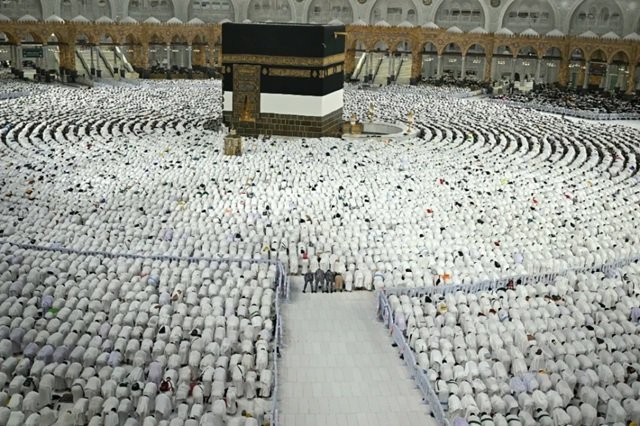
Saudi authorities confirmed that 1,518,153 international pilgrims had arrived for this year’s season, their movements tracked in real time by the Saudi Data and Artificial Intelligence Authority (SDAIA). When domestic pilgrims, Saudi nationals and resident expatriates, are included, the total approaches 1.8 to 2.0 million, exceeding the average of 1.7 to 1.8 million recorded across the previous three seasons.
To place that figure in perspective: it is the equivalent of the entire population of Paris converging on a single valley, performing identical acts of worship, simultaneously, over the course of five days.
They arrived from over 120 nations. Indonesia, home to the world’s largest Muslim population, dispatched the greatest number of pilgrims, as it does each year. Pakistan, India, and Bangladesh followed in close succession. But the delegations also included pilgrims from the United States, Canada, the United Kingdom, Australia, and across continental Europe, numbers smaller in absolute terms, but growing steadily with each passing season.
A grandmother from Morocco walked beside a university student from Toronto. A retired schoolteacher from rural Nigeria completed the same circumambulation as a financier from Dubai. In white cloth, on equal footing, none of it mattered.
Fourteen Centuries, Unchanged
The rituals of Hajj predate modernity by more than a millennium, and they have not been revised.
On the 8th of Dhul-Hijjah, corresponding this year to the 25th of May, 1.5million pilgrims departed Mecca for Mina, the vast tent city on the city’s eastern edge, where they spent the night in prayer and contemplation following the Sunnah of the Prophet Ibrahim. The next day saw the whole gathering travel to the sunny planes of Arafat, where they stood together in Wuquf, the standing considered the spiritual peak of the Hajj journey. They stayed here in prayer till sundown after which they went straight to Muzdalifah, where they collected seventy pebbles out in the open air.
The following days were marked by the performance of the Rami, when pilgrims symbolically stoned Satan, sacrificed a goat or ram, shaved or cut their hair, thereby ending the condition of Ihram, followed finally by circumambulating around the Kaaba.
Each and every pilgrim performed all the rites in the exact same way, in the exact same order. There was no variation allowed.
The Hajj has been carried on for fourteen hundred years now. As historians record, it has been called off or severely disturbed just about forty times in all that time, the last being in 2020 during the COVID-19 pandemic.
The Infrastructure Behind the Spiritual
What the pilgrim at Arafat does not see, and is not meant to, is the scale of the apparatus sustaining the experience.
Saudi Arabia’s preparations for Hajj 2026 represented what officials and observers described as the most technically advanced operational deployment in the pilgrimage’s modern history.
Central to this effort was artificial intelligence. SDAIA, working in partnership with the Ministry of Interior, operated two integrated platforms, Baseer and Sawaher, employing computer vision, thermal imaging, and AI-driven analytics to monitor crowd density and movement across Mecca, Mina, Arafat, and Muzdalifah in real time. The systems identified congestion before it reached critical levels, automatically redirecting foot traffic away from pressure points. The process was, by design, invisible to those it protected.
Drones were deployed around the sacred sites, not as novelties, but rather as operational facilities. They were used for monitoring crowd movement and identifying violations of regulations, as well as sending instant notifications to the authorities on the ground. Fixed-wing aircraft conducted flights through the air, following the campaign slogan of “No Hajj without a permit.” In Hajj operations for the first time ever, a special drone was deployed to detect any chemical or radioactive materials.
Facial recognition technology was utilized to confirm all pilgrim permits at points of entry in real time. The Nusuk digital platform, with users exceeding 51 million, served as credentials, itineraries, and means of communication, working nonstop since their departure cities till their return.
In terms of medical provision, more than 52,000 healthcare workers and emergency responders provided coverage in field clinics set up along the pilgrimage routes. There were four medical evacuation aircraft in continuous operation. Before peak ceremonies began, the health sector was already able to deliver 121,626 health services to arriving pilgrims. Heat-reflective thermal coatings were applied to walkways and misting fans installed along them because the temperature in Mecca often exceeds 40°C in May.
Navigation within the Grand Mosque was also systematically improved. A new colour-coded zoning system was introduced across the ground-floor columns, accompanied by 84 directional signs in the Sa’i area, each synchronised to entry gates and prominent landmarks. An interactive digital map , deployed at the Prophet’s Mosque in Medina for the first time, allowed pilgrims to locate essential services directly from their mobile devices.
Saudi Arabia also introduced the “Hajj Without Luggage” initiative this season, streamlining baggage logistics to ease movement at high-density sites and preserve emergency evacuation corridors within the Mina tent networks.
Beyond the Statistics
Numbers convey scale. They do not convey meaning.
In 2026, a year marked by sharpening geopolitical divides, contested borders, and the fracturing of multilateral frameworks, nearly two million human beings made a common journey. They arrived from countries that do not always speak to one another. They dressed identically. They prayed in unison. They stood, in the words repeated across fourteen centuries, before God alone.
No hierarchy. No delegation seated ahead of another. No VIP enclosure at the Kaaba.
Only white cloth, open sky, and one collective act of submission.
That, stripped of all annotation, is what Hajj is. And that is why, across fourteen centuries of an often turbulent human story, it has never, for long, stopped.