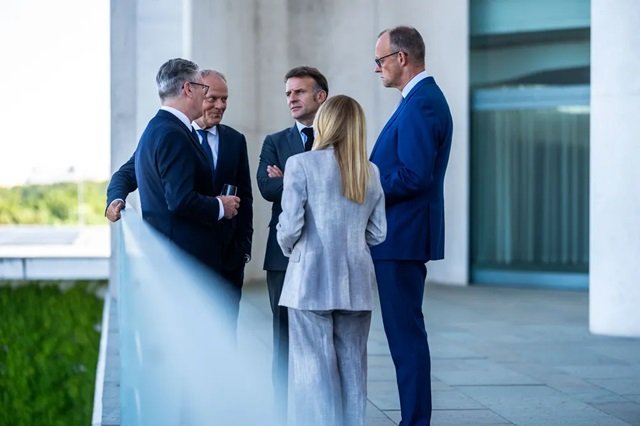
On the terrace of the German Chancellery, with the Reichstag visible in the background, five European leaders gathered for a meeting designed to project unity at a moment of growing uncertainty. But the gathering also exposed the political challenges facing those expected to guide Europe’s security policy as the future of NATO and the continent’s defence responsibilities come under pressure.
German Chancellor Friedrich Merz hosted the meeting of Germany, France, Britain, Italy and Poland — a new format known as the E5 — bringing together the countries considered central to Europe’s ability to respond to Russia’s threat while the United States’ long-term role in the alliance remains uncertain. According to German publication Die Zeit, the meeting was intended as a demonstration of coordination, but it also came amid tensions between partners over Germany’s growing defence ambitions and Europe’s future strategy.
The group brought together leaders facing significant domestic and political challenges. British Prime Minister Keir Starmer attended while his political future was increasingly uncertain. French President Emmanuel Macron arrived after years of political difficulties in Paris. Merz himself faced declining popularity, while Polish Prime Minister Donald Tusk was dealing with domestic obstacles to his security agenda. Italian Prime Minister Giorgia Meloni was described as the only participant with a comparatively stable political position.
Despite their differences, the five countries represent the core of Europe’s defence discussions. Germany, France and Britain have traditionally shaped European security decisions, while Italy and Poland have increasingly demanded a stronger role in determining the continent’s direction. NATO Secretary General Mark Rutte also joined by video from Washington before meeting U.S. President Donald Trump.
For Merz, the meeting represented an opportunity to reinforce his claim to leadership on questions of war, peace and European security. However, recent disagreements had created concerns among partners about Germany’s approach. In response, the chancellor sought to reassure allies, stating that national approaches to defence policy would be the wrong path and emphasizing that Germany’s strengthening should make neighbouring countries feel safer.
The concerns were linked partly to Germany’s plans to expand military spending. The meeting was held ahead of the upcoming NATO summit in Ankara, where alliance members are expected to continue discussions about defence commitments. At the previous summit in The Hague, NATO countries agreed to significantly increase defence-related spending after pressure from U.S. President Donald Trump.
However, the alliance’s burden-sharing debate has continued to evolve. European countries are now expected to take on more responsibility, particularly as the United States signals plans to reduce some military capabilities within NATO, including certain naval, air and drone assets. European allies will have to address potential gaps in the alliance’s defence structure.
Germany’s plans to expand the Bundeswehr have also created unease among some partners. Berlin has announced ambitions to make the German military the strongest conventional force in Europe, but France and Poland have expressed concerns that Germany could pursue its defence expansion independently. The cancellation of the major Franco-German FCAS fighter project has become a symbol of wider disagreements over defence cooperation.
Merz attempted to counter those concerns by emphasizing that Germany’s military development would remain connected to European cooperation. Government officials have argued that Germany’s approach to defence has always been rooted in a European framework.
A second major issue discussed in Berlin was Europe’s possible role in future negotiations with Russia. Earlier signals from the German government suggested that a window for diplomatic engagement could emerge, although no immediate talks were planned. The idea was intended partly as a way to increase pressure on Russian President Vladimir Putin, but it quickly created disagreements among European partners.
Merz, Macron and Starmer had previously met Ukrainian President Volodymyr Zelenskyy in London and positioned themselves as Europe’s representatives in possible future negotiations. The move angered Italy and Poland, which argued they should also have a place in discussions affecting the continent’s security.
Italian Prime Minister Meloni questioned whether the E3 group had the legitimacy to speak on behalf of all European countries, while Poland’s Foreign Minister Radosław Sikorski said his country demanded a place at the negotiating table.
The dispute comes as Europe debates how many countries should participate in future diplomatic efforts. German officials have indicated that any European negotiating group would need broad legitimacy while remaining capable of making decisions. The challenge is balancing inclusion with the need for a manageable format.
Other tensions have also emerged, including disagreements over European communication channels with Moscow. EU Council President Antonio Costa reportedly allowed a staff member to establish contact with the Kremlin, a move that Merz was said to have criticized during a recent EU summit.
The Berlin meeting ended with public expressions of support among the leaders, including thanks to Starmer for his role in Ukraine policy. For Merz, Starmer has been considered a reliable partner on the issue, but his uncertain political future highlighted another challenge facing Europe’s security leadership.
As NATO prepares for its next summit and Europe adjusts to a changing strategic environment, the Berlin gathering showed both the need for greater coordination and the difficulties involved in achieving it. The question of who will lead Europe’s security efforts remains unresolved.