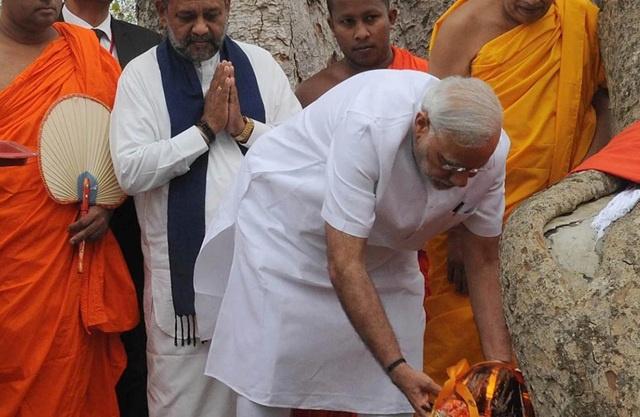
The government has officially announced that Indian Prime Minister Narendra Modi will visit Sri Lanka at the invitation of President Anura Kumara Dissanayake. This visit is more than symbolic—it signals the shifting power dynamics in the region. Modi, the first foreign head of state to visit Sri Lanka under the new leadership, arrives amid growing concerns over whether this renewed engagement is a partnership of equals or a subtle assertion of dominance. Notably, President Dissanayake’s own first foreign visit was to India—an unmistakable gesture of deference or pragmatism?
India, our closest neighbour and an ascendant global power, wields enormous influence over Sri Lanka’s economic and diplomatic trajectory. The notion of true non-alignment is a romantic illusion; in the brutal reality of geopolitics, smaller nations must pick sides, or they will be picked apart. Sri Lanka must decide—does it embrace India as a partner in mutual progress, or does it risk becoming a dependent outpost in New Delhi’s regional ambitions?
A particularly controversial development is the potential signing of a defence cooperation agreement between the two nations, as reported by the Hindustan Times. Strengthening military ties can foster stability, but at what cost? Sri Lanka must scrutinise the fine print. Is this a step towards securing national security, or a slow erosion of sovereignty under the guise of cooperation?
Equally pressing is the decades-old issue of Indian trawlers plundering Sri Lankan waters, particularly in the northern regions. This isn’t just an economic grievance—it’s an act of maritime trespass that has been met with diplomatic hand-wringing rather than decisive action. Consider this: India’s seafood exports, particularly shrimp, generate nearly two billion dollars annually, with a significant portion originating from Sri Lankan waters. Meanwhile, Sri Lanka’s total fish exports hover around a meagre $350-400 million. The disparity is glaring. If Sri Lanka were to reclaim even a fraction of what rightfully belongs to it, the economic benefits would be transformative. Yet, successive governments have either lacked the will or the backbone to challenge India on this front. A joint venture could be a pragmatic solution—if, and only if, it is negotiated on equal terms.
Further raising concerns is the proposed Memorandum of Understanding (MoU) between the Indian Navy and the Sri Lanka Navy for hydrographic surveys. These agreements should never be entered into lightly, as they involve sensitive territorial data. The surveying of Sri Lanka’s waters must remain a sovereign undertaking, free from external influence that could compromise long-term national security. Will President Dissanayake stand firm on this matter, or will he allow diplomatic niceties to dictate Sri Lanka’s maritime future?
Both nations have touted the importance of the blue economy, but the reality is clear: Sri Lanka must first ensure that its own waters are not exploited before engaging in grand discussions about sustainability. A well-negotiated fisheries and maritime rights agreement could be a game-changer—but only if Sri Lanka enters the discussions as an assertive player, not a junior partner.
As Prime Minister Modi’s visit looms, Sri Lanka faces a crucial test. Will this be a moment of recalibrated relations based on equality and mutual respect, or yet another instance of subtle economic subjugation? President Dissanayake has the chance to redefine Sri Lanka-India relations—but that depends entirely on whether he is prepared to negotiate with strength, or simply extend a hand in quiet acquiescence.