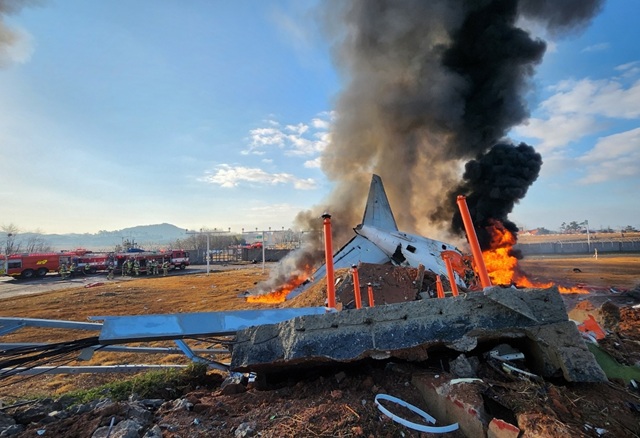
UPDATED: A Jeju Air Boeing 737-800 crashed while attempting an emergency landing at Muan International Airport on Sunday morning, killing 179 of the 181 onboard, including all passengers, in South Korea’s worst domestic aviation disaster. Only two crew members, a male and a female, survived. The pilot issued a mayday after a bird strike warning, with the crash occurring five minutes later during a belly landing attempt. The ill-fated flight carried passengers primarily on year-end trips, with ages ranging from 3 to 78. Authorities recovered all bodies by Sunday evening and are working with bereaved families on identification and funeral arrangements. Hotlines have been established for inquiries: 080-898-1500 (in Korea), +82-1599-8629 (from overseas), and 1-833-892-0197 (North America). The government has designated Muan a special disaster zone, enabling financial aid and expedited recovery efforts as investigations into the cause continue.

A devastating plane crash at Muan International Airport on Sunday has claimed the lives of 179 passengers, leaving only two survivors. The Jeju Air flight, carrying 181 passengers from Bangkok, veered off the runway during a crash landing attempt caused by a suspected landing gear malfunction.
The tragic incident unfolded at 9:07 a.m. as the flight attempted to land following an unsuccessful initial landing attempt. Authorities suspect a bird strike may have damaged the landing gear, rendering it inoperable and forcing the plane into a crash landing.
The plane failed to reduce its speed as it reached the end of the runway, ultimately colliding with a fence and nearby structures. The impact caused catastrophic damage and ignited a fire, complicating rescue efforts.
Emergency responders confirmed that only two passengers survived the crash, both of whom sustained severe injuries and are currently in critical condition. The remaining 179 passengers, including crew members, were tragically killed.
Jeju Air Co., the airline operating the flight, issued a statement expressing deep sorrow and a commitment to uncover the cause of the disaster. “Jeju Air will spare no effort to respond to the accident,” the company said. A spokesperson added, “We are working to determine the exact cause and details of the situation.”
The aircraft, which had been in operation for 15 years without prior incidents, underwent routine maintenance checks, according to airline officials.
Eyewitness accounts and preliminary investigations point to signs of landing gear malfunction, including unresponsive tires, which may have forced the crash landing. Authorities also suspect a bird strike as the possible trigger for the malfunction.
A Grim Chapter in South Korea’s Aviation History
Sunday’s crash marks one of the deadliest aviation incidents in South Korea in recent decades, adding to the nation’s tragic history of plane crashes:
- Asiana Airlines Flight 733 (July 26, 1993):
A crash near Mokpo Airport resulted in the deaths of 68 of the 116 passengers and crew on board. Poor weather and a failed landing attempt contributed to the disaster. - Korean Air Flight 801 (August 6, 1997):
A Boeing 747 crashed into a hillside near Guam while attempting to land, killing 229 of the 254 people on board. The cause was attributed to pilot error and poor communication with air traffic control. - Korean Air Flight 858 (November 29, 1987):
This tragic incident was a bombing orchestrated by North Korean agents, causing the aircraft to explode over the Andaman Sea. All 115 passengers and crew perished. - Asiana Airlines Flight 214 (July 6, 2013):
While not on South Korean soil, this crash involved a South Korean airline. The Boeing 777 crashed during landing at San Francisco International Airport, killing 3 and injuring more than 180. Pilot error was cited as a primary factor.
These incidents, combined with Sunday’s tragedy at Muan International Airport, highlight the need for continued emphasis on aviation safety and emergency preparedness.