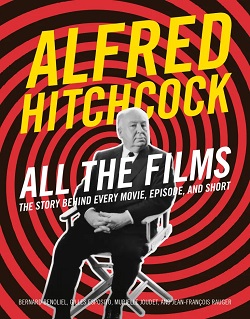
The following excerpts adapted from the newly released book, Alfred Hitchcock All the Films: The Story Behind Every Movie, Episode, and Short, published by the Running Press
by Bernard Benoliel, Gilles Esposito, Murielle Joudet, Jean-François Rauger
“I’ve become a body of films, not a man; I am all those films.” ~ Alfred Hitchcock
February 1927 saw the release in London of a young man’s third film, shot the previous year and almost left on the shelf because one of his investors found it so different from current productions: The Lodger was inspired by an atmospheric novel, which was itself inspired by the memory, still very present at the time, of the terrible acts of Jack the Ripper. Fifty feature films later, Alfred Hitchcock, no longer a young man in 1971, returned to London to direct his penultimate opus: Frenzy, the story of a psychopath who strangles his victims with a necktie.
Taking Control of the World
It is no exaggeration to say that Hitchcock is a constant presence in the popular culture, both because of his undying love of the macabre (peppered with black humor), which reveals the true passions of humankind, and because of his obligation to make his presence known. More than any other filmmaker, Hitchcock was the willing victim of a worldwide success story, a prisoner of his immense reputation and the renewed expectations of an audience that he himself created. Jean-Luc Godard’s voice-over in his Histoire(s) du cinéma best describes the extent to which this artist was able to capture the imagination of twentieth-century audiences: “Alfred Hitchcock succeeded where Alexander, Julius Caesar, and Napoleon failed: in taking control of the world.” Hitchcock’s breathless films, with their heady figures and motifs, fulfilled a totalitarian dream of cinema: to appeal to the whole world (which required the impactful power of the Hollywood film industry). He succeeded better than the great Soviet filmmakers, who dreamed of speaking to the masses rather than to the sum total of individuals suggested by “the general public.”
“Life is not just about breathing, it’s about being breathless.” (Hitchcock)
A twentieth-century art form that remained figurative and narrative out of loyalty to the great narratives and representations of the previous century (theater, painting, serial novels), relegating plastic abstraction to its margins, cinema invented both its audience and its language: Hitchcock is the man who brought the science of filmmaking to a degree of near absolute perfection. Surely suspense, the feeling experienced by the spectator to which the filmmaker’s reputation remains most attached, is the consequence of the use of classical film editing as invented by the American filmmaker David Wark Griffith in the mid-1910s: not only a way of making images follow each other logically, but also the parallel presentation of two competing or rival actions whose coincidence ends up resolving an expectation, a fear, an anguish. Undoubtedly more than Soviet filmmakers in general, and Eisenstein in particular, Hitchcock used film editing as a means of stirring the emotions of the spectator, whose unconscious the author of Battleship Potemkin dreamed of “plowing through.”
Fear and Trembling
If the director of The Birds (1962) invented a machine to frighten the viewer, it is because he was first and foremost an artist who lived through, described, criticized, and analyzed the twentieth century, perceived as a period of war and terror. Totalitarianism, whether Nazi or Stalinist, forms the backdrop to some of his films (Foreign Correspondent, 1940; Saboteur, 1942; Lifeboat, 1943; Notorious, 1946; Torn Curtain, 1966; Topaz, 1969), which convey the image of a world structured solely by fear: The twentieth century is therefore “Hitchcockian.” Hitchcock unmasked another threat, that of the wretchedness of the democratic subject, whether British or American citizen, the ordinary man confronted with his own miserable impulses. Behind his feverish, illusory romanticism (Vertigo, 1957), Hitchcock’s work is a relentless exposure of the individual reduced to his needs and appetites (Psycho, 1960; Frenzy). This impulsive individual was Hitchcock himself. For the filmmaker, fiction was also a means of calming the fire of his desire by providing it with the outlet of a work of art. Many films celebrate the “Hitchcock blonde,” the mirage he observed with pain and passion, sadism and adoration. He knew how to create beauty from his unavowable desires, sublimating his sexual frustration to reveal and shape actresses: Joan Fontaine, Ingrid Bergman, Grace Kelly, Tippi Hedren…
The Art of Fear
When Hitchcock talked about his beloved art of fear, it is hardly surprising that this child of the century had recourse to a metaphor taken from war: “Fear in cinema is my special field, and I have, perhaps dogmatically, but I think with good cause, split cinematic fear into two broad categories—terror and suspense. The difference is comparable to the difference between a buzz bomb and a V-2. To anyone who has experienced attacks by both bombs, the distinction will be clear. The buzz bomb made a noise like an outboard motor, and its chugging in the air above served as notice of its impending arrival. When the motor stopped, the bomb was beginning its descent and would shortly explode. The moments between the time the motor was first heard and the final explosion were moments of suspense. The V-2, on the other hand, was noiseless until the moment of its explosion. Anyone who heard a V-2 explode, and lived, had experienced terror.”1
“It is in form that we need to look for depth”2
Hitchcock, more than any other, worked to ensure that cinema achieved a status reserved for the so-called noble arts. And it was necessary, in a grandiose paradox, for this metamorphosis to involve a director long considered a master of entertainment, a champion of the “fairground attraction,” all qualities that should have condemned cinema to remain specifically a trivial form of amusement. From then on, it was the French critics of the 1950s, mainly those of the Cahiers du cinéma, who were the first to recognize and bring to light the metaphysical concerns underlying this work. But if Alfred Hitchcock, an English Catholic, is now perceived as a filmmaker of the realms of sin and the Fall, of the damnation of man, who is immediately and irremediably guilty, it is as much through the exposition of religious motifs and themes (I Confess, 1952) as through his formal or dramatic choices (the shadow that draws a cross on Ivor Novello’s face in The Lodger, or James Stewart on the edge of the void in Vertigo).
“Self-plagiarism is style” (Hitchcock)
Hitchcock’s entire oeuvre describes an evolution that seems to encompass the entire history of cinema. The division of the latter into “classical,” “modern,” and “postmodern” periods applies as if in miniature to his films, which he progressively adopted, self-criticized, redeployed, and subjected to a mannerist deformation, taking them from the classical age to modern times. He was a director who shot remakes of his own films, becoming his own first successor: North by Northwest (1958), a film about a chase across a continent, takes The 39 Steps (1935) and Saboteur (1942) as its starting point, extending and diverging from them. He even permitted himself to make the “same” film twice, The Man Who Knew Too Much (1934 and 1955), the first version lasting just over an hour and the second almost twice as long.
Experimentations
However, the filmmaker was never content to simply plow the same furrow. The filmography of the man who has often been referred to as a “shrewd shopkeeper” is, in truth, full of insane risk-taking and experimentation of all kinds: Salvador Dalí’s “signature” dream in Spellbound (1944) and James Stewart’s nightmare in Vertigo (1957); an hour-and-twenty-minute film shot in eleven sequence shots (Rope, 1948) and a shower scene in forty-five seconds and seventy-eight shots (Psycho); a historical work (Under Capricorn, 1948) and a science fiction one (The Birds); insanely complex set designs (Lifeboat, Rope, Rear Window, 1954); films in VistaVision and Technicolor (To Catch a Thief, 1954), and, from 1955 onward, square-picture black-and-white TV movies (Alfred Hitchcock Presents); “visions” (The Island That Wants to Be Visited [Mary Rose], 1964) and visual experiments (Kaleidoscope, 1964–1967) so astonishing that Hitchcock was prevented from making them by his producers. He sought to break his own image, to thwart the expectations of the system, to challenge the common perception of his art, at the risk of commercial failure (the dry realism of The Wrong Man, 1956; the clinical case of Marnie, 1964) or unexpected success (the brutality of Psycho).
The Man Who Knew Everything
Such films convey the impression of a coherent, terrible world, along with a sense of unrivaled formal and technical mastery, to the point where the director gives the impression of an omniscience that intimidates every analyst and commentator: Hitchcock or the man who knew everything… If the viewer does not understand something in an Alfred Hitchcock film, the spectator can be sure that the filmmaker has the answer. This art of total control over both the detail and the overall picture is rare in the history of cinema, and probably only Stanley Kubrick could have achieved such demiurge-like status. Hence the certainty that nothing in a film directed by Hitchcock is devoid of meaning. This infallibility does not, of course, imply a license to make his cinema say anything, but rather implies the impossibility of exhausting its secrets. In fact, from the 1950s onward, such a work contributed to the seemingly infinite number of aesthetic and poetic reflections on the human sciences (sociology, psychoanalysis, philosophy…).
“‘Pure cinema’ is what I believe in” (Hitchcock)
And why Hitchcock now? Precisely because he is inexhaustible, and therefore always rewards revisiting. Because his name has become synonymous with his art, a man who, trained in the silent era, sought to express himself only in visual terms (“pure cinema,” as he put it). Because the influence of his work is gigantic, and far exceeds the remakes and conscious rereadings of his films. Hitchcock forever laid the foundations for transforming the rules of contemporary entertainment. There is not one Hollywood thriller, from the exploits of James Bond to the works of Steven Spielberg, not one adventure or horror film, in the US, Italy, or Korea, that does not pay tribute to the author of Psycho. It was an oeuvre of enduring relevance that has yet to have its last word.
Fifty-Three Feature Films
From 1925 (The Pleasure Garden) to 1975 (Family Plot), from London to Hollywood, Alfred Hitchcock created a total of fifty-three feature films, some of which are the most famous in the history of film: Blackmail (1929), The 39 Steps, The Lady Vanishes (1938), Rebecca (1939), Notorious, Rear Window, Vertigo, North by Northwest, Psycho, The Birds… And other lesser-known or more controversial works, well worth (re)discovering: The Ring (1927), Rich and Strange (1931), the first version of The Man Who Knew Too Much, Secret Agent (1935), Stage Fright (1949), The Trouble with Harry (1954), Marnie…
Twenty TV Movies
But this total of fifty-three does not by any means account for everything. He also made twenty films for television, between 1955 and 1962, as part of his celebrated series Alfred Hitchcock Presents and The Alfred Hitchcock Hour (ten seasons between them, 1955–1965). These TV films, placed here in the context of the filmography, have long been considered secondary, an appendix to the main body of work. But can we imagine Hitchcock, a born experimenter, indulging in bread-and-butter work rather than seizing this new form and using it as a laboratory? We need to see “One More Mile to Go” (1957) or “Lamb to the Slaughter” (1958) again and again to gauge the extent to which these “short forms” prepared the way for Psycho, itself intentionally filmed under the economic conditions of television. We need to see “Mr. Blanchard’s Secret” (1956) and, above all, “The Crystal Trench” (1959) again and again to realize that both, like variations on a theme, continue Rear Window and Vertigo. We need to see “Revenge” (1955), “The Case of Mr. Pelham” (1955), “Four O’Clock” (1957), and “Bang! You’re Dead” (1961) over and over again to feel that the filmmaker is using the new medium, which had entered American homes on a massive scale, to hold up a merciless mirror to all his (TV) audience. By means of television, which is nonetheless also subject to the censors’ gaze, he could freely explore one of the dimensions of his cinema: the humdrum of everyday life, sexual frustration to the point of madness, the horror of married life, the savagery beneath the thin veneer of civilization. Beyond “Uncle Alfred’s” debonair, ever-joking demeanor, the Hitchcock universe is one of total pessimism, where everything—from access to material comfort to the advent of true love—is a deadly illusion.
War Films
Fifty-three plus twenty… still not the complete list. To this we need to add the “war films”—his two propaganda shorts (Bon voyage, Aventure malgache, 1944) and his photo dramatization published in Life in 1942 (“Have You Heard?”)—and also list the films on which he “helped out” on behalf of the war effort, without being credited. Of these, the most important and crucial has long been known as Memory of the Camps. In the summer of 1945, Hitchcock, who had been living in Los Angeles for six years, returned to London at the request of his friend and producer Sidney Bernstein to help him make a film from unprecedented images: those of the liberation of the Nazi concentration camps and death camps. The filmmaker had a month in the English capital, but the shock waves of what he saw were to spread, either beneath the surface or clearly visible, through the American work that followed.
All the Films…
To be truly comprehensive, we must also mention all the unrealized projects (and they are numerous) and identify the documentaries and other small films to which Hitchcock contributed, often for his own reasons. Cinema came to this somewhat strange and solitary child, who, though frightened of police officers from an early age, found pleasure in the meticulous and insatiable observation of the world around him.