As extreme weather events continue to escalate in frequency and intensity, communities around the world are grappling with the mounting pressure to prepare for and respond to disasters that not only threaten lives and property, but also disrupt power systems, devastate agriculture, and sever critical supply chains. Now, a major leap in artificial intelligence may offer a transformative solution.
A new study published in Nature details the capabilities of Aurora, a state-of-the-art AI foundation model developed by Microsoft Research, which promises to dramatically enhance the accuracy and efficiency of forecasting not just weather, but a wide array of environmental events. From cyclones and air quality to ocean waves and sandstorms, Aurora offers a glimpse into the future of AI-driven environmental intelligence.
A New Class of Forecasting Model
Aurora is a foundation model, a large AI model trained on a broad and diverse dataset—over one million hours of data from satellites, radar, weather stations, and simulations. What sets Aurora apart is its ability to be fine-tuned for highly specific tasks beyond traditional meteorology, including air pollution tracking and wave prediction.
Unlike conventional numerical models that often require immense computing power and hours of processing time, Aurora can deliver precise forecasts in seconds at a fraction of the cost. According to the Nature paper, Aurora outperforms traditional and other AI-based models across 91% of medium-range weather forecasting targets, achieving industry-leading accuracy at a 0.25-degree resolution for up to 14 days.
Real-World Results: Cyclones, Sandstorms, and Waves
Aurora’s ability to foresee extreme weather has already demonstrated remarkable promise in real-world scenarios:
- Typhoon Doksuri (2023): Aurora correctly predicted the typhoon’s landfall in the Northern Philippines four days in advance, outperforming the official Joint Typhoon Warning Center forecast, which misplaced the storm’s trajectory near Taiwan.
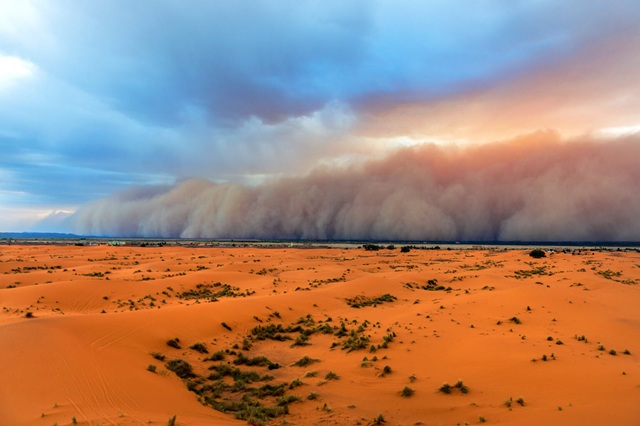
- Iraq Sandstorm (2022): With minimal fine-tuning, Aurora accurately predicted a devastating sandstorm that blanketed Baghdad and grounded air travel—a feat achieved at a significantly lower cost than traditional air quality forecasting methods.
- Typhoon Nanmadol (2022): Aurora predicted complex wave patterns and storm-driven wave heights better than existing models in 86% of test comparisons, despite limited wave data availability from only 2016 onward.
Accelerating Science, Democratizing Forecasting
With a highly flexible encoder architecture and the capacity to learn dynamically from diverse inputs, Aurora is proving that deep learning models can make accurate environmental predictions without hard-coded physical rules. This allows for rapid adaptation to new tasks, and enables researchers to deploy specialized versions within just weeks—compared to the years typically needed to build traditional models.
“It’s not just about weather,” said Megan Stanley, a senior researcher with Microsoft and core Aurora team member. “Aurora is a foundation model for the entire Earth system.”
Microsoft has made Aurora’s source code and model weights publicly available, enabling global access through platforms like Azure AI Foundry Labs and the European Centre for Medium-Range Weather Forecasts (ECMWF). Aurora’s technology is also being integrated into MSN Weather, where a tailored version is now delivering hyperlocal hourly forecasts with enhanced accuracy on precipitation and cloud coverage.
A Catalyst for Climate Resilience
Aurora’s groundbreaking performance has attracted attention from across sectors—meteorological agencies, disaster preparedness groups, energy providers, and even commodity traders—all eager to harness its predictive power. Its adaptability could be especially transformative for underserved regions, helping them anticipate floods, protect crops, and bolster infrastructure resilience.
“This is just the beginning,” said Stanley. “Aurora is the first of its kind, but it certainly won’t be the last. The ability to fine-tune such a powerful model for local or task-specific needs opens the door to countless applications.”
As the climate crisis continues to intensify, tools like Aurora offer hope—not as replacements, but as powerful complements to existing systems, unlocking faster, more reliable, and more inclusive forecasting for the challenges ahead.