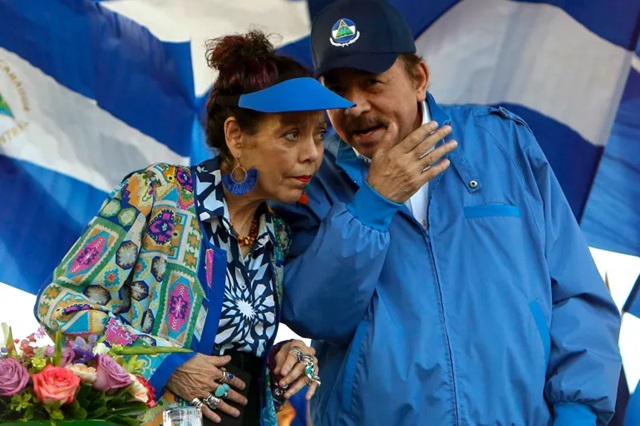
Nicaragua’s National Assembly, under the control of President Daniel Ortega’s ruling Sandinista National Liberation Front (FSLN), ratified a controversial constitutional amendment on Thursday that significantly strengthens the president’s grip on power. The amendment grants Ortega and his wife, Rosario Murillo, sweeping control over all branches of the government, marking a further erosion of democratic structures in the country.
The reform, proposed by Ortega, elevates Murillo to the position of “co-president,” effectively consolidating the couple’s rule over Nicaragua. It transfers control of the legislative, judicial, electoral, and supervisory bodies, which were previously designed to operate independently, directly into their hands. This drastic move consolidates Ortega’s 79-year-old leadership, extending his hold on power for an additional year, as the amendment also lengthens the presidential term from five to six years.
“These drastic changes mark the destruction of the rule of law and fundamental freedoms in Nicaragua,” said Reed Brody, an American lawyer and member of a UN human rights expert group. Brody argued that Ortega and Murillo have now enshrined their “absolute power” in the country, diminishing any hope of political pluralism or opposition.
Since Ortega’s return to power in 2007, the country has seen increasing authoritarianism, with hundreds of political opponents imprisoned, thousands of non-governmental organizations shut down, and many exiled. The Ortega government faced international backlash after violently suppressing mass protests in 2018, in which over 300 people were killed. Ortega’s regime has since placed restrictions on the media, opposition groups, and international organizations, further isolating Nicaragua from the international community.
The recent constitutional amendment has also raised significant concerns from international bodies. The UN High Commissioner for Human Rights voiced “deep concern,” stressing that the reform deepens setbacks in civil and political liberties. Furthermore, Ortega and Murillo have used the reform to tighten control over the media and the Church, accusing them of supporting an alleged coup attempt during the 2018 protests.
The amendment also includes provisions to strip Nicaraguan citizenship from those deemed “traitors to the homeland,” which has already been applied to hundreds of politicians, journalists, and activists critical of the regime. One of the most controversial aspects of the reform is the establishment of a “voluntary police” force, which critics argue amounts to a paramilitary group. Since January, thousands of civilians have been sworn in as part of this force, with many wearing masks to conceal their identities.