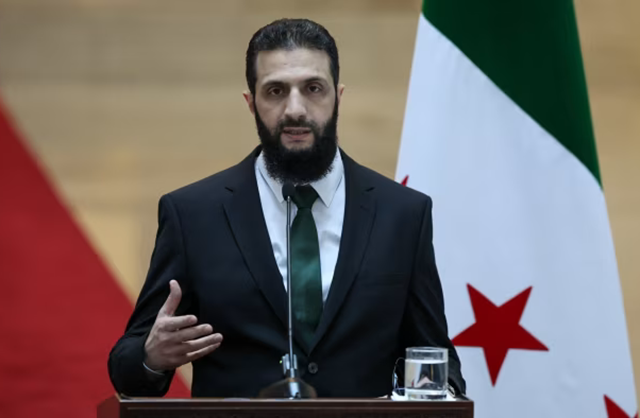
According to the Financial Times, Syria’s de facto leader, Ahmed al-Sharaa, has stated that the country may not hold elections for up to four years following the eventual fall of former President Bashar al-Assad’s regime. Sharaa, who previously operated under the nom de guerre Abu Mohammad al-Jolani, explained that any legitimate elections would necessitate a comprehensive population census. He also mentioned that drafting a new constitution could take as long as three years. These remarks were made in an interview with Saudi broadcasters al-Arabiya and al-Hadath on Sunday.
The announcement of a longer-than-expected transition period is likely to raise concerns among Western powers who have been pressing Sharaa to form an inclusive administration. These powers are currently considering whether to ease sanctions on Syria and remove terrorist designations on Sharaa and Hayat Tahrir al-Sham (HTS), the Islamist group that spearheaded the successful rebellion against Assad’s regime.
Earlier this month, HTS named Mohamed al-Bashir as Syria’s interim prime minister. Bashir, who had led the civilian administration in Idlib, the region that has been under HTS’s control for years, revealed that his government, mostly made up of HTS members, would function as a caretaker administration until March of the following year. Sharaa emphasized that HTS’s dominant role in the transitional government was a necessary stage, adding that a quota system at this juncture could jeopardize the transition.
Hadi al-Bahra, the head of the Syrian National Coalition, which includes prominent anti-Assad factions, called for the inclusion of all opposition parties in the transitional government and proposed an 18-month timeline for political transition, with six months allocated for drafting a new constitution. Sharaa confirmed that HTS and other armed factions would eventually be dissolved into new state structures, although it remains uncertain whether the various factions will agree to this plan.
A National Dialogue Conference, expected to be held at an undetermined date, will announce the dissolution of HTS and other factions, along with the former parliament and constitution. It will also call for the establishment of an advisory council to guide the transition. This conference will include opposition leaders, ethnic and religious figures, and some Assad regime officials who did not have military or security roles.
One key group outside of Sharaa’s control is the Kurdish-led, US-backed Syrian Democratic Forces, which holds a large portion of Syria’s northeast. Sharaa confirmed that his administration is in discussions with the SDF regarding the future status of the region.
Meanwhile, a suspected Israeli drone attack on the outskirts of Damascus on Sunday resulted in at least 17 deaths, according to media reports. Sky News Arabia reported that the attack targeted the town of Adra, northeast of the capital, leaving several others injured.