


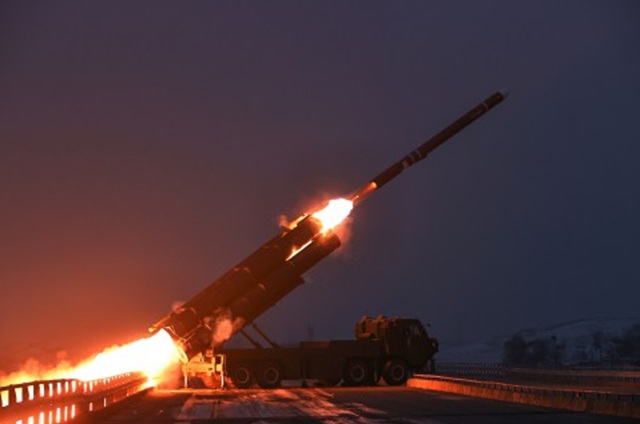
North Korea fired a ballistic missile towards the sea off the east coast of the Korean Peninsula on Wednesday, South Korean and Japanese authorities said, days before major joint military exercises between South Korea and the United States that Pyongyang has long condemned.
The missile was launched from the Wonsan area on North Korea’s east coast at around 6 a.m. (2100 GMT Tuesday), South Korea’s Joint Chiefs of Staff (JCS) said. The launch came six days after North Korea fired another ballistic missile from the same area.
The latest test comes ahead of the South Korean and U.S. military exercises known as Ulchi Freedom Shield, scheduled for August 17 to 27. The drills are aimed at countering what Seoul and Washington describe as evolving nuclear and weapons capabilities in North Korea.
Hong Min, a senior researcher at the Korea Institute for National Unification in Seoul, said the launch was likely part of North Korea’s existing weapons development schedule. However, he said its timing could also have been chosen to send a political message ahead of the joint exercises.
“Even if it was a test of a weapon under development, choosing when to conduct it requires a political decision,” Hong said.
South Korean authorities said North Korea had also fired a ballistic missile from Wonsan on August 6, although Pyongyang did not report that launch through its state media. Hong said the earlier test may have failed to achieve its intended objective.
North Korea has conducted a series of weapons tests this year, including short-range ballistic missiles, artillery rockets and other tactical weapons. Wednesday’s launch was the 11th suspected ballistic missile test by North Korea in 2026, according to South Korean assessments.
South Korean and Japanese defence authorities said the missile travelled around 700 km (435 miles). The JCS did not identify it as a short-range ballistic missile, saying authorities were conducting a detailed analysis of its specifications.
That omission leaves open the question of what type of missile was launched. Ballistic missiles with ranges of 300 km to 1,000 km are generally classified as short-range. Hong said the missile’s range, trajectory and launch site suggested it may have been a type of hypersonic missile, although a submarine-launched missile was also possible.
There was no immediate statement from Pyongyang on Wednesday’s launch.
South Korea and Japan both condemned the test. Japanese Defence Minister Shinjiro Koizumi said Japan had lodged a strong protest with North Korea through diplomatic channels at the Japanese Embassy in Beijing and strongly condemned the action.
The launch followed criticism from North Korean state media on Tuesday of Japan’s latest defence white paper. Pyongyang described the document as an attempt to revive militarism and accused Tokyo of using what it called an unfounded portrayal of North Korea as a security threat to justify an arms build-up.
South Korea’s Office of National Security convened an emergency meeting and expressed concern over North Korea’s continued ballistic-missile launches following the August 6 firing. It urged Pyongyang to halt provocations that violate U.N. Security Council resolutions.
South Korea’s military said it was maintaining readiness to respond “overwhelmingly” to any provocation under its combined defence posture with the United States.
The U.S. Indo-Pacific Command said it was consulting closely with allies and partners. Its initial assessment was that the launch posed no immediate threat to U.S. personnel or territory, or to its allies.
The test also comes amid wider international attention on North Korea’s military cooperation. On Tuesday, Ukrainian President Volodymyr Zelenskiy said Moscow had used North Korean ballistic missiles during a Russian attack that killed seven workers at a steel plant in the southeastern city of Zaporizhzhia.









