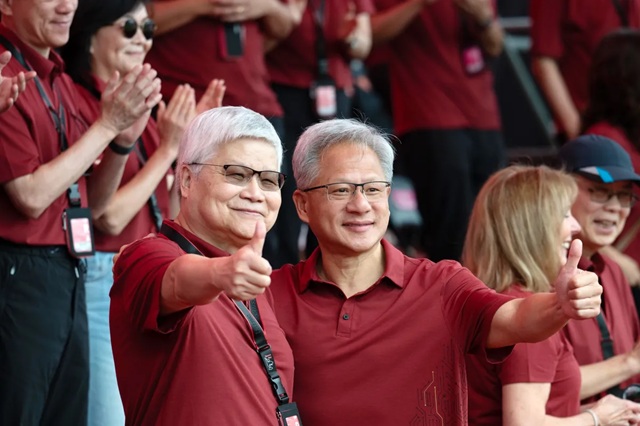
Nvidia Corp. Chief Executive Officer Jensen Huang has turned to Taiwan Semiconductor Manufacturing Co. (TSMC) for more chip supplies as the artificial intelligence boom shows no signs of slowing. Speaking to reporters in Hsinchu, Taiwan, during TSMC’s annual sports day, Huang said, “The business is very strong, and it’s growing month by month, stronger and stronger.” Bloomberg reports that the three AI memory chip suppliers supporting Nvidia — SK Hynix Inc., Samsung Electronics Co., and Micron Technology Inc. — have all expanded “tremendous capacity” to meet the surging demand.
The discussions between Nvidia and TSMC came after Huang met with TSMC CEO C.C. Wei for dinner on Friday, with Huang emphasizing the importance of the Taiwanese manufacturer to his company’s success. “No TSMC, no Nvidia,” he said. Wei confirmed that Huang had requested more wafers during the meeting, and he expects TSMC to continue experiencing record sales year after year.
Despite this optimism, the broader tech sector has seen turbulence. Stocks of major technology companies have recently faced declines as investor enthusiasm over AI was tempered by concerns over funding at OpenAI and bearish positions on Nvidia by Scion Asset Management, led by Michael Burry. Nevertheless, Nvidia remains the world’s most valuable publicly traded company, surpassing both Apple Inc. and Microsoft Corp., according to Bloomberg data.
Huang’s bullish outlook on AI demand is shared by industry peers. Qualcomm Inc. CEO Cristiano Amon told Bloomberg TV earlier this week that the world is underestimating the potential scale of the new technology. The surge in AI adoption has sparked competition among semiconductor firms, with rivals like Qualcomm attempting to challenge Nvidia’s leadership in AI accelerators while navigating limited chip supplies from TSMC.
TSMC has acknowledged the pressure on capacity. In October, Wei told analysts that the company’s manufacturing resources remain “very tight,” and the firm is striving to bridge the gap between escalating demand and current supply. Huang’s ongoing engagement with TSMC underscores Nvidia’s strategic effort to secure the production needed to sustain its dominance in AI, with the CEO highlighting that the support of TSMC has been “key to Nvidia’s success.”
As AI-driven computing continues to reshape the technology landscape, Nvidia’s push for additional wafers illustrates both the opportunity and the bottlenecks inherent in a sector where demand is surging faster than production capabilities. Bloomberg’s reporting emphasizes that the collaboration between Nvidia and TSMC will be crucial to maintaining the pace of growth in AI hardware over the coming years.