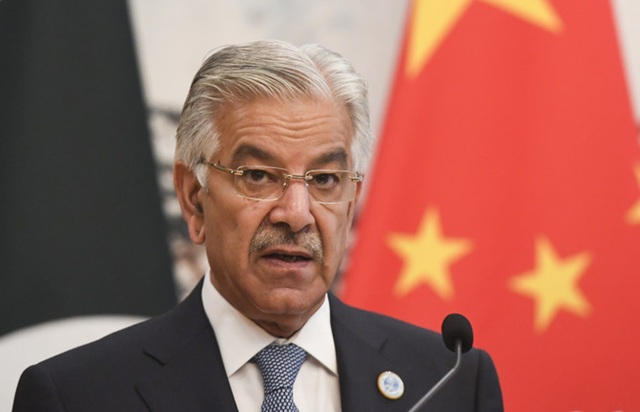
Pakistani Defense Minister Khawaja Asif has launched a scathing critique of Western powers, particularly the United States, accusing them of contributing to decades of regional instability by using Pakistan as a tool in their strategic conflicts.
In an interview with Sky News aired Friday, Asif admitted that Islamabad had carried out “the dirty work” on behalf of the West, especially during the Cold War and the post-9/11 era. “We have been doing this dirty work for the United States for about three decades, you know, and the West, including Britain,” Asif stated. “It was a mistake, and Pakistan has suffered for that.”
The minister’s comments referenced Pakistan’s involvement in the Soviet-Afghan war during the 1980s, where it collaborated with the U.S. in arming and supporting anti-Soviet insurgents, and its subsequent role in the U.S.-led “War on Terror” following the September 11 attacks.
Asif alleged that the West has long used extremist groups as proxies, suggesting that many militants now labeled as terrorists were once welcomed by Western powers. “When we were fighting the war on their side, way back in the ‘80s against the Soviet Union, all these terrorists of today, they were wining and dining in Washington,” he said. “They were treated like VIPs.”
He described militant groups operating in the region as not being independent actors but rather manifestations of a single ideological network. “They’re not multiple organizations. They’re just one single organization, religiously organized, and with different faces, different leadership,” he claimed.
Asif also pushed back against Indian accusations of Pakistan’s involvement in a recent deadly attack in Indian-administered Kashmir that killed 26 people. The Resistance Front, a group allegedly linked to the banned Pakistan-based Lashkar-e-Taiba, has claimed responsibility, prompting sharp rhetoric from New Delhi.
Dismissing the allegations, Asif stated that Pakistan has “never heard of” the Resistance Front and insisted that Lashkar-e-Taiba “no longer exists.” He accused India and other “big powers” of conveniently blaming Pakistan for unrest in the region. He even suggested that the Kashmir incident could be a “false flag” operation aimed at maligning Islamabad.
“No country in the world has suffered so much from terrorism as Pakistan,” Asif said, pointing to thousands of casualties and widespread instability within the country over the past two decades.
When asked how Pakistan would respond if tensions with India led to military escalation, including potential airstrikes, Asif delivered a stern warning: “We would retaliate in kind.”
The minister’s remarks come at a particularly volatile moment for South Asia, as diplomatic ties between India and Pakistan remain deeply strained. The escalation follows years of sporadic violence and mutual accusations, centered largely around the disputed region of Kashmir.
The Pakistani government’s statements are likely to stir further debate about the legacy of Western military intervention in the region, and the long-term consequences for countries like Pakistan that became entangled in global strategic rivalries.