


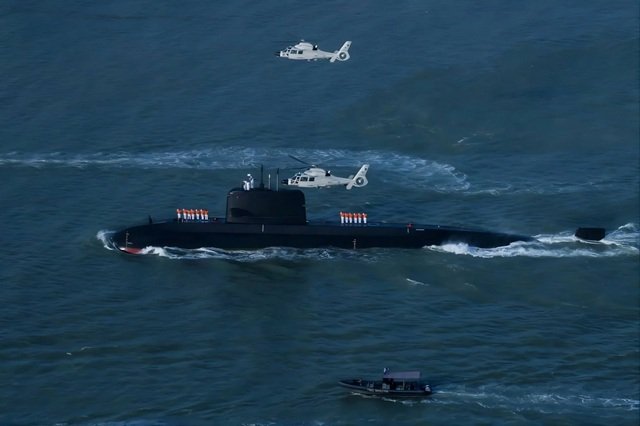
More than five decades after Pakistan lost its naval presence in the Bay of Bengal during the 1971 war, Islamabad is signalling a return to the region with a new generation of submarines designed to strengthen its underwater warfare capabilities and deepen its strategic partnership with China.
The message came with the arrival of PNS Hangor at Karachi on June 11, the first of eight attack submarines under Pakistan’s Hangor-class programme. Four of the vessels are being built in China, while the remaining four are planned for construction in Pakistan as part of efforts to expand the country’s domestic shipbuilding capacity.
The submarine carries the name of an earlier Pakistani vessel, the Daphne-class PNS Hangor, which gained prominence after sinking the Indian frigate INS Khukri in the Arabian Sea during the 1971 conflict. That episode remains one of Pakistan’s few naval successes in a war that otherwise resulted in the separation of East Pakistan and the creation of Bangladesh.
Commodore Omer Farooq, who oversaw the new submarine’s transit voyage from China, described the vessel as a “game changer”, saying it was capable of operating beyond Pakistan’s traditional maritime boundaries and extending its reach eastwards into waters India considers strategically vital.
The announcement has attracted attention in New Delhi because Pakistan has not maintained a meaningful naval presence east of India since its defeat in the eastern theatre of the 1971 war. During that conflict, India’s navy blockaded East Pakistan, disrupted supply routes and played a major role in the surrender of Pakistani forces, ending Islamabad’s control over the territory that became Bangladesh.
The arrival of the Hangor-class submarines therefore carries significance beyond immediate military capability. Maritime security analyst Swaran Singh said the move was strategically important less because of its immediate operational impact and more because of the geopolitical message behind Pakistan’s attempt to project naval power into India’s eastern maritime sphere.
The Hangor-class submarines are equipped with air-independent propulsion technology, allowing them to remain submerged for longer periods compared with conventional diesel-electric submarines. The capability reduces the need to surface frequently for battery charging, making the vessels quieter and more difficult to detect in contested waters.
Pakistan currently operates a fleet of diesel-electric attack submarines and smaller vessels used for specialised missions. India, meanwhile, maintains a larger submarine force that includes conventional submarines and nuclear-powered ballistic missile submarines.
Researchers in Pakistan argue that the Hangor-class programme is not aimed at matching India vessel-for-vessel but at achieving strategic balance through advanced technology. Abdul Moiz Khan of the Centre for International Strategic Studies in Islamabad said the submarines provide Pakistan with a form of “parity” by offering precision and deterrence rather than numerical strength.
Khan said the submarines could provide Pakistan with retaliatory reach if Indian naval forces attempted to blockade or strike Pakistani assets in the Arabian Sea.
However, analysts say the submarine programme must be viewed within the broader context of expanding China-Pakistan military cooperation. The Hangor project forms part of a wider defence relationship involving naval exercises, weapons transfers and joint production arrangements.
China has expanded its naval presence across the Indian Ocean through warship deployments, its overseas military base in Djibouti and access agreements involving ports such as Gwadar in Pakistan and Hambantota in Sri Lanka. Analysts warn that the combination of Chinese maritime activity and Pakistan’s new submarine capability could create additional pressure around India’s coastline.
Retired Pakistan Air Force officer Sultan Mahmood Hali described the submarine’s significance as a strategic signal rather than simply a military acquisition. “Maritime power is not only about ships and submarines,” he said. “It is about shaping perceptions, influencing alignments and signalling resolve.”
The development comes amid renewed tensions between India and Pakistan following a serious military escalation between the two nuclear-armed neighbours in May last year. Although the confrontation ended with a ceasefire, both countries have continued expanding their defence capabilities.
Indian analysts acknowledge that the Hangor-class submarines present operational challenges because their stealth capabilities could make them harder to locate. India has invested heavily in anti-submarine warfare systems, including maritime patrol aircraft, underwater surveillance networks and its own submarine construction programmes.
Despite these advantages, analysts say the emergence of a China-supported undersea network around India’s maritime neighbourhood represents a longer-term challenge. The issue, they argue, is not an immediate shift in naval dominance but an increase in uncertainty over future strategic calculations.
“The balance of power has not changed yet,” analysts noted. “What changes is the balance of uncertainty.”










