


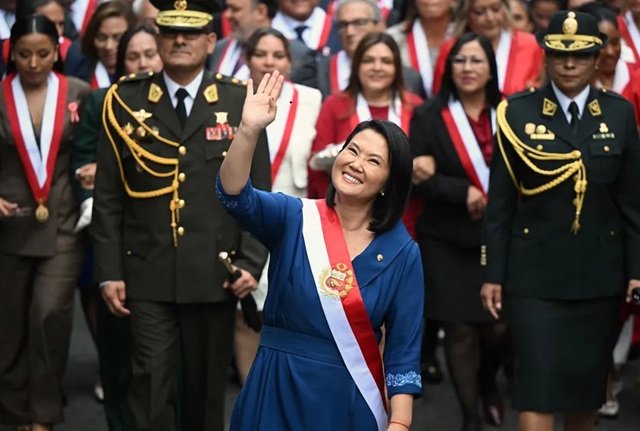
Peru’s newly inaugurated President, Keiko Fujimori, has declared a state of emergency as her first official act in office, announcing that the military will temporarily assume control of regions with high levels of crime in an effort to restore public security.
Speaking immediately after taking the oath of office at the Congress Palace in the Peruvian capital, Lima, Fujimori said the armed forces would take “temporary control” of parts of the country most affected by criminal activity. The conservative leader pledged to reclaim “every neighbourhood, every street and every public space for Peruvian families”, presenting the measure as the opening step in her administration’s campaign to improve security.
The declaration forms part of a broader programme that Fujimori says is intended to stabilise Peru’s prolonged political turbulence, reduce crime and stimulate economic growth. In her inaugural address, she also highlighted preparations for the expected impacts of the El Niño climate phenomenon, which is anticipated to affect Peru in the near future.
Alongside her security measures, the new president announced plans to significantly increase pensions and expand the country’s transport infrastructure. She also committed to strengthening the national police force, signalling that law enforcement reforms will accompany the temporary deployment of the military in high-crime areas.
Fujimori secured the presidency after narrowly defeating left-wing candidate Roberto Sánchez in the June run-off election. Sánchez has not accepted the election result and has indicated that he intends to challenge the outcome.
The closely contested election follows a prolonged period of political instability in Peru. Over the past decade, the country has had eight different heads of state, with only three reaching office through elections. The remaining presidents assumed office after their predecessors either resigned or were removed by Congress following corruption scandals.
The new president’s political background is also closely tied to Peru’s recent history. Fujimori is the daughter of former president Alberto Fujimori, who was convicted of human rights violations before his death. She has openly aligned herself with her father’s political legacy, noting that her inauguration coincided with his birthday.
Shortly before taking the presidential oath, she posted a message stating: “Papa, today Peru remembers you, and millions carry you in their hearts.” The statement reflected her continued identification with her father’s political tradition despite the controversy surrounding his presidency.
The inauguration ceremony drew a number of international dignitaries, including Spain’s King Felipe VI, Argentine President Javier Milei and Chilean President José Antonio Kast. However, the event also highlighted the country’s continuing political divisions, with a group of left-wing legislators leaving the chamber in protest during the ceremony.
Fujimori begins her presidency with significant parliamentary support. Her party, together with its principal ally, Renovación Popular, controls half of the seats in Peru’s newly established Senate. That parliamentary strength is expected to make it more difficult for legislators to remove the new president from office, providing her administration with a stronger institutional position as it seeks to implement its programme of security, economic and political reforms.









