


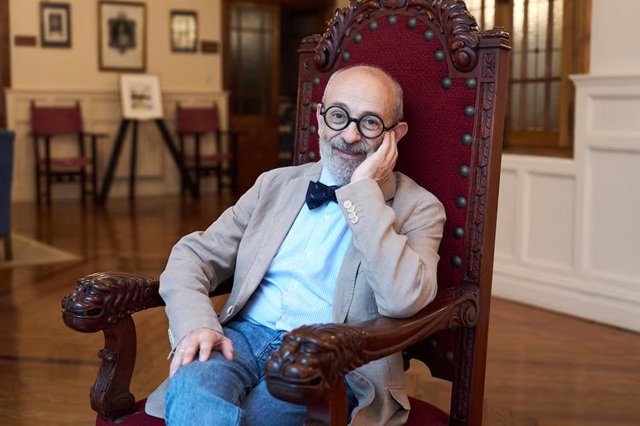
Beauty is not simply a matter of symmetry, proportion or artistic taste. For Spanish philosopher Ricardo Piñero, it is a transformative encounter capable of changing the course of a person’s life. That conviction lies at the heart of his reflections on aesthetics, education, technology and human relationships, subjects that have shaped both his academic career and his teaching across several disciplines.
In an interview with El País, Piñero, Professor of Aesthetics and Theory of Art at the University of Navarra, discusses how modern society risks losing something fundamental as digital technology increasingly mediates everyday life. Drawing on decades of teaching students from economics, philosophy, architecture and science, he argues that beauty, presence and genuine human interaction remain indispensable to understanding both ourselves and others.
Born in León in 1965, Piñero began his academic career at the University of Salamanca before moving to the University of Navarra in 2015. The decision, he explains, was driven not by ideology but by practical realities. Having served as a dean within Spain’s public university system, he recalls working in an environment with such limited resources that there was not even sufficient funding to purchase books. An unexpected offer from the University of Navarra, accompanied by greater academic resources and an ambitious interdisciplinary programme, convinced him to make the transition.
Piñero’s understanding of beauty departs from conventional definitions centred on harmony or visual perfection. During the interview, he recounts asking ChatGPT to define beauty, receiving three different interpretations, including one attributed to himself. He dismisses the artificial intelligence’s attempt with humour before offering his own explanation: beauty is an experience that affects a person so profoundly that life is divided into a “before” and “after” that encounter.
Such experiences, he argues, are deeply personal rather than dependent upon universal agreement. Art, in his view, speaks not primarily to reason but to sensation, judgement and understanding. Just as people can love someone without fully understanding them, works of art can profoundly affect individuals even when they resist rational explanation.
Although Piñero does not dismiss artificial intelligence outright, he believes philosophy offers an important reminder about its limitations. The discipline, he says, has always been driven less by finding definitive answers than by asking meaningful questions. That approach, he suggests, provides a more intelligent way of engaging with emerging technologies such as AI.
His greatest concern, however, lies elsewhere. Piñero argues that contemporary society has become increasingly detached from direct human contact because people spend so much of their lives looking at screens instead of one another. Human beings, he says, are inherently social creatures whose identities are formed through relationships with others. The ability to see and, equally importantly, to be seen by other people plays a central role in personal development.
He warns that prolonged isolation carries profound anthropological consequences. If individuals cease engaging directly with others, they risk becoming detached from the shared human experience, existing instead as isolated minds disconnected from the wider world. For his students, Piñero summarises this understanding through a simple sequence: people exist because of others, with others and ultimately for others.
This concern extends into his broader assessment of modern society. Piñero believes the ideals of the Enlightenment promised continuous progress through reason but often overlooked essential dimensions of human existence. While rational thought remains important, he argues that contemporary culture has neglected sensitivity, imagination, creativity, emotion, religion and political life. Humanity, he suggests, has become emotionally anaesthetised, losing touch with many of the qualities that make life meaningful.
Such shortcomings, he believes, help explain the contemporary appeal of populism and political polarisation. Reason alone, he argues, is easily manipulated when people retreat into ideological camps that reinforce only their own views. Societies divided into opposing groups lose the capacity for genuine reflection because, in his words, where everyone thinks alike, nobody truly thinks.
For Piñero, diversity has always been one of humanity’s defining strengths. Differences between generations, cultures and perspectives should become opportunities for dialogue rather than confrontation. He argues that the encounter between youth and experience, between tradition and modernity, should enrich society rather than deepen divisions.
Teaching successive generations of university students has reinforced that belief. Piñero describes it as a privilege to work with young people willing to challenge established ideas. Although he believes today’s students generally possess a less extensive academic foundation than previous generations, partly because educational programmes have been reduced, he sees considerable reasons for optimism. Their enthusiasm for creativity, collaboration and new experiences remains intact, qualities he considers invaluable from a philosophical perspective.
Presence itself has become one of his central concerns. While acknowledging the importance of virtual technologies, Piñero insists that nothing can replace the physical presence of people, objects and shared experiences. Becoming conscious of others’ presence, he argues, remains fundamental to understanding both oneself and society.
His reflections ultimately extend beyond philosophy into questions of mortality. Piñero speaks openly about death, describing it as an inseparable part of living rather than something to avoid contemplating. After losing several people close to him, he became dissatisfied with conventional gravestones and commissioned his own. It already bears his birth year, 1965, along with the first two digits of the year in which he expects to die, leaving only the remaining numbers to be completed. The monument also carries a Christian cross, reflecting his faith, and a Latin epitaph meaning “row out into the deep sea.”
The inscription captures a philosophy that has shaped both his academic work and personal outlook. Piñero explains that the most meaningful part of the sea begins when the coastline disappears from view, leaving individuals to confront the vastness before them. In that encounter, he says, people recognise both their own smallness and the possibility of discovering something greater.
Throughout his career, whether teaching economists, architects, philosophers or scientists, Piñero has sought to encourage precisely that search. For him, education is ultimately not only about knowledge but about pursuing truth, beauty and authentic human relationships in a world where those ideals are increasingly challenged by distraction, technological mediation and social fragmentation.









