


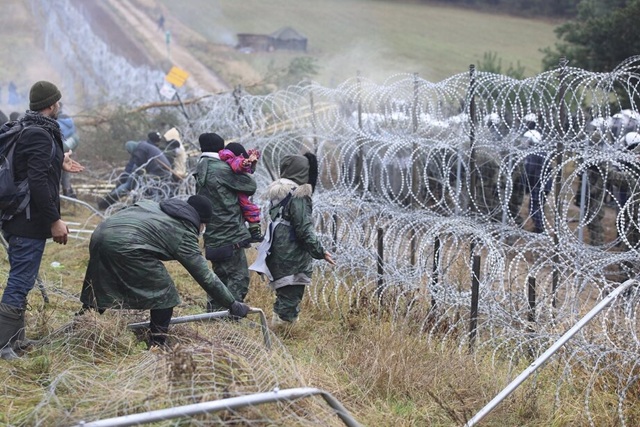
Tomas, a migrant attempting to cross into Poland from Belarus, describes his perilous journey through the so-called “Death Zone” as “hell, where they shoot from both sides.” This harrowing account sheds light on the dangerous conditions at Poland’s eastern border, where thousands of migrants, drawn by smuggling networks, attempt to enter Europe. Tomas, who was assisted by Belarusian smugglers on all seven of his attempts, shares how he paid £2,000 for a flight to Minsk, followed by a bus ride led by an “armed Arab” to the border fence. On each attempt, he was instructed to bribe border guards.
The migrants, most of whom did not know each other before their journeys, were lured by promises of a “boat-free” route into Europe. Telegram and WhatsApp groups, operated by international smuggling networks, offer flight-and-bus packages to Poland’s border, and often advise on how to pay bribes to Belarusian soldiers to allow passage. In the past year alone, more than 15,000 asylum applications were filed in Poland, with many of these applicants originating from East Africa, the Middle East, and other regions affected by conflict and instability.
A report by The Times reveals the stark reality of life for these migrants, who often face violent opposition from border forces. In an exclusive report, The Times joined a patrol along the 116-mile-long border wall, which is being extended to curb the flow of migrants. The border is a fortified zone, with barbed wire, motion sensors, and constant surveillance by armed guards. “Attacks [from migrants] take place almost every day and every night,” explains Michael Bura, a senior officer with the Polish border guards, who shared that over 2,500 border crossing attempts were stopped this month alone. He added that one night, more than 110 migrants crossed in just a single stretch.
The border crisis began in earnest in 2021 when an unprecedented surge in crossings followed Belarusian leader Alexander Lukashenko’s controversial election victory, which the EU declared fraudulent. In retaliation, the EU imposed sanctions on Belarus, while Lukashenko allowed the flow of migrants to be directed to Poland, Latvia, and Lithuania in an apparent act of retaliation against the EU.
Poland, in response to the surge, implemented strict border controls and even suspended asylum claims for those entering via Belarus. The country has also deployed additional troops along the border, raising the number of personnel from 6,000 to 8,000, while also expanding the 200-meter buffer zone into Poland’s protected Bialowieza forest. In addition, Poland has introduced a new gun law that allows border personnel to use lethal force in “self-defence” or “preemptively” against migrants.
The Polish government has accused Belarus of orchestrating this migrant crisis as part of a broader destabilization campaign, with reports suggesting that Moscow is involved. According to security experts, Russia is allegedly using migrants as a “hybrid warfare” tactic against Poland and its NATO allies. Olivier Guitta, managing director of GlobalStrat, argues that Moscow’s goal is to punish its adversaries by creating chaos on its borders.
The deadly consequences of these crossings are also evident. Since 2021, at least 130 people have died attempting to cross the border, with many succumbing to hypothermia or exhaustion while stranded in the forest. Others have perished in accidents while being chased by border guards. Three soldiers were arrested in March for firing on a group of migrants, and there were reports of 700 “warning shots” being fired by Polish border guards in May alone.
Tomas, who now resides in a migrant camp in Bialystok, has serious regrets about his journey. “It is not worth it to come to Poland,” he says. “Our friend is still there suffering in the Death Zone.” His words serve as a grim reminder of the dangers faced by migrants attempting to cross one of Europe’s most tightly policed borders.









