Editorial
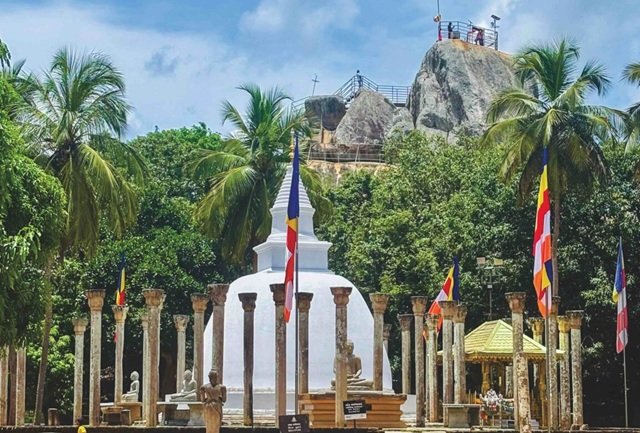
Today is our Poson Poya Day. The day we are asked to believe that we got Buddhism, even though, according to our own historical tales, we are asked at the same time to believe that the Buddha himself was here three times — visiting Mahiyangana, Nagadipa, and Kelaniya, centuries before any emperor’s son supposedly waded ashore at Mihintale to introduce us to the faith. Nobody seems to notice the contradiction sitting in plain sight inside our own chronicles, and on a day of white clothing and full moon poya announcements, almost nobody asks how a nation that received three personal visits from the Buddha could simultaneously need an Indian missionary several centuries later to discover what Buddhism even was.
This is not a small wrinkle. It is the seam where the entire official story of Sri Lankan Buddhism comes apart if you pull on it. The Mahavamsa, the great Pali chronicle that gives us Mahinda and his sister Sanghamitta, was written roughly seven hundred years after the events it describes, by monks of one specific monastery — the Mahavihara — who had every institutional reason to want their lineage traced to the most famous Buddhist patron in history. Ashoka’s own rock edicts, carved in his own lifetime, mention sending the dhamma to Tamraparni. They say nothing about a son. They say nothing about Mahinda by name at all. No Indian text outside the Sri Lankan tradition — not the Ashokavadana, not the Divyavadana, not the Puranas, none of the sources that are perfectly happy to discuss Ashoka’s other sons, Kunala and Jalauka — has ever heard of him. A man supposedly born to the most documented emperor of ancient India left no trace anywhere except in the writings of the very monastery that needed him to have existed.
That is worth sitting with on a day when we are taught to receive this story as settled history rather than as theology doing the work of politics. Because what the Mahavihara built with Mahinda was not a record. It was a claim to power. If your monastery’s authority rests on being the one true continuation of a lineage personally founded by Ashoka’s own blood, you have just out-argued every rival sect on the island without needing a single relic or a single debate. Sanghamitta does the same work for the bhikkhuni order and for the Bodhi tree cult at Anuradhapura — note that her very name means “friend of the sangha,” a suspiciously on-the-nose label for a supposedly real historical princess, the kind of name a chronicler invents rather than a kind a person is actually given at birth. This is not subtle. It is myth-making with a clear institutional beneficiary, and the beneficiary was not India. It was one Sri Lankan monastery’s claim to supremacy over its island rivals, dressed up as imperial pedigree.
And here is where the real loss sits, the one worth marking on Poson rather than the imagined loss of some external Indian conquest. The loss is that this single chronicle, written by a single faction, became the unquestionable national narrative — and every competing memory, every rival monastic account, every inconvenient detail like the Buddha’s own three visits, got flattened into a contradiction nobody is allowed to notice out loud. The Abhayagiri monastery, the Mahavihara’s great historical rival, has no chronicle of its own that survived in anything like the same authority. We are not reading history. We are reading the winner’s press release, recited annually as liturgy, and mistaking its survival for its truth.
This matters beyond academic nitpicking because a country that cannot interrogate its own founding myth cannot meaningfully defend the philosophy that myth claims to carry. The tragedy is not that Mahinda might be fictional. Religions run on useful fictions constantly, and there is no shame in that. The tragedy is that two thousand years later, a fabricated genealogy still does more work in the Sri Lankan Buddhist imagination than the actual content of the Dhamma does — the rigor, the psychology, the ethics that the Pali Canon itself preserves with real discipline, regardless of who delivered it or when. We have spent centuries defending the messenger’s invented credentials and far less energy defending or even reading the message he supposedly carried.
So on Poson, before the white clothes and the pandals and the recitation of Mihintale as settled fact, it is worth asking what exactly we are commemorating. Not a missionary. Not even, really, a moment. We are commemorating a seven-hundred-year-old institutional victory that successfully rewrote itself as a two-thousand-year-old historical fact — and in doing so, made questioning the legend feel like questioning the faith itself, when the two were never the same thing to begin with.