Wernher von Braun’s Project Mars: A Technical Tale, written in 1949, stands as a unique combination of science fiction and visionary engineering. In a world still recovering from World War II, von Braun projected a future where humanity united to conquer space, specifically the planet Mars. The story is centered on a monumental expedition to Mars and is notable for its blend of precise technical details and speculative creativity. However, the most intriguing aspect for modern readers lies in the governance system of the Martian society described in the book, where the leader is titled “Elon.” This has sparked curiosity due to the parallels with Elon Musk, the contemporary entrepreneur and visionary leading efforts to colonize Mars through SpaceX.
The narrative begins with humanity achieving global unity after a catastrophic world war, paving the way for an international mission to Mars. Von Braun meticulously describes the technical and logistical challenges, including the construction of massive spacecraft, the intricate physics of orbital mechanics, and the rigorous training of astronauts. He envisioned a fleet of ten spacecraft, carrying a combined crew of 70, with the journey requiring over a thousand preparatory flights into Earth’s orbit. This massive undertaking highlights von Braun’s belief in the necessity of collaboration across nations, fields, and disciplines to achieve such a grand objective. The attention to scientific accuracy is a hallmark of the novel, with von Braun grounding his descriptions in real-world physics and engineering, emphasizing that space travel, though challenging, was within humanity’s reach.
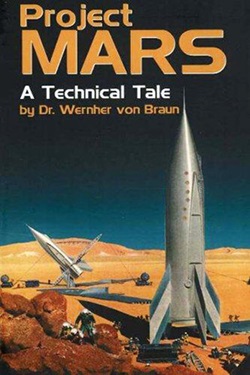
Upon reaching Mars, the Earth expedition discovers an advanced Martian civilization that has adapted to the planet’s harsh conditions. One of the most fascinating aspects of Martian society is its political structure, described in striking detail. Von Braun writes, “The Martian government was directed by ten men, the leader of whom was elected by universal suffrage for five years and entitled ‘Elon.’” The Elon, as leader, worked alongside a bicameral legislative system. The upper house, called the Council of the Elders, consisted of 60 members appointed for life by the Elon, chosen for their expertise and wisdom. This council served as a stabilizing force, ensuring continuity in governance. Meanwhile, the lower house, the Assembly of Deputies, was responsible for enacting laws and engaging in the vigorous debates necessary for progress. Von Braun draws a parallel between the Martian system and the College of Cardinals in the Roman Catholic Church, particularly in the method of appointing the Council of Elders.
This choice of the name “Elon” for the Martian leader is striking, given that decades later, Elon Musk emerged as a central figure in humanity’s real-world efforts to colonize Mars. While there is no evidence to suggest Musk’s parents named him with von Braun’s work in mind, the coincidence has fueled speculation and fascination. Musk himself has acknowledged this connection on social media, adding an intriguing layer of serendipity to the book’s legacy.
Von Braun’s depiction of the Martian civilization also reflects his philosophical musings on the trajectory of human progress. The Martians are portrayed as a society far older than Earth’s, having developed technology and infrastructure to sustain life on a resource-depleted planet. Their advanced irrigation systems, stretching symmetrically across the planet and channeling water from polar ice caps to arid regions, serve as a metaphor for human ingenuity and the necessity of adapting to environmental challenges. The Martians’ peaceful nature and focus on collective survival contrast with Earth’s history of conflict, offering a vision of a society that has transcended its warlike origins.
The book also captures the grandeur and peril of space exploration. Von Braun’s characters grapple with both technical obstacles and the psychological challenges of extended isolation in space. For example, the protagonist, Colonel Holt, reflects on the enormity of the mission: “What a year that would be! It was the real objective of the whole expedition. During that time they would be finding out the nature of the inhabitants, and the circumstances and conditions in which they lived.” Holt’s internal conflict mirrors the universal tension between the call to adventure and the pull of home, a theme that resonates deeply with anyone who has dared to dream of the unknown.
Von Braun’s narrative style is emblematic of mid-20th-century science fiction, focusing on collective achievement rather than individual heroism. Unlike the lone savior archetype common in many stories of the era, Project Mars emphasizes teamwork and the contributions of specialists from diverse fields. This approach aligns with von Braun’s real-world advocacy for multidisciplinary cooperation in space exploration.
While the novel’s technical aspects are impressive, it is the philosophical and speculative elements that make it enduringly relevant. Von Braun envisions space exploration not as an end in itself but as a means to ensure humanity’s survival and evolution. He writes, “It is the vision of tomorrow which breeds the power of action.” This forward-looking ethos underpins the story and mirrors the motivations of contemporary visionaries like Elon Musk, who see space colonization as essential to securing a future for humanity.
The parallels between von Braun’s fictional Mars project and modern efforts are striking. The book emphasizes international cooperation, a principle that echoes in the collaborative nature of organizations like NASA and SpaceX. Moreover, von Braun’s detailed descriptions of spacecraft design, mission logistics, and the challenges of interplanetary travel anticipate many aspects of contemporary Mars mission planning. The book even includes a 65-page appendix with technical drawings and calculations, underscoring the seriousness with which von Braun approached the subject.