by Luxman Aravind
Lies may elevate you to power, but they will never secure it. To cling to power through deception, you will be forced to resort to ruthless brutality—first against those who dissent, and ultimately against your own political followers who once believed in you. In Sri Lanka’s current political climate, no regime can achieve this without first corrupting institutions to manufacture false charges against chosen victims, imprison them, and construct a propaganda machine to mask the truth. However, such tactics are fragile, for geopolitical realities will inevitably determine just how long this house of cards can stand.
It is nothing short of pitiful. The dawn has yet to break; not even the hen has begun to ‘cluck’, let alone feel the warmth of the sun’s first rays. We are still enshrouded in the deepest darkness, the final hours of the night, where the forces of corruption settle into their beds, knowing full well that the coming daylight will merely be a disguise for their continued misdeeds. But will they, for once, sleep through this awakening? ( read my earlier take on this here; The Illusion of Sri Lanka’s Intellectual Cabinet)
The political climate in Sri Lanka today is a breeding ground for deceit, where manipulation trumps reality, and those in power have perfected the art of illusion. When we turn our gaze upon figures like Asoka Sapumal Ranwala, we are not merely looking at a lone opportunist but at a grotesque reflection of a far more insidious truth—this is not an isolated failure, but a symptom of a systemic rot that has infected every crevice of Sri Lankan politics. Ranwala is not the cause, but the embodiment of a deeper malaise, a disease that has entrenched itself in the very heart of the nation’s political fabric.
Using Derridean deconstruction and Lacanian psychoanalytic theory, the name Asoka Sapumal Ranwala can be critically examined as a linguistic construct that operates both as a symbol of legitimacy and a mask for personal deception. Derrida’s notion of différance suggests that meaning is not fixed but constantly deferred, and thus, the components of the name—Asoka, Sapumal, and Ranwala—are laden with historical connotations that create an illusion of integrity and valor. Asoka evokes the grandeur of Ashoka the Great, embedding an image of enlightened leadership; Sapumal recalls the heroic figure who liberated Jaffna, positioning the individual as a liberator. Meanwhile, Ranwala, tied to the idea of war and bravery, alludes to a martial legacy.
However, as Derrida would argue, these meanings are unstable, manipulated by the person who appropriates them. Lacan’s theory of the mirror stage further complicates this: the individual who adopts these names, like Ranwala, constructs an idealized image of himself—an ‘Other’—in an attempt to gain power and recognition, but this image is a false je, a fragmented self that exists only in the gaze of others. In this case, Ranwala’s appropriation of these historical and cultural signifiers functions as a superficial mask that hides his true identity as a con artist. His performance is one of constructing a symbolic self that aligns with powerful national and historical ideals, while beneath it lies the deceitful manipulation of symbols to bolster his own fraudulent ascent. This tension between appearance and reality reflects the deeper emptiness that Lacan identifies in the formation of the self, as Ranwala’s public persona is ultimately a hollow construction, built on illusion and deception.
Back to the subject, the tragic reality is that Sri Lanka’s self-proclaimed “political elite” has become a breeding ground for individuals who, instead of genuinely leading or offering innovative solutions, have chosen the path of personal gain disguised as intellectualism. The rise of Ranwala, who inflated his credentials to gain power, highlights the absence of true intellectuals in the decision-making spaces of the nation. It’s no longer surprising to hear of people like him being touted as ‘Professors’ or ‘Doctors,’ titles that are wielded not because of intellectual merit, but to manipulate the public and increase personal authority.
What is even more alarming is the fact that such figures often climb the ranks by appealing to a culture that lacks political literature, critical thought, and genuine engagement with issues that matter. Instead of nurturing leaders who can guide the nation towards a more prosperous and enlightened future, Sri Lanka has become a playground for crooks disguised as intellectuals—men and women whose only real talent lies in spinning lies and manipulating the masses. These individuals thrive in a system where the bar for intellectual and political honesty is set so low that deception becomes the only currency that matters.
Ranwala is not unique; he is merely one of many who have exploited the culture of mediocrity that now defines Sri Lankan politics. The obsession with titles—’Doctor,’ ‘Professor,’ ‘Specialist’—is a clear manifestation of the political corruption that runs rampant. In many cases, the individuals in question may hold degrees from world-renowned institutions, yet they are unable to compose even the most basic piece of writing. This is not just an intellectual failing; it is an indication of the moral and ethical decay that has infected the political class. Those who are genuinely qualified and capable are often shoved aside, their potential squandered, while those with inflated titles and empty rhetoric rise to the top.
This situation creates a vicious cycle, where those in power are constantly in fear of being exposed. When someone with real talent or intellect challenges the status quo, they are met with resistance—petitions, legal cases, and character assassinations—all designed to suppress anyone who might expose the truth. This is where the real failure of leadership lies. Instead of fostering an environment where talent is nurtured and intellectuals can thrive, the political elite in Sri Lanka have created a system where only those willing to play the game of lies and manipulation succeed.
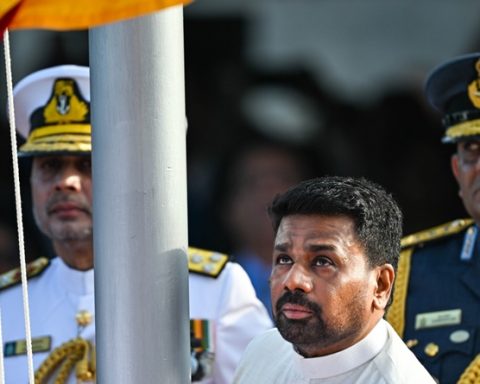
As the current government faces increasing internal and external pressures, it is clear that the situation cannot be sustained for much longer. Despite their minimalist rhetoric and empty promises, the regime lacks tangible accomplishments to justify its continued existence. President Dissanayake, despite his growing accumulation of power, seems terrified of his own reputation and the potential for youth uprisings. Yet, he and his political allies continue to push forward with a narrative of stability and progress, while in reality, they are merely scrambling to maintain the façade.
The United States, plays a significant role in this dynamic, offering strategic advice and maintaining diplomatic relationships with the current government. However, their support may prove to be short-lived. The US’s relationship with Sri Lanka is romanticised in some circles, but history has shown that such partnerships often come with unexpected consequences. Former leaders, like President J.R. Jayawardene, once enjoyed close ties with the Reagan administration, only to face the fallout later when the public was left to shoulder the consequences. Today’s political leaders may be enjoying the support of foreign powers, but when the storm finally hits, it will be the people who suffer.
In the coming years, Sri Lankans must brace themselves for the inevitable fallout. The storm may be coming sooner than anticipated, and it will not be a product of some external force alone. Rather, it will be the consequence of the hollow political system that has been built by opportunists like Ranwala and the countless others who have followed in his footsteps. This storm is the result of decades of neglecting intellectual engagement, political honesty, and social responsibility. The system has become a breeding ground for deception, where lies are the primary tool used to maintain power. And, as history has repeatedly shown, lies may elevate you temporarily, but they will not sustain you in the long run.
The time for change has long passed. The people of Sri Lanka must reject the crooks posing as intellectuals, demand true leadership, and push for a future where power is not sustained by lies but by integrity, competence, and a commitment to the greater good. If this does not happen, then the storm will not be just a metaphor—it will be the inevitable collapse of a broken system that has long been on the verge of collapse.