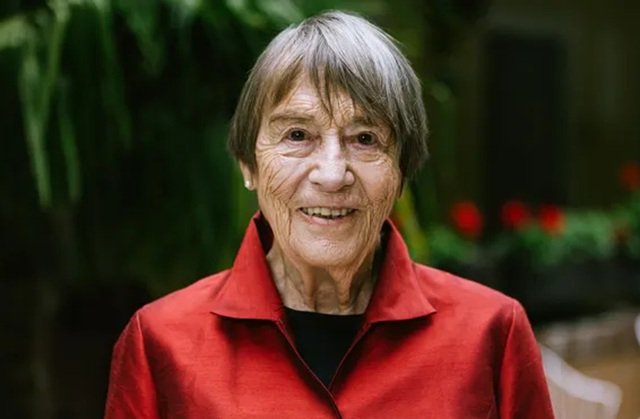
Renate Welsh spent much of her life giving words to those who struggled to be heard. Through decades of children’s and adult literature, she explored loneliness, injustice, exclusion and the search for belonging. But in 2021, the acclaimed Austrian author faced a challenge that struck at the centre of her own identity: she lost her ability to speak after suffering a stroke.
For a writer, the loss was devastating. Yet Welsh fought her way back, working with a speech therapist to recover her language. Her experience later became the subject of her book “Ich ohne Worte” (“Me Without Words”), a deeply personal account of losing and rebuilding the tool that had shaped her entire life.
In an interview with Die Zeit, Welsh reflected on her childhood during the Second World War, her career as one of the most influential German-language children’s authors and the difficulty of revealing herself through writing.
Born in Vienna in 1937, Welsh grew up in a world marked by war and uncertainty. She said the society of her childhood and the present day appear very different, but some attitudes have remained.
“The mentality of shortage” continues to influence many people, she said, describing a feeling among some that they have been deprived of something they never actually lost and that others are responsible for their difficulties.
Welsh believes children today face their own pressures. Although young people have more opportunities than previous generations, she said those possibilities can also become a burden when success is treated as an expectation rather than a choice.
The author, known for books that address difficult realities rather than idealised childhoods, said she now writes less frequently for children and teenagers because their world has changed significantly. While she still finds it easy to connect with young people, she feels she no longer has the same authority to write specifically for them.
A children’s book, she explained, requires a powerful idea. A writer cannot simply tell a story because it touched them personally; the story must connect with children themselves.
Welsh never set out to write specifically for a young audience. She said her writing always began with curiosity, surprise, anger at injustice, questions and uncertainty. If the result became something children could engage with, she considered that a success.
Her breakthrough came in 1979 with “Das Vamperl”, the story of a small vampire who does not drink blood but instead removes people’s excess bile, making them calmer and more peaceful. The idea emerged during a frustrating traffic jam caused by aggressive drivers refusing to give way.
Welsh remembered her grandmother often saying, “You are full of poison and bile,” and wondered what might happen if there were a creature capable of removing that anger from people.
The book became one of the best-known children’s stories in the German-speaking world and was translated into several languages. Welsh said one of the greatest joys was receiving children’s own Vamperl stories, which they created after reading her work.
Her writing placed her among the leading figures of socially engaged children’s literature, alongside authors such as Christine Nöstlinger and Mira Lobe. Welsh accepts that description because she believes literature is always connected to society.
For her, books encourage independent thought and develop empathy by allowing readers to encounter people whose lives differ from their own. Literature, she said, can help people understand that failure is not only unavoidable but also an important part of life.
Her commitment to empathy was shaped by her own childhood experiences under National Socialism. Welsh said she believed the remnants of fascist thinking could not easily be removed from adults, but children still had the ability to question and change prejudices.
“The fascism is not built into the genes,” she said, describing her belief that children often begin life with fewer fixed assumptions about others.
That perspective shaped many of her stories, where children’s viewpoints often challenge adult assumptions. Welsh said books should serve as a place of refuge for those who feel isolated.
She described literature as a space where readers and characters face problems together, searching for possible solutions. When people speak honestly about books, she said, they often reveal something about themselves.
One of the experiences that confirmed this belief came during a reading in Sanliurfa in southeastern Turkey, after the publication of her novel “Johanna”. The book tells the story of an illegitimate girl growing up in rural Austria during the 1930s and the rise of National Socialism.
After the reading, a young Turkish woman approached Welsh and told her that although the story was set in another time and place, it was also her story.
For Welsh, that moment demonstrated how literature can cross boundaries of time, culture and circumstance. She believes the deepest human questions are not determined only by external conditions but by each person’s search for meaning and connection.
Her own childhood was difficult. After her mother’s early death, Welsh lived in Bad Aussee with her stepmother, separated from her beloved father. She described feeling excluded within the family and later as an outsider at school, where she was known as the red-haired girl from Vienna who did not speak the local dialect.
She believes those experiences contributed to her lifelong effort to understand others.
“Understanding is important – but also impossible,” she said, describing it as something people can never fully master.
Her relationship with storytelling began early. At school, she wrote stories for an older boy who promised to protect her from other children in exchange. He distributed her handwritten stories among classmates in return for food, giving Welsh her first experience of publishing and her first lesson in fairness.
Later, before becoming a recognised author, she told stories to children in hospital wards. After her own son became seriously ill, she began creating stories for him and other children, often making sick children the heroes of the narratives.
She wanted to show that children facing difficult circumstances were not the problem; rather, it was the situations around them that created hardship.
In later years, Welsh also ran writing workshops with adults, including farmers and homeless people, aiming to give people a voice through language.
Her own battle with losing speech brought that mission into a new personal dimension. Writing about ageing, physical vulnerability and fear required complete honesty, she said.
“Sometimes I think: I didn’t actually want to be that naked,” Welsh said. “But half naked doesn’t really work either.”
Now approaching her 89th birthday, Renate Welsh continues to explore the relationship between language and humanity. After a lifetime of writing stories for people searching for connection, she has shown that even when words disappear, the desire to communicate can remain.