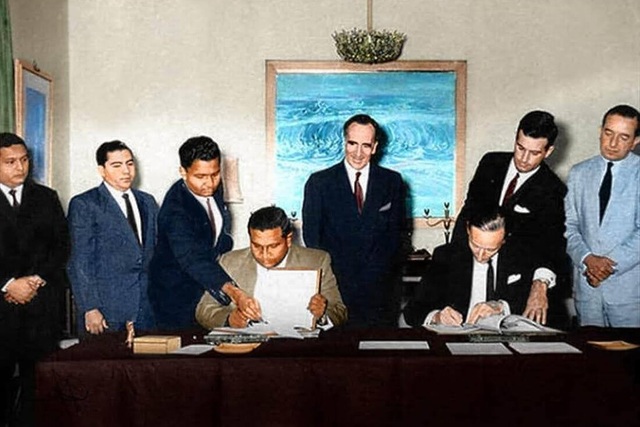
President Dissanayake’s forthcoming official visit to the Maldives comes at a time that demands not ceremony, but sober reflection and strategic recalibration. It holds particular significance as the Maldives prepares to mark the 60th anniversary of relinquishing its defence agreement with Britain on 26 July 1965—an event historically formalised not in Malé, but in Colombo. For decades, the relationship between Sri Lanka and the Maldives stood as a quiet yet profound example of how two small nations could uphold mutual dignity, foster deep economic interdependence, and maintain close cultural ties without the intrusive burden of hegemonic ambitions. Yet today, that relationship seems to be unraveling—complicated by bureaucratic obstacles, misaligned security classifications, and a decline in diplomatic sensitivity. The Maldives, once described as a natural extension of Sri Lanka’s own civilisational and economic ecosystem, now finds itself labelled a “country of security concern” (CSC)—a designation that is not only diplomatically ambiguous, but also operationally damaging. There is hope it will be revoked soon after review.
However, the implications of such a categorisation are far-reaching. In practice, the CSC label has resulted in an unduly rigid visa regime, prolonged vetting processes, and the imposition of protocols that, while arguably intended to safeguard national security, appear to disproportionately affect Maldivian nationals. These restrictions have had a chilling effect on the free movement of individuals who have long considered Sri Lanka a second home—whether for education, medical treatment, commerce, or retirement. Reports of Maldivians encountering cumbersome visa procedures are now commonplace. This evolving perception of Sri Lanka as an inhospitable destination is gradually displacing the Maldives’ traditional orientation towards Colombo, redirecting it to alternatives such as India and Malaysia.
Historically, the relationship between the Maldives and Sri Lanka has been underpinned not merely by diplomatic formality, but by centuries of socio-cultural and economic enmeshment. From the transmission of Buddhism in ancient times by emissaries from Anuradhapura to the socio-linguistic affinities reflected in shared islander identities, the historical record is replete with evidence of deep and enduring ties. Even after the Maldives’ conversion to Islam in 1153, it continued to engage with Sri Lanka as its principal point of civilisational contact, trade, and learning. In the mid-20th century, Colombo served as the locus of Maldivian economic life—Maldivian merchants owned property in areas such as Pettah and maintained active trade networks in copra and Maldives fish. For much of the Maldives’ early post-independence period, Sri Lanka remained its only viable trading and service partner.
Today, however, a significant economic asymmetry is emerging—one that, ironically, disadvantages Sri Lanka. According to official records, over 27,000 Sri Lankan nationals are employed in the Maldivian tourism and hospitality industry, a vital sector in which Sri Lankan labour and managerial expertise remain in high demand. Moreover, at least 16 resorts in the Maldives are owned or operated by Sri Lankan business interests, collectively contributing upwards of USD 500 million in economic returns. These interconnections not only facilitate employment and investment flows but also strengthen Sri Lanka’s balance of payments and its relevance in the regional economy.
In contrast, the flow of Maldivians into Sri Lanka—a trend once characterised by robust educational, medical, and retirement-related mobility—has significantly declined. Prior to the 2019 Easter Sunday attacks, an estimated 10,000 Maldivians resided in Sri Lanka. That number has now dropped to fewer than 1,500. Those who remain frequently report bureaucratic impediments that are misaligned with the long-standing trust and cooperation that previously defined bilateral mobility. These restrictions have strained interpersonal and familial relationships and curtailed the steady inflow of foreign income into the Sri Lankan economy. Estimates suggest that each Maldivian expatriate or long-term visitor contributed approximately USD 1,000 per month to local economic activity—capital now being redirected to other regional markets.
From a policy perspective, the classification of the Maldives as a CSC suffers from both conceptual ambiguity and procedural opacity. No publicly available evidence has been presented to justify this designation, and the absence of reciprocal treatment by Malé further underscores its asymmetrical character. Indeed, even during Sri Lanka’s most turbulent years—including the protracted conflict involving the LTTE—the Maldivian government continued to regard Sri Lankan nationals and institutions with neutrality, if not favour. Notably, following the LTTE’s 2001 attack on Bandaranaike International Airport, the Maldives was among the few countries that extended operational support to SriLankan Airlines by granting access to its aviation infrastructure—while others withheld such assistance.
The application of CSC status has also created a secondary and more insidious problem: the emergence of informal channels and actors who exploit the procedural complexity to their advantage. Private agents, some operating in regulatory grey zones, have reportedly capitalised on the lack of clarity by offering to “facilitate” visa approvals—effectively monetising a process that ought to be administered transparently and equitably. This introduces not only corruption into the immigration system but also delegitimises Sri Lanka’s formal institutions for migration management. By placing genuine applicants—especially those with medical or humanitarian needs—at the mercy of such intermediaries, the system risks undermining the very security objectives it purports to uphold.
The strategic importance of solidarity among small states cannot be overstated. The concept of “niche diplomacy,” as articulated by scholars such as Andrew F. Cooper, highlights how small states, through targeted collaboration and functional interdependence, can amplify their international agency and hedge against the structural disadvantages inherent to their size. Within this paradigm, bilateral relationships between similarly situated nations are not merely advantageous—they are essential. Sri Lanka and the Maldives, by virtue of geographical proximity, economic complementarity, and shared vulnerabilities, constitute natural allies within this strategic framework. Policies that disrupt such alignments risk weakening both sides.
In the context of the Indian Ocean—an increasingly contested geopolitical space—Sri Lanka and the Maldives stand to gain considerably from deepening their coordination in areas such as tourism, higher education, healthcare, fisheries, maritime security, and environmental stewardship. These are domains where both countries possess strategic stakes and comparative strengths. Diplomatic discord, particularly when triggered by unexamined security designations, threatens to squander these opportunities.
Given the historical intimacy, economic interdependence, and longstanding diplomatic goodwill that have characterised Malé-Colombo relations, there is an emerging consensus among informed observers that present-day frictions require urgent reassessment. Policy instruments must be responsive not only to abstract security imperatives but also to the lived realities of those directly affected. A recalibrated visa regime, enhanced administrative sensitivity to humanitarian contexts, and greater transparency in official communication would go a long way in restoring mutual confidence.
The trajectory of this bilateral relationship should not be dictated by residual hostilities or unexamined assumptions. Rather, it must be guided by a rigorous understanding of mutual benefit, shared historical consciousness, and a recognition of collective resilience. In a geopolitical climate where smaller states are disproportionately exposed to external pressures, it is strategically untenable to alienate historically aligned partners through over-securitised frameworks. For Sri Lanka, regional relevance is best preserved not by perceiving proximity as a risk, but by cultivating it as an enduring source of stability and opportunity.
Views expressed are personal