


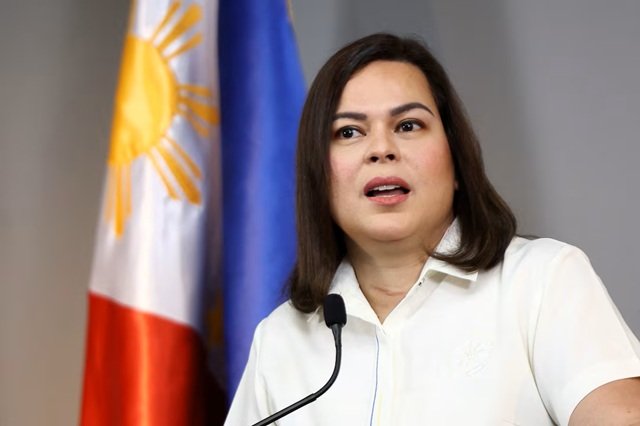
Philippine Vice President Sara Duterte faces a high-stakes impeachment trial in the Senate beginning Monday, a case that could reshape the country’s political landscape and determine whether she remains a leading contender to succeed President Ferdinand Marcos Jr. in 2028.
Duterte has denied allegations that she plotted to assassinate Marcos, misused public funds and accumulated unexplained wealth, arguing that the charges are politically motivated. She is seeking to have the case dismissed by the Supreme Court after it rejected an earlier impeachment effort last year on procedural grounds.
Authorities have increased security ahead of the proceedings, with more than 6,000 police personnel deployed at the Senate complex in Manila and the capital placed under full alert status, according to local media reports.
The trial is expected to deepen political tensions in the Philippines, where confidence among consumers and investors has been affected by corruption allegations involving large-scale graft. The case also places two of the country’s most influential political families at the centre of a major power struggle.
Sara Duterte is the daughter of former President Rodrigo Duterte, who is awaiting trial at the International Criminal Court in The Hague over alleged crimes against humanity. Ferdinand Marcos Jr. is the son of former dictator Ferdinand Marcos, whose removal in 1986 restored democracy in the Philippines.
Prosecutors require at least 16 votes in the 24-member Senate to convict Duterte. A conviction would remove her from office and permanently disqualify her from holding public office. While her allies believe they have enough support to secure an acquittal, analysts say evidence presented during the trial could influence some senators to change their positions.
Yuko Kasuya, a professor at Waseda University specialising in Philippine politics, said the possibility of conviction would depend on whether senators become convinced by the evidence against Duterte.
“If enough pro-Duterte senators come to see it as prudent to abandon the Duterte camp, persuaded by the gravity of her alleged wrongdoing, and if senators ultimately vote on the evidence, the pro-conviction side could reach 16,” Kasuya said.
The trial, which could continue for months, is being closely watched across the country of 113 million people. Analysts say its outcome could affect financial markets, with the peso already down 4% against the US dollar this year and Philippine stocks showing weaker performance compared with broader Asian markets.
An acquittal would allow Duterte to contest the 2028 presidential election, where she currently leads opinion polls. Marcos, who is constitutionally limited to a single six-year term, would then face the possibility of power passing to a political rival who has strongly criticised his administration.
The outcome could also have implications for Philippine foreign policy. Marcos has strengthened ties with the United States, particularly amid rising tensions with China in the South China Sea. By contrast, Rodrigo Duterte pursued closer relations with Beijing during his presidency, and Sara Duterte has accused Marcos of lacking a truly independent foreign policy.
The Senate vote remains uncertain despite claims from Duterte allies that she has enough support to survive. Senator Imee Marcos, the president’s sister but a political opponent of her brother, said there were insufficient votes for conviction, calling the proceedings a “futile exercise.” Senator Rodante Marcoleta, another Duterte ally, also expressed confidence that prosecutors would not succeed.
However, Duterte’s support base in the Senate has weakened. One ally was arrested on corruption charges, another went into hiding, and two others moved away from the Duterte-aligned bloc. Although nine senators remain technically capable of blocking conviction, the final outcome remains uncertain.
Senator Erwin Tulfo said lawmakers serving as jurors must decide the case based solely on evidence presented during the trial. Senator Risa Hontiveros, who is not aligned with either Marcos or Duterte, warned against predicting the outcome.
Hontiveros also raised legal questions over how the required two-thirds majority would be calculated if some senators are absent during the proceedings.
Political tensions increased further after an anti-graft court ordered the arrest of Senator Marcoleta on plunder allegations. Marcoleta has denied the charges, describing them as politically motivated attempts to prevent him from participating in the trial.
Prosecutors are seeking access to Duterte’s tax records and plan to call bank representatives and government officials as witnesses. Among those listed is a court sheriff who alleged that Duterte, while serving as mayor of Davao City, assaulted him in 2011.
Duterte’s lawyer Michael Poa said the defence remains confident and argued that both sides should be allowed to present evidence and challenge testimony through legal procedures.
Political analysts say a lengthy trial exposing evidence of wrongdoing could damage Duterte’s political future, while an acquittal could strengthen her support base ahead of the 2028 election.
The vice president also faces separate graft and plunder complaints before the Office of the Ombudsman over alleged misuse of public funds.
President Marcos has said Duterte should directly address the accusations against her rather than relying only on lawyers. However, his sister Imee Marcos has accused his administration of having a strong interest in removing the vice president.
The impeachment proceedings come as the Philippines faces economic challenges despite recently being classified by the World Bank as an upper-middle-income country. Slower growth expectations, a public works corruption scandal and inflation pressures linked to the US-Iran war have added to uncertainty.
Investors are watching the trial closely, given the Philippines’ history of political instability. In 2001, President Joseph Estrada was forced to leave office after his impeachment trial collapsed amid mass protests.
Senator Hontiveros said she hoped the proceedings would follow constitutional procedures but acknowledged the uncertainty surrounding the outcome. “Who knows, all bets could be off,” she said.









