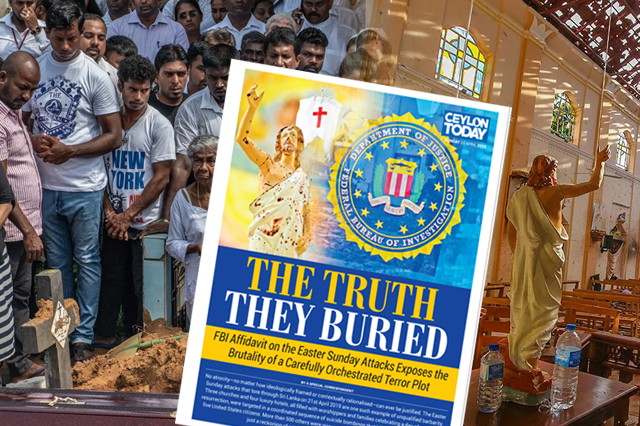
The following article was originally printed in a supplement published by Ceylon Today, a Colombo-based daily newspaper.
by A Special Correspondent
No atrocity—no matter how ideologically framed or contextually rationalised—can ever be justified. The Easter Sunday attacks that tore through Sri Lanka on 21st April 2019 are one such example of unqualified barbarity. Three churches and four luxury hotels, all filled with worshippers and families celebrating a day of peace and resurrection, were targeted in a coordinated sequence of suicide bombings that killed 268 people, among them five United States citizens. More than 500 others were grievously wounded. What followed, however, was not just a reckoning of grief, but a chilling unraveling of fact and fiction.
Since the day of the attacks, the public discourse—particularly within Sri Lanka—has been plagued by a fog of conspiratorial obfuscation. Theories implicating foreign intelligence agencies, rival political parties, and even state complicity gained rapid traction. But as Sri Lankan society spun itself in cycles of suspicion, the real architecture of the massacre was already under the scrutiny of the United States Federal Bureau of Investigation.
We are publishing in full the FBI’s 72-page sworn affidavit, filed in the U.S. District Court, Central District of California, on 11 December 2020, as it constitutes the most comprehensive forensic account of the planning, execution, and ideological foundations of the 2019 attacks. In doing so, we hope to restore public focus to truth, which has too often been masked or politicised in pursuit of ulterior motives.
What the affidavit reveals is a narrative that is unambiguously clear and factually devastating. It obliterates conjecture by documenting the acts of a formally affiliated ISIS cell operating in Sri Lanka, led by extremist cleric Mohamed Cassim Mohamed Zahran, also known as Zahran Hashim. As the affidavit states unequivocally, “the attackers and their co-conspirators were members and supporters of ISIS and created a group, ‘ISIS in Sri Lanka,’ that ISIS formally recognised as an ISIS affiliate”.
The report traces the evolution of this network and its ideological formation. Zahran, the mastermind, “claimed to have communicated directly with ISIS leadership in Syria and obtained approval to operate as an ISIS affiliate.” This is not an incidental boast, but a critical act of allegiance. The attackers had pledged “bayat” (a formal oath of allegiance) to Abu Bakr al-Baghdadi, ISIS’s now-deceased leader. A photograph released by ISIS’s media outlet, Amaq, shortly after the attack, confirmed this: “Zahran is visible unmasked in the centre of the group standing in front of the ISIS flag. Four of the attackers are brandishing knives”.
The attacks were not the outcome of last-minute radicalisation. They were the fruition of methodical preparation and ideological indoctrination. According to the FBI, this group—operating under Zahran’s leadership and with a hierarchy that included Mohamed Naufar as “second emir”—carried out multiple training programmes, both ideological and paramilitary. “These multi-day courses were held in rented homes,” the affidavit reports, “and included instruction on ISIS ideology, firearms and explosives training”.
The syllabus? ISIS-authored. The materials? Extracted from hard drives recovered by Sri Lankan law enforcement. One drive alone, seized from the suicide bomber Ilham Ibrahim, contained over one terabyte of ISIS training media, including Dabiq and Rumiyah, ISIS’s signature propaganda magazines. Among the literature was The Book of Jihad, advocating for “urban mujahid” combat preparedness, such as the “use of explosives against populated areas in nations that are at war with Muslims”. Elsewhere, the hard drive hosted manuals on “concealing online presence, making homemade destructive devices,” and “improvised weapons, explosives, grenades, and mines.”
The narrative of victimhood and retaliation that ISIS cultivates was seamlessly integrated into the Sri Lankan cell’s motives. As the affidavit records from Naufar’s interviews, Zahran allegedly told his associates that the church attacks were revenge for “an American-led airstrike in March 2019 on ISIS fighters in Syria that purportedly killed 3,000 people using white phosphorus.” Furthermore, an issue of Rumiyah encouraged followers to “target Christian churches” just weeks before the attack. One article, in fact, shows an image of an American church, ominously captioned: “a popular crusader gathering place waiting to be burned down”.
It is easy to understand how such incitement travels rapidly across geographies. Zahran, Naufar, and co-conspirator Mohamed Riskan used end-to-end encrypted apps like Telegram and Threema to maintain communications with ISIS-linked individuals in Syria. According to FBI technical experts, “Zahran distributed mobile phones to ISIS in Sri Lanka members… and used encrypted messaging applications… to avoid detection.” FBI forensics showed that Facebook accounts associated with the suspects exchanged hundreds of messages glorifying ISIS. On 28 April 2016, a Facebook user asked Naufar directly: “Do you accept ISIS’ caliph?” To which he replied in Tamil: “The answer to your question is yes”.
While some suspects attempted, post-factum, to claim a schism with Zahran prior to the attacks, the FBI remains unequivocal in its interpretation: “Despite some members’ claims that a division among members arose days before the attack… the defendants and their co-conspirators remained committed to ISIS ideology and to conducting attacks on ISIS’ behalf”.
The operational sophistication of the attacks is perhaps the strongest rebuke to those who still cling to conspiracy. This was no spontaneous combustion of fanaticism—it was an engineered act of mass murder. The attackers used nitrate-based IEDs. The FBI’s Terrorist Explosive Device Analytical Center confirmed that “the presence of nitrite ions is consistent with the detonation of nitrate-based explosives… such ions do not naturally occur in the environment”. The IEDs contained aluminium powder, water gel (ammonium nitrate), and in some cases urea nitrate—compounds requiring both chemical knowledge and deliberate acquisition. M.M.M.H., a detained co-conspirator, confessed to providing “approximately 1,900 detonators and 1,300 water gel explosives” to Zahran.
One cannot ignore the calculated choice of targets. All four luxury hotels attacked—Shangri-La, Cinnamon Grand, Taj, and Kingsbury—were frequented by international travellers. “Zahran selected the Shangri-La hotel because the hotel’s headquarters was in China,” Naufar revealed, adding that “ISIS had instructed its followers to attack Chinese interests”. Churches were chosen not only for their religious symbolism, but because Easter Sunday guaranteed maximum attendance. This was designed slaughter—timed, targeted, and terroristic.
Perhaps the most haunting episode in the affidavit concerns Zahran’s wife, Fatima Mohamed Jifry, who, when cornered by Sri Lankan special forces later that day, detonated a device in her own home—killing herself, her three sons, and three Sri Lankan officers. She was pregnant.
Click here to download and read the full text of the Supplement
And yet, even in the face of such painstaking detail, sections of the Sri Lankan public and political class have continued to argue that the “real story” remains hidden. What this affidavit confirms—without a trace of ambiguity—is that the Easter Sunday attacks were an ISIS-led operation executed by ideologically aligned local actors. To pretend otherwise is not only a distortion of reality, but an obstruction of justice. Conspiracies do not simply misinform—they actively hinder the pursuit of accountability by diverting attention from the perpetrators to phantoms.
The FBI affidavit is not an op-ed. It is a legal instrument grounded in surveillance data, forensic testing, eyewitness testimony, and direct confession. Every detail—every switch, detonator, phone, and travel itinerary—is corroborated. To ignore this document is not an act of scepticism; it is an act of bad faith.
In publishing this affidavit, we seek not only to inform but to challenge: let this be a line in the sand between speculation and evidence, between truth and invention. Let us respect the memory of the victims not by surrendering to fiction, but by confronting the facts—however disquieting they may be.
Let the record speak, for the dead can no longer do so.
Courtesy: Ceylon Today, Colombo