Hannah Arendt raises the question of solidarity against the backdrop of a broken world. In the wake of totalitarianism, she insists, the Western tradition itself is irretrievably broken. That tradition began, as she frames it, when the Romans “adopted classical Greek thought and culture as their own spiritual tradition.” The Greeks were the artists who brought forth the great ideas and works of Western culture; they wrestled truth from wonder, chiseled beauty from nature, and birthed democracy from tyranny. The Romans cultivated that inheritance, built upon it, and preserved it for two thousand years. Today, in the wake of the fact of totalitarianism, the pillars are shattered. “The break in our tradition,” Arendt writes, “is now an accomplished fact.”
Modern philosophy, as Arendt understood it, is a long rebellion against the loss of this tradition. With the death of God, the collapse of inherited authority, and the dawning realization that anything is possible — that human beings can make, remake, and unmake worlds — politics has become terrifying, and we recoil from it. In doing so, however, we risk losing what makes life meaningful. For Arendt, this refusal of action is born from what she calls “the ominous silence that still answers us whenever we dare to ask, not ‘What are we fighting against,’ but ‘What are we fighting for?’”
That silence has only deepened in our own moment. It is the silence at the center of our political life, and it is the silence that this year’s Arendt Forum is convened to break.
Last year, at the close of my speech at the Arendt Center’s 2025 Arendt Forum, “Joy: Loving the World in Dark Times,” I found myself drawn — almost against my own intentions — toward the question of solidarity. Joy, fully thought through, refuses to remain a private feeling. To love the world enough to find joy in it, in spite of everything, is already to commit oneself to other people, to a common world, and to the political labor of holding that world together. Joy, in Arendt’s sense, is not an escape. It is solidarity in another key. And so the question that closed last year’s festival became the question that will open the next: What are we fighting for?
Politics in the twentieth and twenty-first centuries is dangerous in ways earlier ages could not imagine: massive advances in weaponry and AI, together with the threat of environmental destruction, mean that conflict can lead to genocide and even to the end of humanity. It is out of this “fear that humanity could destroy itself through politics” that Hannah Arendt writes that liberal democracy embraces a prejudice against politics. What Arendt calls our prejudice against politics turns us against the free, albeit chaotic, activity of living together; it impels us to prefer a safer and more orderly life governed by authority and experts.
Our liberal prejudice against politics also arises from the hope that humanity will rid itself of politics through the inauguration of a world government. Against the disorder of politics, we have hope that an “administrative machine” could resolve “political conflicts bureaucratically,” and could replace “armies with police forces.” Such a hope is, Arendt argues, rather more dystopian than utopian. “Bureaucratic rule, the anonymous rule of the bureaucrat, is no less despotic because ‘nobody’ exercises it. On the contrary, it is more fearsome still, because no one can speak with or petition this ‘nobody’.” If we understand politics as freedom, the ideal of a world bureaucracy would eviscerate politics and action through tyranny and totalitarianism.
Traumatized by fascism, totalitarianism, and the destruction wrought by ideological politics, postwar liberal democracy reconfigured the Platonic aspiration to replace politics with truth into a distinctly modern form. It elevated constitutionalism, rights, markets, bureaucratic competence, and institutional stability above mass mobilization and existential contestation. If mass politics had produced catastrophe, then liberal democrats sought to tame politics through liberal constraints.
Arendt saw this coming, with eerie prescience, in her late essays of the 1960s and 1970s. The greatest threat to freedom, she wrote, comes not from open tyranny but from a class of liberal intellectuals who enter politics as bureaucrats and technocrats. The danger is not that they are evil but that they calculate where they ought to think. Confident in their capacity to predict and control human affairs, technocrats put common sense to sleep and dress every act of governmental coercion in the language of rational necessity. There is no reason to assume, Arendt insists, “that those whose claim to power is based on knowledge and technique will be more benign in their exercise of power than those whose claim is based on wealth or aristocratic origin.” When school boards are replaced by professional managers, when municipal decisions are outsourced to consultants, when political parties surrender deliberation to pollsters, citizens become spectators of the government rather than its authors. Resentment grows. And so, increasingly, does violence.
This is where the silence comes from. A politics organized around competence and management can provide many things, but it cannot answer the human need for purpose. We are creatures who seek significance, who want our lives to matter, who often find meaning in struggle and even in pain. To live fully, we sometimes flirt with death — not in the pursuit of destruction but in the pursuit of freedom, dignity, and honor. The agonal virtues — courage, sacrifice, the striving for excellence — are not relics. They are the soil in which any serious politics grows. To pretend otherwise is to abandon the field to those who answer the question of purpose with cruder, more dangerous answers.
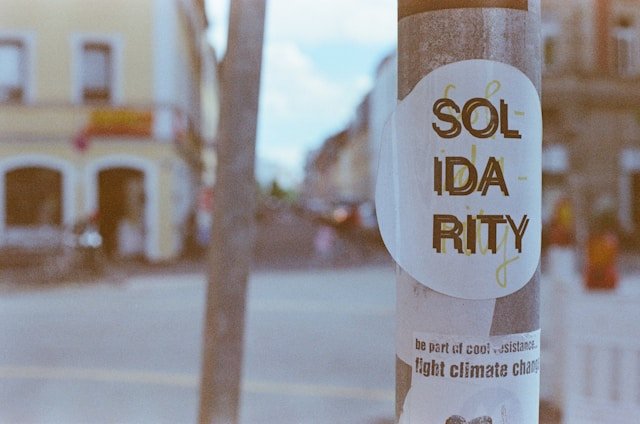
What, then, can we say we are fighting for? Arendt’s answer is solidarity. But the word, as she uses it, is not what we usually mean by it. Solidarity is not a feeling of togetherness, and it is emphatically not pity. “Pity,” she writes, “may be the perversion of compassion.” It pulls us toward the weak and the poor out of condescension or guilt; it isolates the one who pities from the one pitied; it narrows the circle of moral concern to the miserable. Solidarity is something else entirely. It partakes of reason and judgment rather than emotion. It binds the strong and the rich no less than the weak and the poor. It labors, dispassionately, to weave what Arendt calls a community of interest across difference. Its foundation is not guilt or empathy alone but what she names “the honor of the human race.” Pity isolates; solidarity binds. Pity is sentimental; solidarity is political. Pity narrows compassion to the suffering; solidarity honors the human being as such.
This is why solidarity, for Arendt, is the political form of her love for the world. It is what allows a plurality of people — people who have wronged one another, failed one another, and disagreed with one another about almost everything — to live together in a common world at all.
Arendt develops her thinking about solidarity alongside her idea of reconciliation. Reconciliation is not forgiveness. It is not a moral act, but a political judgment. To reconcile is to accept the wrong and the wrongdoer in the world and to make a judgment that in spite of their wrong, the world is better with them in it. Reconciliation does not excuse the wrong, but says yes to the world inclusive of the wrong and also the wrongdoer. It says, in spite of the wrong, we can all share the world together.
The precondition for reconciliation is that the wrongdoer admit their wrong. And then the wronged person judges that they can then live together with the wrongdoer. Reconciliation is based on a mutual release. And when that happens, it opens a path to solidarity.
If reconciliation is what allows us to live with imperfect friends, solidarity is what allows a plural polity to live together at all. It is the political work of repairing the fabric of the polis where wrongs and divisions have torn it. Arendt’s most arresting illustration of this is her argument about Adolf Eichmann. We hang Eichmann, she insists, not because of who he is but because doing so is an act of solidarity with the world we still wish to share. Even our gravest judgments are, at their best, acts of binding rather than of expulsion.
From this understanding follows what I have come to think of as solidarity’s double courage. To say no to a world broken beyond repair is an act of solidarity with a future world. But to say yes — the joyful affirmation of life within brokenness — is also a political act, and an act of solidarity with the world we already share. Refusal and affirmation are not opposites but two sides of the same courage: the courage to share the world with others as it truly is. From that double courage solidarity arises. Born of joy, solidarity holds together refusal and affirmation to open the possibility of a truly human world, a world we share founded upon friendship and respect.
Which brings us back to the question we have learned, quietly, to avoid.
What are we fighting for?
It is a question we have for the most part stopped asking. The 2026 Arendt Forum does not pretend to answer this question. What it can do is gather people, in public, to ask the question out loud — and to treat the asking as itself the work. Solidarity does not begin in agreement. It begins in the willingness to stand with others in a question whose answer we do not control, on the conviction that the world is still worth the trouble of sharing.
Solidarity, if it means anything, begins there: not in agreement, but in the willingness to stand with others in asking a question whose answer we do not control.