by A special Correspondent in Colombo
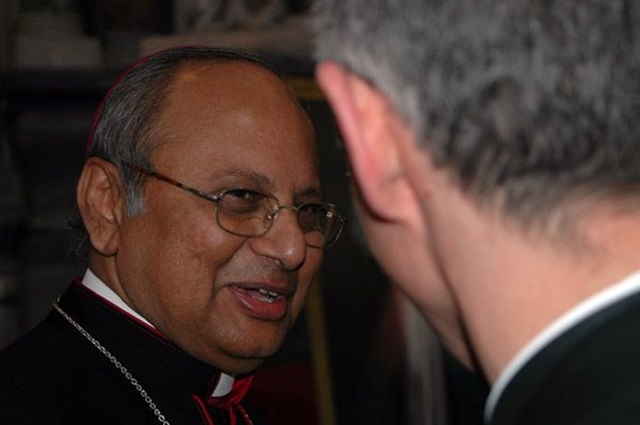
As Sri Lanka approaches the sixth anniversary of the devastating Easter Sunday bombings, Cardinal Malcolm Ranjith has once again brought the issue of justice to the forefront, summoning government officials to his residence and sending a pointed message to the country’s leadership. The Archbishop’s actions last week have raised concerns among local political observers, with many viewing his public interventions as an attempt to politically mobilize the issue of the bombings in a way that may serve his broader agenda.
On Sunday, Cardinal Ranjith, speaking from the Archbishop’s residence in Colombo, issued a strong statement to the government, warning that if no significant progress is made in bringing the masterminds of the Easter attacks to justice before the April 21st anniversary, the Church would take further action. His remarks were not made in isolation but followed a series of discussions with Catholic leaders and other representatives to determine the Church’s next steps.
According to local media reports in Colombo, less than 24 hours after his public warning, a highly unusual development occurred — seven senior government officials, some from security-related sectors, were seen entering the Archbishop’s residence for a private meeting with the Cardinal. The delegation, which reportedly included high-ranking officials from various sectors of national security, was said to be deeply disturbed by the Cardinal’s pointed remarks.
The meeting was described as tense, lasting several hours, during which the Cardinal reportedly expressed his frustration over the lack of concrete results from the government’s ongoing investigations into the bombings. The government officials who were summoned to the Archbishop’s residence are understood to have provided an update on the current status of the investigations, though the details of the discussions remain unclear. It is believed that the officials sought to reassure the Cardinal that progress was being made, but the Cardinal’s subsequent public statements suggest he was not fully convinced by the explanations offered.
The arrival of these seven officials at the Archbishop’s residence was seen by many as an attempt to placate the Cardinal, whose statements have drawn sharp attention from both the government and the public. Local media outlets reported that the meeting had a charged atmosphere, with both sides seeking to understand each other’s position on the handling of the Easter attacks’ investigation.
Politicization of the Tragedy
While the Cardinal’s intervention may have been framed as a call for justice, many political analysts are pointing to the growing trend of Cardinal Ranjith’s actions becoming increasingly politicized. Over the years, he has emerged as one of the most vocal critics of the country’s political leadership, particularly in relation to the handling of the Easter bombings. Cardinal Ranjith’s comments have not only raised questions about the progress of the investigations but have also highlighted the ongoing power struggle between the country’s political elite.
The fact that Cardinal Ranjith has made such direct appeals to the government ahead of a highly significant anniversary, coupled with the summoning of top officials to his residence, has led to speculation that the Archbishop’s involvement in this issue may be a strategy to mobilize political pressure on the current administration. In particular, local media have noted how the Cardinal’s outspoken stance on the Easter attacks aligns with the opposition’s critiques of the current government’s perceived failure to take decisive action.
Potential March and Political Implications
According to local reports, discussions have also revolved around organizing a significant march to commemorate the anniversary of the Easter attacks. In past years, such marches were common, but this time, there is speculation that the Church may be planning something on a larger scale, using the anniversary not only as a moment to remember the victims but also as a platform to make a political statement about the state of the country’s justice system.
While the exact nature of the Cardinal’s plans remains unclear, some reports indicate that the Church is preparing for a more pronounced political intervention, with the possibility of organizing a protest march aimed at both memorializing the victims and pressuring the government to act decisively.
Cardinal Ranjith’s involvement in this issue, particularly his summoning of government officials, has thus become more than just a religious response; it is increasingly viewed through a political lens. His actions suggest that he is positioning himself as a key figure not only in advocating for justice for the Easter attacks but also in influencing national politics, especially as the country nears another critical election cycle.
Local Media Reactions
This series of events — the public statement, the summoning of high-ranking officials, and the growing signs of a politicized approach to the Easter Sunday bombings — has sparked debates across the political spectrum. While some view the Cardinal’s actions as a necessary push for accountability, others are critical of what they see as an attempt to politicize a national tragedy for personal or political gain. The Archbishop’s growing prominence in the political arena has stirred controversy, with many questioning whether his calls for justice are being used to further a political agenda, potentially influencing the outcome of future elections.