


When Mahinda was at his peak, having won the 2010 presidential and general elections, an astrologer made a prediction: Mahinda would one day meet his end at the hands of a woman. Mahinda was not perturbed by this prediction.
But at an unexpected moment, then Chief Justice Shirani Bandaranaike’s ruling against Basil’s ‘Divineguma’ project enraged the Rajapaksa family. They decided to remove Shirani from the post of Chief Justice. Shirani, however, did not succumb to the threats of the Rajapaksa dynasty.
Sri Lankan lawyers came forward to support her. The opposition, which had been secretly opposing the Rajapaksa dynasty, also mobilised. They rallied around Shirani. She became a heroic figure, standing against the Rajapaksa dynasty. The impeachment against Shirani gained international attention, and the Rajapaksas were brought under pressure.
Amid the impeachment of Shirani, the then US Ambassador to Sri Lanka, Michele J. Sison; Samantha Power, an advisor to the then US President Obama; and Navaneethan Pillay, Commissioner of the United Nations Human Rights Commission, jointly passed a resolution against Mahinda’s government at the Human Rights Commission. When the US and European countries passed the resolution by majority vote, Mahinda’s government was forced onto all fours.
Shirani, Michele J. Sison, Samantha Power, Navaneethan Pillay—these were all women. While these women were mounting attacks on the Mahinda and Rajapaksa empire, another woman was working behind the scenes to unite the opposition and present a common candidate to overthrow Mahinda’s government in the 2015 presidential election. She was Chandrika. She orchestrated the removal of a group of powerful ministers from Mahinda’s government by supporting Maithripala as the common candidate. That was the final multi-pronged assault on the Rajapaksa empire, which ultimately fell.
However, a woman did not become president or prime minister. Although Chandrika aimed to rule the country in the manner of Sonia Gandhi in India by installing Maithripala as president, Maithripala sidelined Chandrika. In the end, Maithripala’s influence waned.
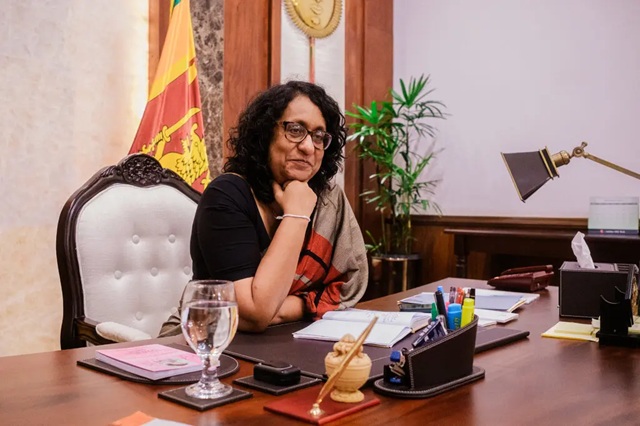
Astrologers began predicting that a woman would rise to power again as the 2024 presidential election approached. Everyone was eager to know who this woman might be. Secretly, a woman was emerging through struggle: JVP National List MP Harini Amarasuriya.
Harini was born in Galle. She came from a family connected to the Minister of Trade, H.W. Amarasuriya, who hailed from a ‘Walau’ background and was a political figure under the D.S. Senanayake government. In this context, she is linked to the UNP family lineage. When Mrs Bandaranaike became Prime Minister in 1970, the Land Acquisition Bill led to the government taking over her father’s estate, forcing Harini’s family to move to Colombo.
She studied at Bishop’s College, and during her time there received a scholarship from the United States to study at an American school under a student exchange programme. Later, she earned a scholarship from India to pursue a degree, establishing early connections with both the US and India.
Subsequently, she worked for an American-funded non-governmental organisation in Sri Lanka. While employed there, she pursued a doctorate at the University of Edinburgh. After completing her degree, she joined the Open University as a lecturer.
Harini played a major role in forming the Federation of University Teachers’ Unions (FUTA) through the Open University. FUTA mobilised against the government, demanding higher salaries for university lecturers and an 8% allocation for education. Harini was a pioneer in these efforts. During this period, she began working closely with university lecturers affiliated with the JVP. The JVP recognised her potential, although Harini did not wish to formally join the party. To attract professionals like her, the JVP established the National People’s Force.
The JVP overestimated its prospects for the 2020 general election, hoping to win 13 seats. Contesting as the National People’s Force, Bimal Ratnayake was first on the JVP national list, Professor Abeyratne second, and Dr Harini Amarasuriya third.
The election results shattered the JVP’s ambitions. Only three members were elected, including a national list seat. Harini, though little-known nationally, was chosen for the national list over Bimal and Professor Abeyratne, in recognition of her efforts to build the National People’s Force. Her parliamentary role, however, was not prominent; she mainly delivered lectures. Some JVP supporters questioned the benefit of placing her on the national list.
It is often said that women’s contributions are undervalued. Following her parliamentary work, Harini participated in a foreign media conference with international figures from the Samagi Jana Balawegaya, including Harsha. This took place when Ranil became president and the JVP was emerging as a force against him. The rise of the JVP did not begin with the struggle against Gota, but against Ranil. Harini’s media presence resonated with the upper middle class and professionals, and she subsequently launched a nationwide campaign to unite women in the Jathika Jana Balawegaya, titled ‘We are Women Together’.
“Harini is an asset to us, just like Anura…” Bimal Ratnayake recently remarked, acknowledging her influence. Rumours had suggested that Bimal sought to secure the Prime Minister’s post over Harini. He lost his National List seat in 2020, and the Prime Minister’s post in 2024. Ministers in the current cabinet have begun issuing statements against Harini’s recent comments on Rohitha Rajapaksa’s satellite.
Between 2010 and 2015, Basil Rajapaksa led government ministers in attacking statements made by party secretary Maithripala in a similar fashion, which ultimately undermined Mahinda’s position.
Will Harini tolerate such attacks? It is too early to say. However, Harini represents a joint Indo-American influence. It is inconceivable that the JVP would risk alienating her by undermining her position.










