


During the Cold War between the United States and the Soviet Union, J.R.’s government sought to take advantage of the situation. J.R.’s government sided with the United States, while India aligned with the Soviet Union. This alignment contributed to the deterioration of relations between Sri Lanka and India.
The conflict in the North was a consequence of this alignment. Ultimately, J.R. yielded to Indian influence and agreed to sign the Indo-Sri Lanka Agreement. Prior to this, he had requested assistance from the United States—the side he had supported during the Cold War—out of fear of an Indian invasion. However, the United States refused to intervene on Sri Lanka’s behalf.
Subsequently, the Rajiv Gandhi government, which came to power following the assassination of Indira Gandhi, sought to renew relations with the United States. The United States did not wish for Sri Lanka to become an obstacle in this regard. After signing the Indo-Sri Lanka Agreement, J.R.’s government requested to purchase helicopter spare parts from the United States. The Americans informed J.R.’s government that India’s approval was required to sell the parts to Sri Lanka.
J.R. was disappointed by this response. The US stance was that, having signed the Indo-Sri Lanka Agreement, J.R.’s government needed India’s consent. Thus, J.R., who had attempted to capitalise on the Cold War rivalry between the United States and the Soviet Union, found himself in an unfortunate predicament.
When Mahinda came to power in 2005, he opened Sri Lanka to Chinese projects and sought to exploit tensions between China, the United States, and particularly India. Subsequent leaders—including Maithripala, Gotabaya, Ranil, and the current President Anura—attempted to strengthen Sri Lanka’s bargaining position by leveraging conflicts between India and the United States with respect to China.
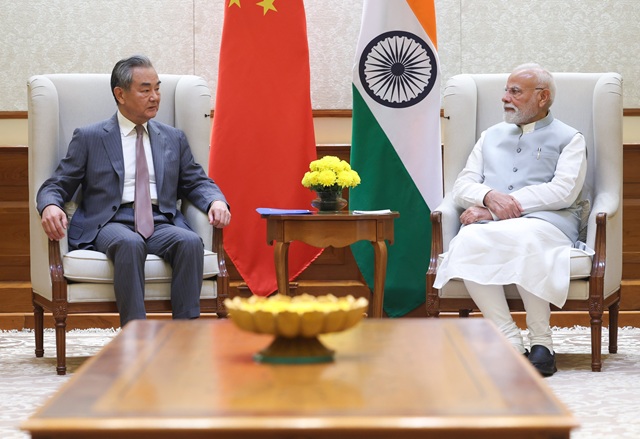
Of these leaders, Ranil managed the situation most skillfully, to Sri Lanka’s advantage, compared with Mahinda, Maithripala, Gotabaya, and Anura. Following the imposition of tariffs on India by the Trump administration, India and China have been working to move past old disputes and establish new relations. The Chinese Foreign Minister is currently in India, and the Indian Prime Minister is scheduled to visit China.
Supporters of Anura’s government believe that closer cooperation between these two countries will allow Chinese projects in Sri Lanka to proceed unhindered. However, if India and China align, Sri Lanka’s bargaining power could be significantly diminished. Should both countries agree to collaborate and China refrain from challenging Indian dominance in South Asia, Sri Lanka risks losing its geopolitical leverage.










