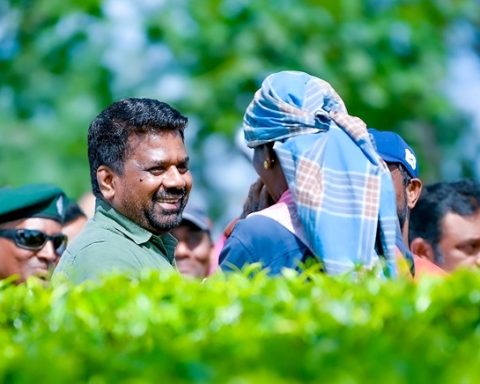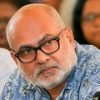

Anura Kumara Dissanayake received the JVP leadership on 02 February, 2014, at the 7th national convention of the party held at the Sugathadasa Indoor Stadium. He was 46 years old at that time. Dissanayake succeeded Somawansa Amarasinghe, who led the party, following Rohana Wijeweera’s cold blooded execution, while in custody, by the Premadasa regime. The JVP also adopted its new constitution with amendments at the 7th national convention. At the time of the change of the JVP leadership, the party had been a constituent of the Democratic National Alliance (DNA). The change of leadership took place over two years before Amarasinghe’s death, at the age of 73.
The DNA was formed under retired General Sarath Fonseka’s leadership to contest the 2010 parliamentary election. Except the JVP, all other constituents had no following. Dissanayake was a National List MP of the DNA. The seven-member DNA parliamentary group included Fonseka, Arjuna Ranatunga and businessman Tiran Alles (National List).
Before the JVP became a constituent of the National People’s Power (NPP) the party had been in coalitions with the PA/SLFP and the UNP since 2001. The NPP adopted its constitution on 20 December, 2021, at its Delegates Conference held at Monarch Imperial, Sri Jayewardenepura, where JVP leader Dissanayake was elected as its leader.
There hasn’t been a previous instance of one person heading two recognised political parties. With the JVP-led NPP government marking its first year in office this month, let me discuss the alliances the JVP had been involved in, since 2001. The JVP reached an agreement with President Chandrika Bandaranaike Kumaratunga’s People’s Alliance (PA) in early September, 2001, in the wake of over a dozen PA lawmakers switching allegiance to the UNP. The JVP-PA/SLFP agreement was meant to help Kumaratunga to stabilise the government and to thwart a UNP-led move to impeach Kumaratunga over abuse of power, violation of constitution and financial irregularities. The UNP had been fully confident of securing the JVP’s support after copies of an impeachment motion, drafted by a four-member team, led by the late K. N. Choksy, PC, was made available to chosen political parties, including the JVP represented in Parliament at that time.
At the time of the JVP-PA/SLFP agreement of September 2001, the former had 10 members in Parliament. The JVP parliamentary group leader at that time had been Wimal Weerawansa, who, along with General Secretary of the party Tilvin Silva, spearheaded talks with the PA. Anura Kumara Dissanayake, too, had been in that parliamentary group.
Somawansa Amarasinghe, who fled the country, in the nick of time, to escape certain elimination at the hands of UNP death squads, involved in a fight to a finish with equally brutal JVP, in the late ’80s, returned in late November, 2001, ahead of the December 2001 parliamentary elections. At the first public meeting the JVP leader addressed, in Kalutara, he thanked India for saving his life. The UNP-led United National Front (UNF) won the parliamentary election, though it couldn’t muster a simple majority. The JVP increased the strength of its parliamentary group, from 10 to 16, including three NL slots.
The UNF’s victory created an unprecedented political environment. With the executive power under one political party, in this case the SLFP and the UNP in command of the legislature, fighting erupted. The political crisis caused uncontrollable turmoil with the SLFP and the UNP pulling in different directions, and with the JVP taking advantage of the situation to push for dissolution of Parliament.
Another CBK-JVP alliance
While the 2001 JVP-PA/SLFP deal had been primarily influenced by President Kumaratunga’s bid to stabilise her government and also to thwart the now forgotten UNP bid to impeach her with the help of a group of MPs who had betrayed her, the Ceasefire Agreement (CFA), signed by Wickremesinghe with Velupillai Prabhakaran of the LTTE in late February 2002, created an environment conducive for the 2004 JVP-PA/SLFP agreement.
The LTTE contributed to Wickremesinghe’s misery and ultimate downfall of his government by repeatedly violating the CFA that had been arranged by Norway, with the backing of the US, Japan and the EU. Finally, the LTTE quit the negotiating table, in late April 2003, alleging the delay in doing away with the Jaffna High Security Zones. A couple of weeks before the LTTE suspended its participation in the Oslo-led negotiating process, the JVP-PA/SLFP entered into a dialogue for the formation of a broader alliance against Wickremesinghe.
President Kumaratunga hadn’t been supportive of the initiative, spearheaded by the late Anura Bandaranaike and the late Mangala Samaraweera, who relentlessly pushed the party to reach an early consensus on a common strategy with the JVP. Once former President Maithripala Sirisena told this writer that President Kumaratunga hadn’t been interested at all in toppling Wickremesinghe, though they didn’t see eye to eye on many issues. Sirisena said so during the time he served as the General Secretary of the SLFP when asked about the negotiations with the JVP. Anura Kumara Dissanayake had been among the JVP delegation that included Tilvin Silva, Wimal Weerawansa and Lal Kantha. The PA/SLFP delegation consisted of Maithripala Sirisena, Mangala Samaraweera, Nimal Siripala de Silva, Susil Premjayantha and Dr. Sarath Amunugama.
Following 11 months of tough negotiations, the JVP and PA/SLFP entered into an agreement in January 2004. However, they hadn’t been able to reach a consensus on the national question. They refrained from dealing with contentious issues but advanced a strategy that was aimed at toppling Wickremesinghe’s government. Consequent to the JVP-PA/SLFP agreement, they decided to name the new coalition Eksath Janatha Nidahas Sandhanaya (United People’s Freedom Alliance (UPFA).
Regardless of forming the UPFA, President Kumaratunga hadn’t been in a hurry to regain control of Parliament. The President believed Wickremesinghe should be allowed to continue till January 2005 before calling for fresh parliamentary election. But, Anura Bandaranaike and Mangala Samaraweerea, who had worked so hard for the formation of UPFA, along with the JVP, brought President Kumaratunga under pressure. In the end, President Kumaratunga succumbed to their pressure. She brought the Defence, Interior and Media Ministries under her, using presidential powers, and dissolved Parliament in February 2004 to pave the way for a general election in April 2004.
In line with the understanding between the two parties, the JVP decided to contest the 2004 April parliamentary election on the UPFA ticket with the ‘Betel Leaf’ as its symbol. The JVP fielded 39 contestants, whereas the party was to receive five NL slots, regardless of the outcome of the parliamentary election result. The JVP campaigned furiously with the aim of securing as many parliamentary seats as possible. But, the Marxist party never expected 36 out of its 39 contestants to enter Parliament. The result was beyond all their expectations. In fact, the JVP’s accomplishment sort of stunned the SLFP. The UPFA obtained 105 seats, including 13 NL seats. The top SLFP leadership felt uncomfortable and to make matters far worse the SLFP had to accommodate five JVPers in their NL. Of the 13 NL slots that had been granted to the UPFA, five places were to be allocated to the JVP. When the SLFP explained the difficulties experienced by the party in meeting the demand for NL slots, the JVP swiftly agreed to contend with three slots. At the end of the day, the JVP parliamentary group consisted of 39 lawmakers (36 elected and three on NL) with some of their candidates polling best results in several electoral districts.
AKD receives ministerial portfolio
There had been a broad understanding among the UPFA constituents that the number of ministers would be restricted to 35 and an equal number of deputies. The SLFP had been taken off guard when the JVP declared that its parliamentary group leader Wimal Weerawansa and Nandana Gunatilake, who had been their candidate at the 1999 presidential election, wouldn’t accept ministerial portfolios. The JVP made the announcement at a time the SLFP had been in severe turmoil over the allocation of ministerial portfolios as well as NL slots. In terms of the agreement, four JVPers were to receive ministerial portfolios.
Instead, the party named Kurunegala District MP Anura Kumara Dissanayake as the Agriculture, Lands and Irrigation Minister. Bimal Rathnayake was named AKD’s deputy. Gampaha District lawmaker Vijitha Herath received the Cultural Affairs portfolio, whereas Badulla district MP Samantha Vidyaratne was Herath’s deputy. Anuradhapura district MP Lal Kantha received the Rural Economy portfolio. Sunil Handunetti was JVP frontliner’s deputy. Fisheries and Aquatic resources portfolio went to Galle District MP Chandrasena Wijesinghe. Hambantota district MP Nihal Galappaththy was Wijesinghe’s deputy.
An appalling JVP bid to block Mahinda Rajapaksa’s appointment as Prime Minister, following the UPFA triumph, caused quite a crisis among the SLFP parliamentary group. President Kumaratunga backed the JVP on the basis they couldn’t be antagonised due to their new status within the UPFA. Maithripala Sirisena is widely believed to have been the only senior lawmaker who stoutly backed Mahinda Rajapaksa, whereas President Kumaratunga declared her readiness to go along with the JVP.
The JVP declared Lakshman Kadirgamar as the most suitable person to receive the premiership. In case, the President couldn’t make that happen due to him not being a Sinhala Buddhist, the JVP suggested Anura Bandaranaike or Maithripala Sirisena.
Obviously the JVP and Kadirgamar had reached an understanding regarding the post at the 2004 parliamentary election and they seemed to have really believed in bringing that operation to a successful conclusion. Perhaps, the abortive JVP bid to secure premiership for Kadirgamar may have influenced the LTTE decision to assassinate the much respected lawmaker. The LTTE sniper took out Kadirgamar, at his Colombo residence, from a nearby building, in August 2005, in the run-up to the presidential election .
Several weeks before Kadirgamar’s assassination, the JVP quit the UPFA over the finalisation of the controversial agreement on the Tsunami Relief Council (TRC) between the government and the LTTE. The JVP insisted that it couldn’t continue with the UPFA as the TRC undermined the country’s sovereignty.
JVP alliance with MR
At the 2005 presidential election, the JVP threw its full weight behind Mahinda Rajapaksa. Having failed to deprive Mahinda Rajapaksa of premiership, the JVP declared support for his presidential candidature. In the absence of genuine SLFP backing for Mahinda Rajapaksa, he heavily depended on the JVP campaign that helped him to defeat Ranil Wickremesinghe. If not for the JVP’s support, the SLFP candidate couldn’t have succeeded, specially against the backdrop of the Bandaranaikes extending tacit, behind the scene, support to Wickremesinghe.
The JVP entered into an agreement with Mahinda Rajapaksa though they couldn’t secure President Kumaratunga’s backing for it. In terms of the agreement signed by Mahinda Rajapaksa, and Tilvin Silva, on behalf of the JVP, they agreed to protect, defend and preserve the unitary nature of the Sri Lankan state under any solution to be presented, formed or formulated for the purpose of the resolution of the national question.
But once elected, President Mahinda Rajapaksa, too, like his predecessors, bent backwards to appease the LTTE. By late 2005, the LTTE had been in a formidable position in the northern theatre of operations. In the East, the LTTE operated freely outside main towns. Most importantly, the group had an undisputed sea supply route to bring in arms, ammunition and equipment.
In spite of the JVP urging the President to take a tough stand in negotiations with the LTTE, he sought to reach some sort of consensus with the LTTE. Obviously, the President had no option but to negotiate with the LTTE, especially with overwhelming international pressure, including countries like Japan, with overwhelming financial clout, to accommodate the Tigers for the sake of achieving peace, which however was farthest from the LTTE thinking. Contrary to an understanding with the JVP, the President went ahead with talks overseas. The President also accepted Norwegian mediation.
Talks were held in February and October 2006 in spite of the LTTE’s failed assassination attempts on Army Commander Lt. Gen. Sarath Fonseka in late April 2006 and Defence Secretary Gotabaya Rajapaksa in early October 2006.
President Rajapaksa and the JVP ended the partnership at quite an early stage in the former’s first term and withdrew support to the war effort as the armed forces gradually pushed back the LTTE from entrenched positions. Amidst warring with President Rajapaksa, the JVP split, leading to an influential section of the party, led by Wimal Weerawansa and Nandana Gunatilake, switching allegiance to President Rajapaksa.
The JVP repeatedly questioned the UPFA’s war strategy, with its leader Somawansa Amarasinghe attacking the government. Once the writer challenged Amarasinghe at a packed media briefing when he claimed that the government had suspended air strikes on the LTTE. When pointed out that a major SLAF operation was underway as the JVP leader made such unsubstantiated allegations, Somawansa Amarasinghe admitted his blunder.
The armed forces brought the war to a successful conclusion in May 2009. The UNP and JVP leaders caused their parties immense harm by failing to extend unconditional support for the war effort.
JVP in UNP-led coalition
Then the JVP, under Somawansa Amarasinghe’s leadership, joined an alliance led by the UNP. There hadn’t been such a previous political alliance. Under the direct intervention of the US, Wickremesinghe formed that alliance to back retired General Sarath Fonseka’s candidature at the 2010 presidential poll. The JVP had no qualms in having the LTTE proxy Tamil National Alliance (TNA) in that alliance.
The JVP conveniently forgot how the UNP executed its leader within 48 hours after taking him into custody in November 1989, as well as wiping out virtually its entire known leadership, barring Somawansa Amarasinghe. That single act of betrayal caused the JVP irreparable harm and destroyed its revolutionary identity.
The JVP continued its alliance with the UNP for nearly a decade, till 2019, when Anura Kumara Dissanayake contested the 2019 presidential election. The JVP leader was placed a distant third. He couldn’t even secure half a million votes at that election.
At the 2015 presidential election, the JVP teamed up with the UNP and TNA to back Maithripala Sirisena. The 2015 parliamentary election reduced the JVP to six MPs while at the 2020 general election it was down to three. NPP bigwig Dr. Harini Amarasuriya entered Parliament on the NPP’s NL that really set the stage for the emergence of that party as the clear leader at the 2024 parliamentary election against the backdrop of the US backed the violent Aragalaya.
The JVP/NPP has totally changed its posture and the clandestine signing of seven MoUs with India, still to be made public, including the one on defence, in April this year, resulted in an irrevocable partnership with India. The current relations between the NPP and the US seemed poised to further improve. The JVP, has, in no uncertain terms, proved that it can adapt, depending on whatever ground situation. The 1989 Indian rescue of Somawansa Amarasinghe is a grim reminder that alliances can be formed at most unexpected moments.