by Luxman Aravind
Did you see that? Did you really listen, or were you simply hearing the words? Is President Dissanayake, the supposed alchemist of change, slowly exposing his inadequacies, blaming everyone in sight? What sort of New Year’s speech was that—a forty-minute diatribe, drenched in finger-pointing, but void of any vision or action plan? The same rhetoric, recycled yet again, promises of reform, but there is no solid roadmap, no timeline for action. Even his critics—those who hold a semblance of hope for change—cannot shake the feeling that the entire government is entrenched in the past, perhaps more so than even the ones it so desperately criticises. Is it not curious how, when political culture is supposed to evolve, it seems instead to be imprisoned by its own inertia, its own contradictions? The question is simple: can a nation truly be cleansed when its very leadership is drowning in the muck of self-preservation and empty promises?
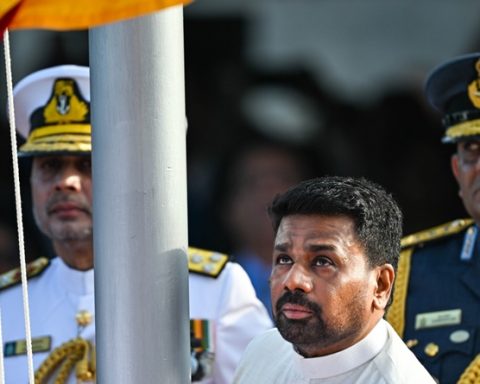
In his inaugural speech for the “Clean Sri Lanka” initiative, President Anura Kumara Dissanayake attempted to invoke a sense of hope, a vision of reform. Yet, what was truly revealed in those minutes of disjointed rhetoric was not a new dawn for Sri Lanka, but a political paradox more glaring than ever. His words, laden with vague promises, ultimately embodied the country’s struggle to break free from its historical entanglements. There was talk of a “strong foundation” being built, but what he didn’t address—what he never truly acknowledged—is that foundations can crumble if not carefully maintained. The state of the Hambantota saltern, the key example he gave of his “foundation-building,” highlights this reality all too well.
Is it not astonishing that in a country teeming with natural resources, one of its most basic and essential commodities—salt—has become a symbol of systematic failure? The once-proud Hambantota saltern, responsible for much of Sri Lanka’s salt production, now finds itself struggling with subpar output, contamination, and the withdrawal of its coveted ISO certification. When salt itself becomes a casualty of mismanagement, what does this say about the nation’s ability to clean up its own governance, let alone address the broader crises at hand? The promise of a “clean” nation cannot possibly be realised when even the most basic industries are being choked by inefficiency. The tragedy is that the salt crisis is not just a crisis of resources; it is a crisis of accountability, of leadership. Domestic salt production is expected to take around six months to recover, potentially alleviating the current shortage, which may last until April or May 2025; this is terrible, and nothing short of an emergency situation, while the “Alchemist” and his team in “renaissance” are bragging that they are laying the foundation for a greater nation.
And yet, President Dissanayake continues to parrot the same rhetoric of change. “We are building this foundation quickly,” he declares. But quickly is relative. How much longer can a government function by simply claiming to be in the process of change without actually bringing any substantial progress? What is the foundation Dissanayake speaks of, when corruption and mismanagement seep through the cracks like water in a crumbling wall? When administrative paralysis takes root, how can one expect any meaningful reform? The truth, as inconvenient as it may be, is that Sri Lanka is trapped in a paradox: a government that promises a clean, reformed future is itself mired in the very problems it pledges to fix.
Consider the salt shortage. The once-reliable Hambantota saltern, now plagued with contamination, mismanagement, and lack of leadership, has failed to meet its basic obligations to the nation. For years, the salt factory operated under the belief that it could meet the nation’s needs without issue. Yet, when the rains came, when production cycles faltered, when political motives overshadowed national needs, the inevitable occurred: a shortage. What the president fails to mention is that the true cause of this crisis is not a natural disaster but lack of ability and the lack of foresight. It wasn’t just poor weather that led to this shortage; it was poor planning, poor execution, and poor governance.
The government’s response to the crisis is as predictable as it is disappointing. Imports of substandard salt from India have been touted as a temporary solution to the crisis. But this is a mere stopgap, a band-aid to cover up the gaping wound of inefficiency that the government has failed to address. This reliance on imports, rather than fixing the domestic problem, exemplifies the government’s passive approach to problem-solving. It’s as if the leadership refuses to face the real issue at hand: that it cannot even manage its own resources effectively.
In a nation where so many basic commodities—like salt—are produced domestically, the question must be asked: Why are we importing what we can already produce? Why is the sovereignty of our own industries being traded for the false comfort of foreign goods? Is it not an embarrassment that a country with abundant coastline, with vast access to seawater, is now turning to a neighbouring nation for something as essential as salt? But the greater question is not just why, but also how this happened. How did we go from self-sufficiency to dependence in such a short time? How can the government claim that the “Clean Sri Lanka” programme is viable when it has failed to keep its own house in order?
When President Dissanayake speaks of a “new foundation,” he fails to acknowledge that the very institutions he champions are decaying from within. The public service, which he deems to be the key to implementing any national changes, is itself entrenched in corruption and dysfunction. The reality is that while he blames the previous government for mismanagement, he overlooks the inherent weaknesses of his own administration, which, despite its promises, has done little to reform the deeply flawed public service. It seems that every reform speech only leads to the same miserable inaction.
It is almost comical, then, when the president claims that voluntary service from experts will be the catalyst for change. It’s the modern-day equivalent of a “do-it-yourself” political solution: bringing in professionals who work without pay, expecting them to somehow clean up the mess left behind by decades of poor governance. Yet these experts, despite their credentials and goodwill, are not magicians. They cannot undo the damage done by years of political patronage, systemic neglect, and administrative inertia. The idea that a few well-meaning professionals can come in and save the day—without any tangible reform of the underlying structures—borders on naïve.
It is telling that the Hambantota Saltern, a government-owned enterprise, is now ranked as one of the country’s loss-making enterprises. This is no surprise when one considers the administrative failures and the staggering lack of oversight. The president talks about building a strong foundation, but what foundation is he referring to when institutions like the Hambantota Saltern are crippled by a lack of investment, poor management, and incompetence at all levels?
It is perhaps even more telling that, in a desperate attempt to salvage the situation, substandard salt, mixed with dust and shells, has been released into the market. What should be a basic staple has become a dangerous product, potentially harmful to consumers. And yet, the government does nothing to intervene or rectify the situation. Is this what Dissanayake envisions when he talks about building a “clean” nation? A clean nation that feeds its citizens contaminated salt, all while presenting a façade of reform that never materialises?
Even when the government admits the severity of the salt crisis, its response is lacklustre at best. Salt imports from India, they say, will fill the gap. But this is an easy out, a temporary solution that does nothing to address the root of the problem. When will the government stop dancing around the issue and face the reality of its own failures? When will it realise that empty promises, however grand, can no longer mask the deep structural rot that underpins the nation’s institutions?
The salt crisis is, in many ways, the perfect metaphor for Sri Lanka’s political paralysis. Here is a government that speaks of renewal and reform, but when put to the test, all it can do is import what it can already produce, rather than fix the broken systems within. This is the paradox at the heart of the current political dilemma: a government that presents itself as a reformist powerhouse but lacks the political will and administrative competence to execute even the most basic of reforms.
The president’s calls for change ring hollow, not because they are inherently wrong, but because they are unsubstantiated and unrealistic in the face of a government so deeply entangled in its own contradictions. How can we expect to have a clean nation when the very mechanisms that are supposed to facilitate that cleanliness—institutions, governance, leadership—are themselves dirty? If salt production, something so fundamental to daily life, cannot be managed effectively, what hope does the country have for addressing more complex issues like poverty, education, and healthcare? The paradox is undeniable: the government that claims it will cleanse the nation is itself drowning in its own filth, unable or unwilling to make the difficult decisions required to pull Sri Lanka out of its malaise.
And so, as Dissanayake continues to spin his tales of reform, the salt crisis remains unsolved, a testament to the gaping chasm between political rhetoric and reality. The irony could not be starker. For in seeking to clean Sri Lanka, the government has only highlighted how much dirt lies beneath the surface.
The writer can be reached at luxmanaravind@gmail.com