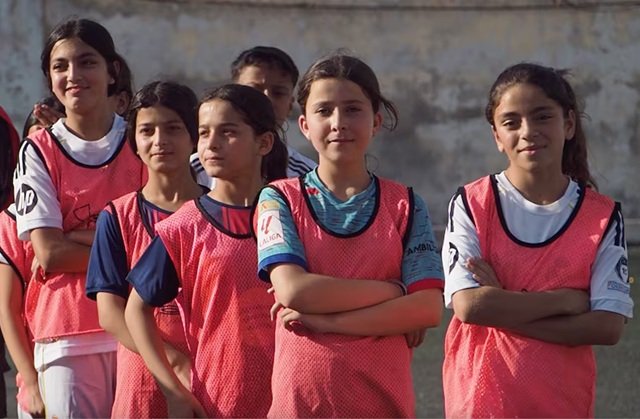
In the shadow of Raqqa’s former municipal stadium, once transformed by the Islamic State into a detention, torture and execution center, children from communities divided by nearly 14 years of war now gather each week to play football together. Their parents watch from the sidelines, many meeting for the first time despite years of living in the same region. The initiative, known as The Hope League, is using sport to reconnect communities fractured by Syria’s conflict.
According to reporting by El País, the project was launched nearly a year ago by the Catalan non-governmental organization NOVACT in partnership with the Kurdish NGO Doz, the Barça Foundation and Oleguer Presas’ football school La Caserna. It brings together Kurdish, Arab and Christian children, including the sons and daughters of former Islamic State members, with the aim of rebuilding trust between communities that were torn apart by war.
More than 1,300 children and over 150 parents participate in activities across four Syrian cities as well as Erbil and Sulaymaniyah in Iraq’s Kurdistan Region. The program combines football with training focused on cooperation, conflict resolution and coexistence, while requiring parents to participate alongside their children.
For many families, the project offers opportunities that extend beyond the football pitch. Redab al Hasan, whose two children attend the program, said she once feared interacting with women connected to Islamic State families. She explained that the initiative had changed those relationships, allowing families from different ethnic and religious backgrounds to visit one another and enabling children to build friendships across traditional divisions. She said the goal was for Syrian children to grow up united rather than separated by religion or ethnicity.
Instructors say those changes have developed gradually. Louai al Qadban, one of the coaches, explained that some parents initially refused to register their daughters because teams were mixed. Women who had previously lived in the Al Hol detention camp were also reluctant to interact with men, while many children refused to play alongside girls. Over time, he said, participation increased and those barriers began to diminish.
Among the participants is Hanan, whose name has been changed for security reasons. She and her two sons were released from Al Hol through an international reintegration program before returning to Raqqa. She recalled that one of her children had spent almost his entire life inside the camp and had never seen everyday objects such as cars or trees. After years surrounded by violence, she said her children struggled with anger and isolation before joining The Hope League. She now credits the coaches with helping them become calmer and more willing to trust others, although she says many people outside the project still fear her because of her past.
The initiative operates in a country where conflict has left deep physical and psychological scars. Syria’s diverse ethnic and religious communities, including Arabs, Kurds and Christians, were drawn into years of violence that followed the outbreak of civil war. According to El País, project organizers argue that rebuilding social relationships is essential to preventing renewed divisions.
Participants also describe continuing insecurity despite the end of major fighting against Islamic State. Turkish attacks continue to affect border areas, while fears of renewed violence remain widespread. Parents say many children suffer trauma after years of bombings, displacement and insecurity. Some still wake in fear at loud noises, while others express anxiety about the possibility of future drone strikes.
Coaches involved in the program say football provides a setting where children can learn to resolve disagreements without repeating the ethnic or religious divisions that shaped much of Syria’s recent history. As children train together in cities still marked by destroyed buildings and memories of conflict, organizers say the project seeks to create relationships that extend beyond the football field and into communities still working to rebuild after years of war.