


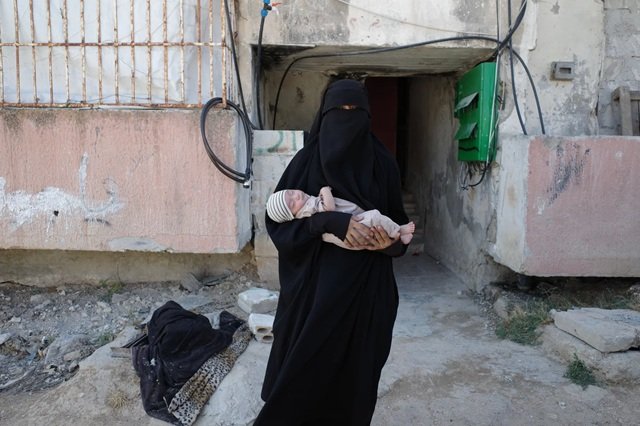
For years, Uyghur fighters arrived in Syria through conflict routes stretching from Central Asia to the Turkish-Syrian border, joining armed opposition groups battling the government of former Syrian President Bashar al-Assad. Many came seeking a battlefield role against a government allied with China. Others arrived as members of a growing displaced community seeking safety, housing and education away from China’s Xinjiang region.
Today, an estimated 20,000 Uyghurs have established roots in Syria, according to reporting highlighted by Middle East Broadcasting Networks (MBN). They are no longer only associated with the battlefield. They run businesses, build homes and send their children to Arabic-language schools. But their future has become one of the most sensitive issues facing Syria’s new government as it attempts to manage relations with Beijing.
China is pushing Damascus to deport Uyghurs back to China, arguing that fighters linked to Uyghur militant groups could eventually pose a security threat. The Uyghurs themselves say they have no intention of returning and have nowhere to go.
“China always worried that removing a sitting government by force would happen to them as well,” Mamatjan Juma, executive director of the Uyghur News Network, told MBN, describing Beijing’s concerns that foreign fighters could bring their opposition movement back to China.
Uyghurs now represent the largest group of foreign fighters in Syria, and their role in the campaign that helped remove Assad has complicated the position of President Ahmed al-Sharaa, the former rebel leader now heading Syria’s government. While Beijing wants all Uyghurs in Syria extradited, Sharaa has an interest in maintaining ties with fighters who contributed to his movement’s success and who could become part of Syria’s emerging security structure.
At the center of the dispute is the Turkistan Islamic Party (TIP), a Uyghur militant organization that China identifies as the same group as the East Turkestan Islamic Movement (ETIM), which Beijing considers a terrorist organization with links to al-Qaeda and the Taliban.
Sean Roberts, a professor of international affairs at George Washington University, told MBN that the connection between the organizations is more complicated than China’s description suggests. He said that while some movement between TIP members in Afghanistan and Syria has continued, the groups no longer operate as the same organizations they once were and do not appear to maintain a unified structure.
TIP fighters began arriving in Syria after the civil war started in 2011, entering through Central Asia and Turkey before settling mainly in opposition-held areas in northwestern Syria. Roberts said their experience in Syria contributed to a shift toward a more nationalist outlook, reducing their dependence on international jihadist networks.
“TIP in Syria started adopting a more nationalist oriented ideology around the same time that HTS did,” Roberts told MBN, referring to Hay’at Tahrir al-Sham, the militant organization through which Sharaa led the campaign against Assad.
The history of Uyghurs in Syria is not limited to armed groups. Roberts said many Uyghurs arrived as refugees rather than fighters, particularly after China intensified restrictions on the Muslim minority following the 2009 Ürümqi riots in Xinjiang.
“In many cases, they came to Syria not as fighters, but because they were guaranteed housing and schools for their families in what was a growing Uyghur community in the country,” Roberts said.
The 2009 violence in Ürümqi followed protests over the killing of factory workers in Guangdong and resulted in around 200 deaths. It was followed by a broad crackdown on Uyghurs across Xinjiang.
Uyghur linguist and writer Abduweli Ayup, who traveled to Syria and interviewed Uyghur militants, told MBN that some fighters believe their years in Syria changed their understanding of how societies and governments function.
According to Ayup, one Uyghur fighter described Syria as a place where he learned how governments are built, constitutions are written and communities with different ethnic and religious backgrounds can coexist. The fighter said returning directly from Afghanistan to Xinjiang would have created conflict with both the Chinese government and ordinary Uyghurs because his earlier views were too extreme and disconnected from democratic principles.
Despite building new lives in Syria, many Uyghurs remain cautious about discussing their experiences. Ayup said they fear speaking publicly about Chinese policies because of concerns over possible pressure on relatives still living in China and Beijing’s influence over Syrian authorities.
“The main problem is that Uyghurs cannot tell their story. They’re afraid because of government pressure,” Ayup told MBN.
Roberts said many Uyghurs in Syria now see the country as their permanent home and believe they can practice their faith and live without the restrictions they experienced in China.
The issue has become a key element in Syria’s cautious diplomatic reset with Beijing following Assad’s removal. Syrian and Chinese officials did not publicly engage diplomatically until two months after the former president’s fall.
China’s main focus in relations with the new Syrian government has been the presence of Uyghur fighters. Beijing’s position mirrors its earlier approach toward Afghanistan after the Taliban first took power in 1996, when concerns over Uyghur militants delayed diplomatic engagement.
Roberts said the issue may not ultimately prevent closer Syrian-Chinese relations, suggesting both Syria and Afghanistan’s Taliban government may provide assurances that Uyghur groups operating within their borders will not threaten China.
That diplomatic balancing act was visible in November 2025, when Syrian Foreign Minister Asaad al-Shaibani visited Beijing. Counterterrorism cooperation was a central issue, with Shaibani promising that Syria would not become a base for attacks against Chinese interests.
Following the visit, China reopened its embassy in Damascus and pledged 380 million yuan in aid to Syria. Beijing also abstained from a United Nations Security Council vote removing Sharaa and Syria’s interior minister Anas Khattab from ISIS and al-Qaeda sanctions listings. China’s UN ambassador Fu Cong said Syria needed to address the threat posed by foreign fighters, including members linked to the East Turkistan Islamic Movement.
Shortly afterward, reports emerged that Syria planned to hand over 400 Uyghur fighters to China. The Syrian Arab News Agency, citing Foreign Ministry sources, denied that such an agreement existed.
At the same time, Chinese companies have continued exploring opportunities in Syria. In May 2025, Chinese firm Fidi Contracting signed a 20-year memorandum of understanding to invest in Syrian industrial zones, though broader economic ties remain limited.
For Damascus, the challenge is maintaining relations with Beijing while managing the fighters who helped bring its new leadership to power. For China, the demand for the return of Uyghurs remains a longstanding security priority. The dispute continues to shape one of the most delicate parts of Syria’s emerging relationship with Beijing.









