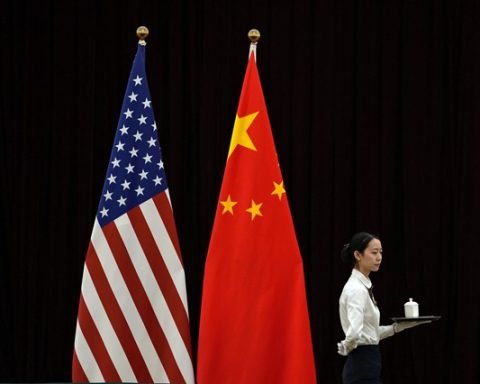
A liberal Taiwanese industry is exploiting a vast Chinese demand for pornography that Beijing bans, using Mandarin, Chinese settings and increasingly artificial intelligence to make audiences believe what they are watching comes from the mainland.
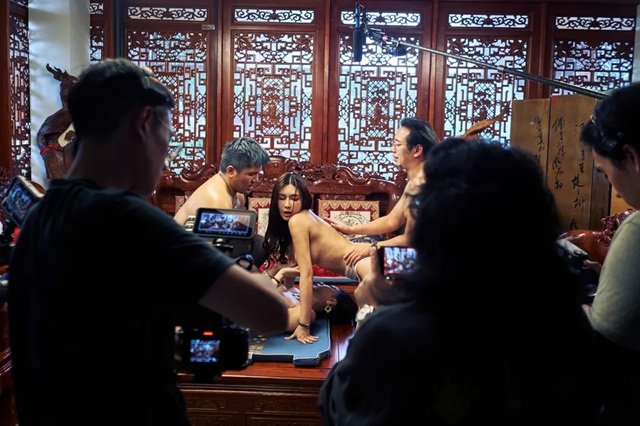
In the mountains of Miaoli, Taiwan, a film crew is preparing a scene designed to look as though it is taking place in China. The setting is a country house. The characters are a Chinese mayor, an industrialist, his daughter-in-law and the politician’s secretary. The actors, however, are not in the People’s Republic of China. They are in Taiwan, filming pornography for an audience largely located across the Taiwan Strait.
The scene is part of an investigation published by DER SPIEGEL, which examines how Taiwan’s legal and commercially developed pornography industry has built a business around Chinese consumers living under a system where the production and distribution of pornographic material are strictly prohibited. The result is an unusual cross-Strait trade in which Taiwan supplies content to a market that Beijing officially refuses to allow to exist.
The production being filmed is “Onkel Hao und seine Frauen”, a three-part series set ostensibly in Hengshan county in Hunan province. Its central character, Onkel Hao, rises from an ordinary employee at a state-owned fertiliser factory to a wealthy social figure who sleeps with numerous women and develops connections with powerful people. Hunan is also the birthplace of Mao Zedong, adding a deliberately Chinese setting to the production.
Ai Xi, the stage name of the 29-year-old actress playing the character Ying, told DER SPIEGEL that a large part of the audience believes the films are actually produced in China. “Our job is to maintain this belief,” she said. The illusion depends heavily on language and cultural detail. Taiwan and China share Mandarin as a common language, allowing Taiwanese performers to reproduce the linguistic environment expected by mainland viewers. Even small differences matter. Ai Xi said performers sometimes deliberately use terminology associated with mainland China rather than words commonly used in Taiwan, because otherwise the illusion could disappear.
The business rests on a stark economic contradiction. Pornography can legally be produced in liberal Taiwan, while in China the production and distribution of “obscene content” are prohibited and can result in imprisonment. Yet China represents an enormous potential market. Statistics cited by DER SPIEGEL indicate that users in China may account for more than a quarter of global pornography consumption, more than any other country.
For Taiwanese producers, that creates an unusually attractive market. Taiwan has a population of only 24 million and consequently a relatively small pool of performers. Ai Xi said Taiwanese women can earn as much as €2,700 for a filmed sex scene, with earnings having been twice as high during the industry’s earlier peak.
Ai Xi herself does not fit the conventional image associated with the pornography industry. Born in Taiwan, she spent part of her childhood in England, where her father was completing a doctorate. She later studied economics at Berkeley and wrote her graduation thesis comparing China’s development policies with those of the West. She subsequently worked in investment banking in Hong Kong and at a hedge fund in Taiwan before deciding that the work bored her. She has been making pornography for more than four years and also tutors secondary-school students in economics.
She describes her work in the language of economics, speaking about market equilibrium, consumers and supply. She also acknowledges the contradictions involved in selling women as a commercial product while personally benefiting from that market. For her, she says, it is a career rather than a lifestyle.
Model Media, the Taiwanese production company examined by DER SPIEGEL, was founded in 2019 and operates from New Taipei City. Its offices resemble those of a conventional modern company, with around 20 young employees working at desks and a broader production team of about 40 people. Its production director, a 38-year-old electrical-engineering graduate who uses the name Aaron, said the company produces between 80 and 100 pornographic films a year as of early 2026. Most are heterosexual, while some are gay.
The company builds sets designed to match what its producers believe Chinese audiences want: an imperial-era brothel, a prison room, a classroom and other locations equipped with costumes and props. Aaron said Chinese consumers are more willing to pay because censorship restricts supply. Distribution is largely conducted through download links leading to an app, which the company says is harder for Chinese authorities to block than a conventional website. The app has reportedly been downloaded more than 37 million times.
The legal risks, however, fall heavily on the Chinese consumer. In 2022, 24 people were arrested in China for producing pornography for Model Media despite the prohibition. Aaron said they had approached the company themselves and had accepted the risk of filming in China.
The demand exists despite decades of official restrictions. According to Runze Ding, a media scholar at Swansea University who researches sexuality in China, the Chinese government views pornography as socially corrupting and incompatible with its vision of a “harmonious society”. Yet he also describes a substantial gap between official policy and private behaviour. Pornography remains taboo publicly, while many people privately consume it.
Research cited in the DER SPIEGEL investigation found that nearly 80 per cent of surveyed Chinese men aged 18 to 29 said they had watched pornography during the previous year, compared with 51 per cent of young women. Ding argues that the internet has made it increasingly difficult for authorities to prevent access. Consumers can use VPNs or private online groups to find material that is otherwise prohibited.
Chinese authorities continue to enforce the ban. The National Office Against Pornographic and Illegal Publications, operating under the Communist Party’s propaganda apparatus, publicly displays cases involving arrests and prison sentences for distributing pornography. The campaigns include initiatives known as “Clean Network” and “Protecting Youth”. Yet researchers cited by DER SPIEGEL found that illegality does not necessarily prevent young people from consuming pornography.
For Taiwanese producers, Chinese consumers have therefore become both a source of opportunity and a source of risk. Model Media’s own scripts draw on Chinese amateur stories and sexualised adaptations of popular cultural works, while performers such as Shiba acknowledge the peculiar nature of producing material for an audience in a country that regards Taiwan as territory to be reunified with the mainland.
The industry’s next transformation may be even more consequential. In April, Model Media announced on social media that it was closing, citing the growing profitability problems caused by piracy and the free circulation of its content online. But Aaron later told DER SPIEGEL that the company was preparing for a new phase rather than abandoning the business. Team members had received AI training in China, and the company was preparing to operate under a new name.
The planned transition is towards AI-generated pornographic dramas. According to Aaron, the technology has advanced faster than expected, allowing producers to generate realistic videos and reproduce Chinese accents with a click. What began as a Taiwanese industry manufacturing an illusion of China is moving towards technology capable of creating that illusion without conventional filming at all.
The commercial logic remains unchanged. A market exists because demand persists. The difference is that the next generation of content may no longer require Taiwanese actors, sets or even cameras to make a Chinese audience believe it is watching something from China. The border between reality and simulation, already central to the industry’s business model, is becoming increasingly difficult to see.