by Our Economic Affairs Editor
When Russian forces invaded Ukraine in February 2022, Western governments unleashed a barrage of unprecedented sanctions aimed at strangling Moscow’s war economy. From semiconductor exports to banking restrictions, the measures were designed to cripple Russia’s ability to produce weapons. But as the sanctions took hold, a parallel network began to form — one that would run through a city long celebrated for its economic openness and legal autonomy. Within months, Hong Kong had quietly become one of the most important gateways for Russia’s sanctions evasion efforts.
A new analytical report from the Trap Aggressor project of Ukraine’s StateWatch think tank reveals the intricate role Hong Kong now plays in circumventing Western export controls. Drawing on customs data, company registries, and open-source investigations, the report details how dozens of newly registered Hong Kong firms have acted as intermediaries, funneling dual-use goods such as microelectronics, engine parts, and high-precision machinery to Russia. Between 2024 and early 2025, fifty-five Hong Kong-based companies exported sanctioned goods worth at least 55 million U.S. dollars to Russia. More than a third of these firms were established after the start of the full-scale invasion, and over twenty percent were founded by Russian citizens or nationals from other former Soviet republics.
For decades, Hong Kong’s reputation was built on speed, transparency, and efficiency. Opening a business in the city takes less than two days. Foreign owners can maintain full control of their companies, while low tax rates and the absence of capital controls make it a magnet for global capital. These same qualities that once made Hong Kong a beacon of open trade have now made it a perfect conduit for illicit commerce. The report notes that the territory’s “streamlined registration process and favourable tax regime provide an enabling environment for intermediary firms that may facilitate illicit trade.” The system’s design — meant for legitimate entrepreneurship — has become a tool for geopolitical manipulation.
The city’s political trajectory over the past decade has only accelerated this shift. Since the mass pro-democracy protests of 2019, Beijing’s tightening control has transformed Hong Kong’s legal and political landscape. Once hailed as a semi-autonomous bastion of the rule of law under the “One Country, Two Systems” framework, Hong Kong is now governed under the shadow of the Chinese Communist Party. The imposition of the National Security Law in 2020, followed by a “patriots-only” electoral system and new national security measures in 2024, has silenced dissent and reshaped the city’s institutions.
Under this reengineered system, Chief Executive John Lee has declared that Hong Kong will observe only United Nations sanctions, rejecting the unilateral measures imposed by Western governments as “lacking legal basis.” That decision, made explicit in 2022 when Lee allowed the sanctioned Russian oligarch Alexey Mordashov’s yacht to dock in the city, sent a clear signal to Moscow and its partners: Hong Kong was open for business.
The consequences have been far-reaching. The total volume of Russian imports from China and Hong Kong has more than doubled since 2019 — from 54 billion to over 125 billion dollars by 2023. Much of this growth has been driven by the covert movement of restricted components through Hong Kong’s free-flowing commercial networks. While official trade data from Russia has become increasingly opaque, customs records analysed by the Trap Aggressor project indicate a thriving parallel market for goods vital to Russia’s weapons manufacturing.
The report’s findings are striking in both scope and detail. Over half of the sanctioned goods exported through Hong Kong to Russia — roughly 54.4 percent — originated in Taiwan, consisting largely of high-value electronic components used in communications, guidance, and weapons control systems. U.S.-manufactured products also found their way through Hong Kong intermediaries, including microchips from Texas Instruments and Analog Devices, fibre-optic systems by Cisco, and electrical connectors produced by Carlisle Interconnect Technologies. Many of these items have been recovered from the wreckage of Russian drones and missiles on Ukrainian soil.
Japanese, Czech, and German goods also flow through the city’s ports. Bearings, CNC lathes, and machining centres made by the Japanese firm Tsugami — used to produce precision parts for missiles and aircraft — were re-exported via Hong Kong-based suppliers. Equipment manufactured by Germany’s Rohde & Schwarz, a defence electronics firm known for secure communications and radar systems, similarly found its way to Russian buyers. Czech-made signal generators and oscilloscopes, designed for advanced testing and measurement, were among the items traced through Hong Kong’s export networks.
Behind these transactions lies a constellation of shell companies — entities with minimal capital, often registered to the same office blocks and managed by proxies. Of the 55 companies examined in the report, nearly one-third are already under international sanctions, but the vast majority of those established in 2023 and 2024 have yet to be blacklisted. Some exist only on paper, with authorised capital as low as one Hong Kong dollar. The report identifies registration patterns typical of front companies: mass-registration addresses, foreign founders, and opaque ownership structures.
One network uncovered by journalists from The New York Times centred around two Russian businessmen, Mikhail Vinogradov and Aleksey Chichenyov, who registered multiple trading entities at a single Hong Kong address. In another case, U.S. authorities arrested Russian citizen Denis Postovoy in 2024 for illegally exporting American-made microelectronics — the same types of components that frequently pass through Hong Kong — to Russia’s defence sector. These examples underscore how easily legitimate business infrastructure can be weaponised.
Some of the companies named in the report have been directly linked to the Russian military’s weaponry. Ukraine’s Defence Intelligence identified Hong Kong-based Align Trading Company Limited, Hytera Communications Limited, and Hadsund International Technology Limited as suppliers of engines and temperature sensors used in Russia’s S8000 Banderol cruise missile, deployed in attacks on southern Ukraine in 2025. Another firm, Wavetel Technology Limited, supplied communication modules incorporated into Russia’s V2U loitering munitions powered by artificial intelligence. None of these companies are currently subject to sanctions.
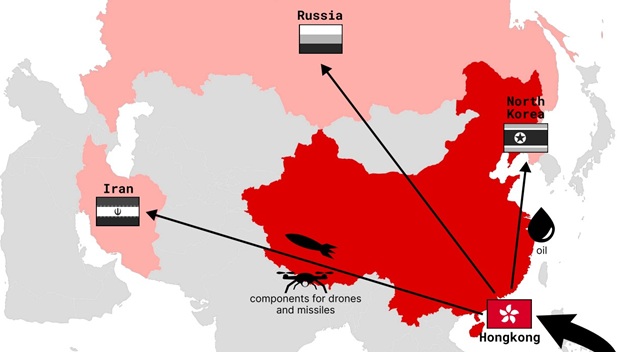
Even more alarming is the overlap between the networks supplying Russia and those tied to Iran’s drone production programs. Hong Kong’s logistics and finance sectors have also been used to facilitate shipments of servomotors and Western electronics to Iranian defence companies, some of which in turn supply Russia with drones such as the Shahed-136. In February 2025, the U.S. Treasury sanctioned six Hong Kong and mainland Chinese firms operating as front companies for Iran’s arms manufacturers, warning that Washington would continue to “disrupt the schemes that enable Iran to send its deadly weapons abroad.”
What enables all of this is not just lax enforcement, but structural permissiveness built into Hong Kong’s legal and financial system. Under its United Nations Sanctions Ordinance, Hong Kong enforces sanctions only when directed by Beijing’s Ministry of Foreign Affairs. Even in cases like North Korea, where UN restrictions apply, compliance has been partial at best. The result is a jurisdiction that functions as an offshore loophole — one where illicit actors can operate under the veneer of legitimacy while remaining beyond the reach of Western authorities.
The European Union’s relationship with Hong Kong further complicates the issue. Unlike the EU’s agreement with mainland China, which mandates cooperation in investigating and combating customs fraud, the EU–Hong Kong agreement only requires the “sharing of information.” In practice, this softer framework limits Europe’s ability to detect and halt the diversion of sensitive goods. Until recently, Hong Kong benefited from its reputation as a trustworthy partner. But that trust is eroding fast. In its 18th and 19th sanctions packages, the EU has begun targeting Hong Kong-based entities for the first time, moving closer to a secondary sanctions regime that punishes third-country facilitators.
Meanwhile, the United States has armed itself with Executive Order 14114, allowing secondary sanctions against foreign financial institutions that support Russia’s military-industrial complex — even indirectly. Yet enforcement has remained hesitant. The Biden administration stopped short of directly targeting Hong Kong banks, and with Donald Trump’s return to power, Washington appears even less inclined to jeopardize relations with China over what officials describe as “gray-zone” violations.
Nevertheless, Hong Kong’s financial system remains deeply entangled with global markets. Its banks and brokerages rely on access to the U.S. dollar system, which gives Western regulators considerable leverage — leverage they have so far chosen not to use. In 2024, after warnings from the U.S. Treasury, several Hong Kong banks began refusing to process payments from Russian clients. But just months later, the Hong Kong government took steps to attract new Russian business. It passed legislation permitting “inbound redomiciliation,” allowing companies from “unfriendly” jurisdictions to relocate their registration to Hong Kong without dissolving. The city also reopened its tourism office in Moscow and resumed direct flights.
For Moscow, the timing could not have been better. With many Western jurisdictions closing their doors, Hong Kong offered a welcoming alternative — a financial ecosystem that looks global but acts local, firmly aligned with Beijing’s political interests. Russian trade with Hong Kong has since flourished in the shadows, buoyed by a symbiotic relationship: Russia gains access to technology and finance, while Hong Kong bolsters its trade statistics and reinforces its economic ties with the Chinese mainland.
The Trap Aggressor report concludes with a stark warning. If unchecked, Hong Kong’s transformation into a hub for sanctions evasion could permanently weaken the architecture of global financial governance. The authors urge the European Commission to designate Hong Kong as a “high-risk jurisdiction for sanctions evasion,” establish continuous monitoring of new companies, and impose tariffs or restrictions on high-priority goods exported through the territory without verified end-user certificates. They also call for sanctions on Hong Kong banks complicit in these schemes, enhanced cooperation with the private sector, and stricter export controls on Taiwanese electronics routed through Hong Kong.
In Nutshell: According to Russian customs data (2024 – February 2025)
- 55 Hong Kong-based companies exported dual-use goods to Russia worth over $55 million.
- 54.4% of the total value came from Taiwanese electronics — microchips, network equipment, and precision technologies from various global manufacturers.
- 38% of these companies were founded after the start of the full-scale invasion.
- Only 30.9% are currently under sanctions.
- Over 20% of the founders are citizens of Russia or other post-Soviet states.
The implications go beyond Russia’s war in Ukraine. The report situates Hong Kong within a broader pattern of collaboration between sanctioned states — Russia, Iran, and North Korea — all using the city’s permissive legal environment to move money and material. In doing so, they exploit the cracks in the international sanctions system, turning one of the world’s most sophisticated financial centres into a clearinghouse for illicit trade.
What makes this story so unsettling is not only the scale of the evasion but its normalization. Business registration portals, bank accounts, and logistics firms continue to operate under the banner of legal commerce, even as their exports fuel a war of aggression. The city that once symbolized the meeting point of East and West now stands as a testament to how globalisation, without accountability, can be repurposed for destruction.
In the end, the Hong Kong of 2025 is a mirror reflecting the contradictions of our age — a city that thrives on openness yet enables secrecy, that champions the rule of law yet shelters those who break it, and that profits from globalisation while helping to dismantle the very order that sustains it. For Ukraine, the cost is measured in lives lost and cities destroyed. For the world, it is the erosion of a sanctions regime once believed to be unassailable.
As long as Hong Kong remains a willing conduit, every shipment that leaves its ports may carry more than microchips or bearings. It carries the quiet complicity of a system that has chosen commerce over conscience — and in doing so, has helped arm a war it claims to have nothing to do with.