When the first tremor struck on the holiday afternoon of June 24, Marisol Rojo was standing inside a friend’s apartment in Caracas’s Chacao municipality, unaware that within seconds the building around her would collapse into a cloud of dust and debris.
She had arrived at the apartment with two friends and other companions after spending time at Playa Bahía in La Guaira. A few minutes earlier, they had been walking through Plaza Bolívar in Chacao. One member of the group later reflected that if they had stayed in the square for another five minutes, the disaster might have been avoided. But for Marisol, the earthquake was something that could have found them anywhere.
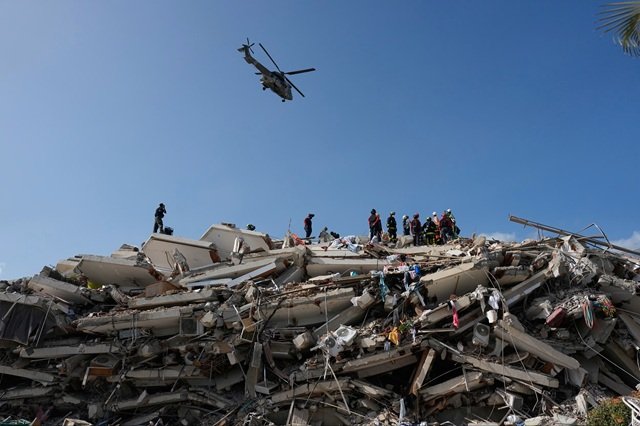
Within moments, the four-story Obelisk building began to fail. Marisol remembers the structure moving violently as the slabs broke apart. “I saw the slabs shatter like matchsticks and explode,” she recalled, describing the building’s walls cracking, the elevator shrinking into the structure, and the floor collapsing beneath them.
During the first earthquake, she managed to shout for someone to check on the parents of one of her friends, who were inside the building. When the second tremor struck, she turned toward the apartment door and warned everyone to escape.
She managed only two steps.
The force of the collapse threw her out of the building. She landed in what she described as a “triangle of life,” with her beach bag protecting her back as concrete, glass, stone, and marble fell around her. The building eventually disappeared into what she described as red dust.
Before the collapse, Marisol reached for the rosary around her neck and prayed that if she died, her death would not be painful, and if she survived, she would not be trapped. When she opened her eyes after the collapse, she saw a small opening of light. She reached toward it and realized she was alive.
But her friends were gone.
She called out for El Biónico and Sensei, the nicknames of the two people she had been unable to rescue. There was no response. A passing motorcyclist pulled her from the rubble and carried her away from the collapsed building.
Marisol later joined rescue efforts, returning to the site and identifying the locations where she believed her friends were buried. She spent the night moving between the office of Los Palos Grandes de Noche, the cultural organization she belongs to, and the rescue operation.
She said professional rescuers arrived later, after media attention increased. The crowd worked through the rubble as much as possible, searching for survivors among the remains of the collapsed structure.
Across the affected areas, survivors described similar scenes of sudden destruction and desperate escapes.
In La Guaira, at the Luz del Mundo evangelical church, parishioners were attending a service when the earthquake struck. The church itself was still under construction, with unfinished walls and exposed beams, but nearby residential towers began collapsing around them.
Georgina Mejía was among those inside the church. She watched as buildings disappeared while her own family members were inside some of those towers. As panic spread, the church roof also began to collapse.
Pastor Israel Tauicen, who had escaped during the first tremor, returned to help those still inside. He called another parishioner and rushed back into the damaged building to bring the women outside before the roof fell completely.
After escaping, the group held hands and continued praying while dust filled the area and some collapsed buildings caught fire. A temporary shelter was later established in a park in Caraballeda, where injured residents received treatment and aid workers distributed clothing and food.
Luis Pueyo, a 52-year-old truck driver, survived after being trapped inside his home. He was in the shower when the shaking began. As walls collapsed around him, he managed to escape through a second-floor window.
“I jumped without thinking because there were 12 stories above me,” he said.
The fall shattered his knee, but he managed to move through the destruction and reach the church, where Pastor Tauicen treated his injuries. The pastor used his own shirt as a makeshift tourniquet to stop the bleeding.
Pueyo later described hearing people trapped beneath the rubble, including children crying, while smoke and the smell of burning materials filled the air.
In Caravalleda, one of the worst-affected neighborhoods near the sea, entire sections of buildings were reduced to empty spaces filled with twisted metal and concrete. Some structures left behind only isolated remains — a gate, a swimming pool, or a basketball hoop — while the rest vanished beneath the debris.
The disaster left families searching for missing relatives and survivors struggling with immediate needs. Pueyo’s wife returned from the road to Caracas after hearing about the earthquake. The couple later sat together in the shelter, asking for basic supplies including clothing and clean mattresses.
The destruction transformed ordinary neighborhoods into rescue zones where residents, volunteers, and aid workers searched through the aftermath. For survivors like Marisol, Georgina, and Luis, the earthquake remains defined by the moments when buildings fell, lives changed, and survival depended on seconds.