
The Financial Times recently published an article on the question of who will succeed Xi Jinping. But perhaps the real question is not one of succession, but of continuity—of how a governance model rooted in long-term vision, pragmatic adaptability, and national rejuvenation sustains itself beyond the tenure of any single leader. Unlike Western portrayals, often laden with exaggerated spectres from ‘debt traps’ to ‘authoritarianism,’ there are profound lessons to be drawn from China’s trajectory—especially as Western democracies now find themselves gasping for air in the suffocating embrace of their own contradictions.
“Democracy is a failed joke,” Ai Weiwei, the Chinese contemporary artist, remarked in a recent interview with The Independent—and perhaps never has this assertion been more starkly evident than in the shambolic decline of the liberal order. Governance, once regarded as the solemn responsibility of those entrusted with the future of their nations, has in the West deteriorated into little more than a revolving spectacle of populist theatre, corporate capture, and institutional paralysis.
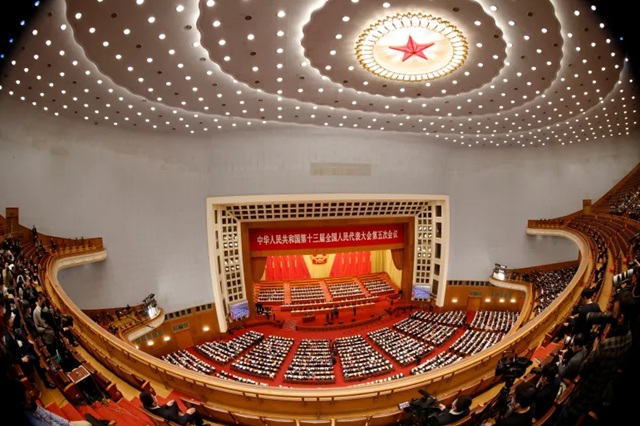
It is within this continuum that China now prepares to convene its most pivotal political gathering of the year—the Two Sessions. The third session of the 14th National People’s Congress (NPC) and the third session of the 14th National Committee of the Chinese People’s Political Consultative Conference (CPPCC), scheduled to commence on March 4 and 5 respectively, are not mere ritualistic formalities but the very engine of governance in a system defined by strategic foresight rather than short-term electoral expedience.
The Western world, entrapped in the myopia of its own dysfunction, looks upon this grand assembly with bewilderment, unable to comprehend a system where efficiency supersedes obstruction and where governance is an instrument of civilization rather than a battleground of perpetual paralysis. As Beijing convenes these pivotal sessions, it does so with a purpose that far surpasses the partisan gridlock that has crippled Washington under Trump and reduced Brussels, under Ursula von der Leyen’s leadership, to a stage of waning relevance.
History does not bestow hegemony upon the indolent. It is earned through foresight, discipline, and a genuine commitment to civilization’s progress. The Western model, long heralded as the apex of governance, is now fraying at the seams, consumed by internal strife, economic stagnation, and an ever-widening gulf between the governed and their rulers. Meanwhile, the Chinese model, grounded in the philosophical profundity of Socialism with Chinese characteristics, marches forward with unparalleled resolve. “The path of socialism with Chinese characteristics is the only correct path for building a modern socialist country,” Xi Jinping declared in his report at the 19th National Congress of the Communist Party of China in October 2017.
What have the last few decades illuminated since China’s opening-up? “Reform and opening up is the key choice that determines the fate of contemporary China,” Deng Xiaoping once asserted. This ethos continues to guide China, as the nation refines its developmental trajectory with an adaptability that the West, bound by ideological rigidity, can scarcely fathom. China is not merely asserting its presence but reshaping the very contours of the global order. The Two Sessions have highlighted the profundity of China’s economic strategy—one that is not predicated on the ephemeral illusions of speculative capitalism but on tangible infrastructural and technological advancement. While Western economies drown in inflationary quagmires and institutional crises, China has charted a path of economic rejuvenation through high-quality development, industrial upgrading, and the indomitable pursuit of technological self-reliance.
Yet the significance of the Two Sessions transcends economic imperatives. It is also a definitive proclamation for a new global paradigm—one where dialogue supplants discord and where stability is not held hostage to the whims of declining empires. The very existence of Western diplomacy has been predicated upon coercion, economic subjugation, and military adventurism.
China, by contrast, has demonstrated that genuine global leadership lies not in the proliferation of conflict, but in its resolution. This year’s Two Sessions will reaffirm Beijing’s role as an indispensable mediator of international crises, bringing adversaries to the negotiating table in a manner that the West, mired in its own moral hypocrisy, has repeatedly failed to achieve.
Consider the diplomatic masterstroke that saw China facilitate rapprochement between Iran and Saudi Arabia—two historical adversaries long ensnared in the machinations of Western interventionism. This ethos extends to the Israeli-Palestinian crisis, where China, in defiance of Western inertia, has actively pursued dialogue among Palestinian factions. The hypocrisy of the liberal order is laid bare when the so-called torchbearers of democracy selectively disregard the suffering of those who do not fit within their geopolitical calculus. Beijing, undeterred by such duplicity, has asserted itself as an honest broker of peace, proving that a multipolar world is not an abstraction but an unfolding reality.
Even in the maelstrom of the Ukraine conflict, where Western powers have inflamed tensions rather than defused them, China’s peace proposal has emerged as the only substantive road map towards deescalation. President Xi Jinping has consistently emphasized that “confrontation, sanctions, and pressure will not solve the problem… what is needed is a mindset of common, comprehensive, cooperative, and sustainable security,” resonating ever more powerfully in contrast to the Western penchant for war profiteering. While NATO expands its influence under the guise of security, China constructs bridges of diplomacy, demonstrating that true global leadership lies not in fueling divisions but in fostering dialogue.
But China’s vision does not stop at terrestrial affairs. This year’s Two Sessions will be held as the next frontier of human progress—space—becomes a new high-tech battlefield. While Western nations hoard technological advancements for geopolitical leverage, China has advanced an inclusive vision of cosmic exploration. The construction of the Tiangong space station, the pioneering lunar projects, and the Mars exploration programme are not mere scientific endeavours; they are emblematic of a civilization that aspires not merely for national greatness but for the collective progress of humanity.
The essence of the Two Sessions lies in the articulation of a governing philosophy rooted in long-term vision, adaptability, and the pursuit of collective progress. It is not governance dictated by ephemeral political cycles but by a civilization’s deeper consciousness—one that understands its historical responsibility not only to itself but to the broader trajectory of human development. In an era where artificial intelligence and artificial general intelligence are reshaping economies, governance, and even social structures, China does not see these advancements as instruments of control or geopolitical leverage but as elements of a broader mission: ensuring that technological evolution remains a force for human cohesion rather than fragmentation. What China has proven is that reform is not an event; it is the flow of history recognizing its own potential.
Simultaneously, the shifting currents of global trade, exacerbated by protectionist measures and economic fragmentation, have reinforced the necessity of an alternative economic logic—one not shackled to the fluctuations of political expediency but rooted in the principle of enduring equilibrium. True strength is not found in dominance, but in resilience—the ability to absorb, adapt, and outlast. This defines China’s approach to trade tensions: rather than engaging in tit-for-tat economic skirmishes, the focus is on structural reinforcement—building self-sufficiency in critical sectors while ensuring that economic interdependence remains a mechanism of stability rather than vulnerability.
Courtesy: The Sunday Island