by Durga
Andrea Iorio’s Between You and AI reads like a manifesto for a new kind of leadership—one that refuses to cling to the comforting illusion that technological transformation is something external, mechanical, or easily outsourced. From the first pages, Iorio insists on a truth that many executives would prefer to deny: “digital transformation is not technological at its core—rather, it is profoundly human.” This declaration is not a soft preface to a business book; it is a provocation. It challenges the belief that the future will be shaped by machines, arguing instead that it will be shaped by our willingness to evolve alongside them. AI is not an intruder or a threat—it is a mirror. As Iorio puts it later, “technology exposes who we already are, both our flaws and our strengths.” In that sense, this is less a guide to artificial intelligence than an indictment of human stagnation.
The book’s ambition is to disrupt the myth that leaders can remain the same while the world transforms around them. Iorio argues that the greatest danger is not the speed of innovation but the slowness of human adaptation. “We have built faster systems, smarter algorithms, and more efficient processes,” he warns, “but we have failed to build ourselves.” The real challenge, therefore, is not to understand the machine but to confront the limitations of our own thinking. That is the book’s central tension: a technology that evolves exponentially paired with a species that evolves reluctantly.
Iorio is particularly sharp in describing the psychological comfort modern leaders cling to. He notes that the old paradigm of leadership—rooted in hierarchy, control, and rigid expertise—has collapsed under the weight of complexity. AI does not simply automate tasks; it rewires the expectations of what it means to know something, to decide something, to guide others. “In a world where information is abundant and easily accessible, the value of leadership no longer lies in knowing more,” he writes, “but in learning faster.” The shift he describes is not cosmetic but existential. The leader is no longer the oracle; the leader is the experimenter. And experimentation, in Iorio’s framework, requires humility, flexibility, and curiosity—traits that corporate culture often treats as weaknesses.
The heart of the book revolves around a concept Iorio calls Digital Soft Skills. Unlike the typical corporate buzzwords that tend to sterilize human traits into checklist competencies, Iorio’s framing is unapologetically philosophical. He argues that “soft skills are becoming the new hard skills” and that capabilities once dismissed as emotional or intuitive have become decisive competitive advantages. The skills he highlights—self-awareness, empathy, adaptability, cognitive flexibility—are not simply tools for working with AI; they are strategies for surviving a world in which uncertainty has become permanent. “The most important skill you can develop for the future,” he writes, “is the ability to learn, unlearn, and relearn.”
But this book is not self-help. It is more confrontational than comforting. Iorio criticizes the inertia that traps organizations in legacy thinking. He describes companies that pour resources into new technologies while refusing to update their decision-making cultures, warning that “upgrading your tools without upgrading your mindset is like installing new software on an outdated operating system.” This metaphor recurs throughout the book: technology is the accelerant, but the human mind is the bottleneck. Leaders who fail to evolve become liabilities.
One of the book’s most compelling ideas is its redefinition of intelligence. Iorio challenges the belief that intelligence is primarily analytical or deterministic. Instead, he argues that the intelligence required in the age of AI is relational, interpretive, and fundamentally human. “Artificial intelligence will outperform us in many cognitive tasks,” he acknowledges, “but it will never replace our ability to create meaning.” Meaning-making becomes, in his vision, the essence of leadership. It is not enough to manage processes; leaders must interpret the future, shape culture, and cultivate trust. He is adamant that trust is the foundational currency of the digital era: “Without trust, technology amplifies fear. With trust, it amplifies potential.”
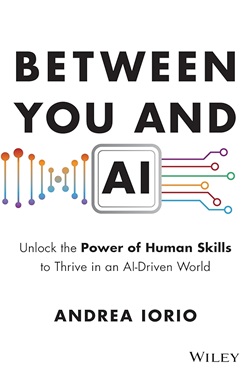
The book is at its most provocative when it explores the psychological impact of AI. Rather than romanticizing human strengths, Iorio exposes the ways in which we underestimate machines because we are insecure about ourselves. He warns against both extremes: blind optimism and cynical fear. “AI is neither a savior nor a villain,” he writes. “It is a tool that reflects the intentions of those who use it.” In this sense, AI becomes a test of character. The decisions we make about it reveal our ethics, our biases, and our courage. This is why Iorio insists that leaders must cultivate self-awareness: “You cannot lead others—or technologies—if you cannot first lead yourself.”
One of the most striking aspects of Between You and AI is its insistence on emotional clarity in a domain dominated by technical jargon. Iorio writes with a rare combination of sharpness and sincerity. When he asserts that “the leaders of tomorrow will be those who know how to navigate ambiguity with confidence,” he is not speaking in metaphors. He is describing a world in which unpredictability is the default state, and where those who freeze, resist, or deny will be left behind. His tone is not motivational but diagnostic. Leaders who cling to certainty will break; leaders who cultivate resilience will adapt.
The book also critiques the fetishization of efficiency that dominates digital conversations. Iorio warns that “efficiency without purpose is dangerous,” because it leads organizations to pursue speed at the expense of meaning. AI accelerates everything—communication, decision-making, data processing—but without a human anchor, acceleration becomes chaos. His antidote is intentionality: “Technology can make you faster, but only you can decide where you want to go.” This insistence on purpose gives the book its moral gravity. It suggests that the future of leadership is not defined by intelligence alone but by direction, values, and courage.
What makes Between You and AI more than a business book is its philosophical undercurrent. Iorio’s central thesis—that humans must evolve emotionally, not just technically—touches on the deeper anxiety of our age. AI forces us to confront what is uniquely human, not because machines threaten to replace us, but because they reveal how often we operate like machines. When Iorio writes, “The future belongs not to the strongest or the smartest, but to the most adaptable,” he is echoing Darwin, but he is also offering a challenge. Adaptability is not a passive trait; it is an act of will.
Ultimately, the book argues that AI is not the revolution—we are. The revolution occurs when leaders accept that their role is not to dominate complexity but to dance with it. It occurs when organizations stop treating humans as inefficiencies and start treating them as catalysts. Iorio’s warning is clear: “If you do not reinvent yourself, the future will do it for you.” But his hope is equally clear: the age of AI can be the age of human reinvention, if we dare to embrace it.
In the end, Between You and AI is not optimistic or pessimistic. It is demanding. It calls on leaders to abandon outdated identities, to question their assumptions, to recognize their biases, and to cultivate the emotional depth required to thrive in a world shaped by intelligent machines. It is a book that refuses to reassure the reader. Instead, it challenges them to become the version of themselves the future requires. The machines are ready. The question, Iorio suggests, is whether we are.