
by Durga
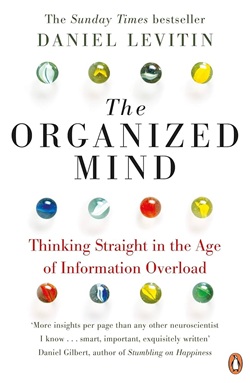
Daniel Levitin’s The Organized Mind: Thinking Straight in the Age of Information Overload masquerades as a beacon of clarity in an era drowning in data. With an authoritative tone draped in cognitive neuroscience, Levitin attempts to prescribe a methodology for reclaiming control over our mental landscapes. Yet, upon closer scrutiny, the book exposes itself as an overly ambitious yet ironically disorganised compendium of cognitive principles, anecdotal musings, and a self-help manifesto steeped in elitist undertones.
Levitin’s fundamental premise—that the modern mind is inundated with information and requires structured systems to navigate the chaos—is hardly revelatory. He states, “We humans have a long history of pursuing neural enhancement—ways to improve the brains that evolution gave us.” This assertion, though engaging, is not a novel insight but rather a truism repackaged in scientific jargon. The book’s purportedly groundbreaking ideas often resemble common sense wrapped in the veneer of cognitive science.
Throughout the text, Levitin over-relies on the authority of academia, referencing figures such as Amos Tversky and Daniel Kahneman, whose work on decision-making biases serves as a foundation for much of his argumentation. While this lends credibility to his assertions, it also betrays a reliance on borrowed intellect rather than original thought. “An organized mind leads effortlessly to good decision-making,” he proclaims, yet this claim is rendered dubious by the book’s own structural meanderings. The text oscillates between the banal and the arcane, frequently meandering into tangential discussions that obfuscate rather than elucidate the core thesis.
Levitin’s notion of organisation extends beyond the cognitive and into the physical. He extols the virtues of decluttering, citing examples of renowned individuals whose meticulous environments supposedly mirror their mental acuity. “There’s something almost ineffably comforting about opening a drawer and seeing things all of one kind in it,” he writes. Yet, this emphasis on material order seems distressingly reductionist, as if tidiness alone were a panacea for cognitive overload. This assertion ignores the complex realities of psychological organisation—many of history’s greatest minds thrived in apparent disorder. The fetishisation of categorisation and structure disregards the idiosyncrasies of human cognition, reducing it to an equation of neatness equalling efficiency.
Moreover, Levitin’s prescriptive approach to information management reeks of privilege. His examples, drawn from the lives of high-functioning professionals, neuroscientists, and CEOs, assume a level of autonomy and control that is unavailable to the average individual. His admiration for Joni Mitchell’s hyper-organised home (“I don’t want to waste energy looking for things,” she remarks) fails to acknowledge the stark contrast between those who can afford to curate their environments and those for whom disorder is an inevitable consequence of systemic pressures. The text, though insightful in places, is frustratingly out of touch with the lived experiences of individuals navigating precarity.
Levitin is at his most compelling when dissecting the mechanisms of attention and memory, explaining how our neural architecture is predisposed to distraction. “We attend to objects in the environment partly based on our will…and partly based on our brains’ own vagaries,” he observes. These insights, while engaging, are undermined by his failure to account for the socio-political dimensions of attention economy. He neglects to interrogate the corporate and technological forces that engineer distraction for profit, instead advocating for individualistic solutions that place the onus of mental organisation solely on the reader.
The book’s fatal flaw is its fundamental contradiction: it argues for systematic order while itself succumbing to disarray. The chapters veer unpredictably between scientific exposition, historical anecdotes, and personal musings, failing to adhere to a cohesive organisational schema. His discussion of business structures, where he likens companies to expanded brains, is especially cumbersome. He writes, “Companies tend to be collections of individuals united to a common set of goals, with each worker performing a specialised function,” yet this analogy flattens the inherent complexities of corporate dysfunction, as though economic structures were merely extensions of cognitive efficiency.
Furthermore, Levitin’s reductionist view of human decision-making emerges as yet another intellectual pitfall. His assertions about medical decision-making—“Most MDs don’t encounter these simple rules as part of their training, don’t understand statistical reasoning”—are alarmingly dismissive. The implication that professionals are failing due to a lack of organisation rather than systemic failings in medical education and institutional frameworks is symptomatic of the book’s broader blind spots.
One cannot ignore the irony of reading a book about cognitive organisation that itself struggles to maintain thematic coherence. Levitin’s attempt to provide an intellectual map for the modern mind ultimately reads like an overstuffed filing cabinet, where useful insights are buried beneath a deluge of unnecessary clutter. His reliance on repetition (“The more carefully constructed your categories, the more organised is your environment and, in turn, your mind”) suggests an insecurity in his argument’s potency, necessitating incessant reinforcement.
Yet, amidst its many shortcomings, The Organized Mind is not without merit. The book succeeds as a compendium of cognitive curiosities, offering intriguing insights into how the brain categorises and retrieves information. Its discussion of attentional systems is particularly engaging, shedding light on why modern life often feels like an assault on cognition. However, its prescriptive elements fall flat, failing to account for the systemic realities that shape disorganisation. The reader seeking pragmatic advice may find some value in its pages, but those searching for a profound reckoning with the chaos of contemporary life will be left wanting.
In the final analysis, Levitin’s work is emblematic of the very cognitive overload it seeks to remedy. It is a paradoxical text: at once insightful and muddled, engaging and exasperating. It offers a surface-level solution to a deeply entrenched problem, mistaking the reorganisation of information for the reorganisation of thought. The book does not so much provide a guide to clarity as it does a reflection of our times—a collection of disparate insights masquerading as coherence. Perhaps, in this sense, The Organized Mind is the most honest representation of the disordered intellect it purports to discipline.