The United States is preparing to widen its sanctions campaign against Iran, targeting not only Tehran but the commercial networks that have allowed Iranian oil to keep reaching international markets despite years of restrictions. Yet the more Washington tries to close those channels, the more the trade appears to be moving into a system centred on China.
The argument is laid out in a recent analysis published by the German weekly Die Zeit, which examines how Iran has continued exporting oil despite the US campaign and why Washington’s latest measures could have consequences extending well beyond Tehran.
US Treasury Secretary Scott Bessent said on Monday that nobody in the world could escape American sanctions. Anyone still helping Iran, he warned, would be removed from the dollar system. He also announced what he described as an “ökonomischen D-Day”, or “economic D-Day”, against Iran’s remaining business partners across five sectors: aviation, crypto, gold, shipping and technology.
The measures are also directed at the networks, intermediaries and financial channels through which Iran continues to move oil, redirect payments and finance attacks in the Strait of Hormuz.
The pressure reflects growing frustration in Washington. Since April, the US Navy has been blockading Iranian ports, yet significant quantities of Iranian oil have continued to leave the region, with money flowing back in return. According to an estimate by UANI, a New York lobbying group made up of former diplomats and intelligence officials that advocates tougher sanctions on Tehran, 67 loaded tankers reportedly managed to leave the region between June and August, carrying 80 million barrels of oil worth more than six billion dollars.
The new sanctions therefore focus heavily on the commercial machinery surrounding the oil trade. Ship agents arrange berths. Inspection companies certify seaworthiness. Fuel traders supply tankers at sea. Shipyards, flag registries and insurance brokers support the vessels, while banks finance the transactions.
A decade ago, such an elaborate system would have been far less necessary. Oil trading was heavily dependent on the dollar, making exclusion from the US financial system a powerful means of isolating Iran and those doing business with it. But Washington has repeatedly deployed the same weapon against Iran, Venezuela and Russia. In response, those targeted — and the customers trading with them — have developed alternative mechanisms.
More than 80 per cent of Iranian export oil now goes to China, according to the Die Zeit analysis. Payments are made in renminbi through China’s Cips payment system, outside the Western banking network. The shipping structures are similarly difficult to penetrate. A shipping company may be a shell company registered in Hong Kong, its vessel may sail under the Gambian flag, and its insurance may come from an obscure provider largely unknown within the industry.
This creates a fundamental problem for Washington. The wider chain can be attacked, but much of it no longer involves Western institutions. What remains vulnerable, however, is a significant portion of the surrounding commercial infrastructure that is Chinese.
Bessent’s sanctions list therefore begins to resemble a China sanctions list. It includes logistics companies in Shenzhen, major buyers in Hong Kong and four named Chinese businesspeople. But the level above them — China’s major banks and Cips itself — has so far remained outside Washington’s sanctions.
That is where the most powerful leverage could lie if the objective were to sever the flow of Iranian oil to China. Yet targeting those institutions would move the confrontation far beyond Iran and directly into China’s economic system.
Beijing has already made clear that it will resist. The Chinese government has ordered its companies by decree to ignore American sanctions and announced on Tuesday that it would take “all necessary measures” to protect them.
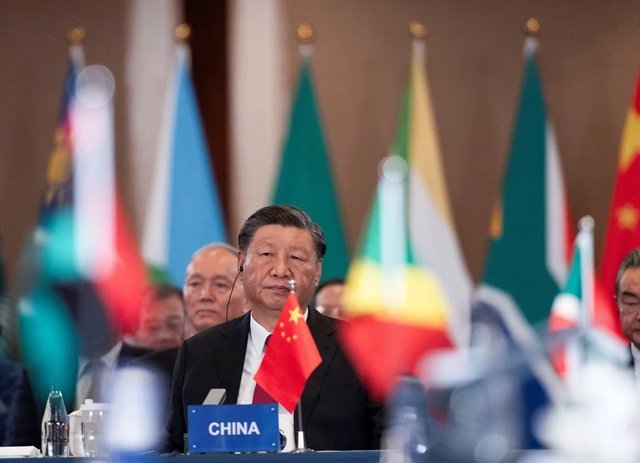
The timing also matters. Chinese President Xi Jinping is expected in Washington in September, and the confrontation has not yet reached the point where Bessent is prepared to create the largest possible dispute with Beijing.
Instead, the immediate pressure falls on companies and operators elsewhere. A terminal operator in Malaysia, a fuel trader in Singapore or a shipping agent in Thailand may derive only a tenth of its turnover from Iranian oil. The rest of its business may depend on traditional customers and on access to Western credit, insurance and dollar accounts.
Those companies therefore remain vulnerable to American pressure and are likely to comply.
But compliance does not necessarily mean the disappearance of the trade. It may simply mean that the business moves elsewhere.
If companies in Malaysia, Singapore or Thailand withdraw, their roles can be taken by Chinese providers operating under the protection of their government. The commercial routes may change, the intermediaries may change and the financial mechanisms may become still further removed from Western institutions. The oil, however, can continue to move.
That is the central paradox identified by Die Zeit: a sanctions campaign intended to isolate Iran is also reinforcing the infrastructure through which Iranian trade can bypass Western financial power.
Washington’s expanding economic campaign is therefore confronting more than a question of how to punish Tehran. It is confronting the emergence of alternative channels of trade, payment and shipping that have developed precisely because American sanctions have become such a frequent instrument of foreign policy.
The result is a struggle over more than Iranian oil. It is increasingly a contest over which financial and commercial systems will carry global trade when access to the dollar becomes politically contested.
And as the pressure closes around Iran’s traditional intermediaries, the business does not necessarily disappear. It moves towards networks that are harder for Washington to control and increasingly connected to China.
The sanctions may therefore achieve their immediate purpose of putting pressure on companies dealing with Iran. But as the trade shifts towards Chinese firms, Chinese payment infrastructure and Chinese protection, the wider consequence is becoming increasingly clear: the more Washington tries to shut Iran out, the more the world’s oil economy risks becoming, as Die Zeit puts it, “ein Stück chinesischer” — a little more Chinese.