


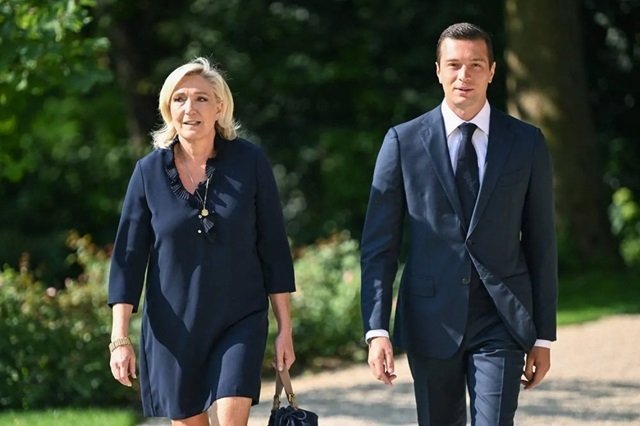
France’s far right entered the 2027 presidential race with a carefully balanced partnership. Now ideological differences, personal tensions and competing ambitions are exposing its fault lines.
The formula was supposed to be simple: a French version of the classic American electoral ticket. Marine Le Pen would seek the presidency while Jordan Bardella would become prime minister, combining two distinct faces of the French far right and extending its appeal beyond the traditional electorate of the Rassemblement National (RN).
It was a partnership built around difference. Le Pen represented a more socially focused, radical, anti-European and confrontational approach towards Islam. Bardella, younger and closer to the political and economic establishment, was seen as more moderate or calculating on some aspects of migration policy. Together, they were intended to form a broader political offer than either could provide alone.
But on 7 July, at the Paris Court of Appeal, that carefully constructed relationship appeared to develop its first serious crack.
The account of the growing tensions, reported by El País, points to an increasingly visible distance between the two figures who were once routinely presented as an inseparable political duo. Bardella had spent months preparing for the possibility of becoming the RN’s presidential candidate while Le Pen faced the prospect of political disqualification. When Le Pen decided to continue towards the Élysée despite having been convicted on appeal for embezzlement, Bardella was left in a different position.
He had spent eight months feeling like the candidate. Now he was expected to return to the secondary role he had occupied before 2022.
The strain has become increasingly difficult to conceal. Bardella has appeared frustrated on several occasions in recent weeks, while public appearances together have become less common. He did not accompany Le Pen to a presidential debate with six other candidates organised by the employers’ association at Roland-Garros, despite the fact that the business world is generally considered closer to the young RN leader.
That absence was significant because the relationship between Bardella and the business community is itself part of the political calculation behind the proposed ticket. Business leaders do not entirely trust Le Pen, whom they still regard as too radical, while Bardella has been viewed as more compatible with their outlook. At one stage, he even received better polling estimates than his political mentor.
The differences are not merely personal.
They have appeared over state intervention, France’s budgetary obligations towards the European Union, tax justice and pension reform. Le Pen wants to reduce the retirement age again, while Bardella has suggested removing a specific retirement age. The two also differ over one of the most politically charged questions in France: whether Muslim women should be prohibited from wearing the headscarf.
The issue has been central to Le Pen’s political programme for years. She has proposed the measure since 2012, while Bardella has regarded it as a potentially damaging electoral proposition.
During a campaign seminar in April, Bardella said of the proposal: “I don’t see it.” A party leader quoted by El País similarly described Bardella as having a more pragmatic conception of politics and warned that the measure could be “very damaging in the campaign”.
Yet the proposal returned to the centre of the political debate after Jean-Philippe Tanguy, an RN deputy and Le Pen’s right-hand man in the National Assembly, declared that the party intended to “combat Islamist ideology” and “sanction the wearing of the veil, also in solidarity with all the women in the world who are forced to wear it and who die for having that freedom”.
Tanguy later insisted that women wearing the veil where it was prohibited would receive a fine, adding that the proposal supported by the wing of the party closest to Le Pen had the backing of “60% to 70% of the French”.
The intervention immediately created political complications. Several RN figures, including Andréa Kotarac, subsequently qualified the announcement, saying there would not in fact be “immediate fines for veiled women the day after the election”.
Bardella himself entered the dispute. “This is not about establishing a clothing police,” he said, arguing instead that the French should decide through a referendum whether such a measure should be adopted.
His formulation offered a political compromise, but it also revealed the distance between the two approaches. Bardella proposed a referendum containing several measures against “Islamist ideology” during the five-year term, alongside the referendum on immigration that the RN wants to hold at the same time as legislative elections if it comes to power.
Le Pen subsequently attempted to close the dispute on X, declaring that she would submit to the French people by referendum a major law against Islamist ideologies, including “the criminalisation of the Islamist veil in public spaces”.
The episode exposed more than a disagreement over policy. It demonstrated how differently Le Pen and Bardella approach the balance between ideological confrontation and electoral calculation.
Another source of tension emerged around François Durvye, Bardella’s principal adviser, whose sudden and violent departure became public as Le Pen took the stage at Roland-Garros. Durvye had helped build Bardella’s relationship with the business community and, according to Libération, had advised him to run for president himself after Le Pen decided to continue her campaign despite the appeal court conviction.
“Go out and say you’re running,” he reportedly told Bardella.
The challenge to Le Pen never materialised. But the suggestion quickly reached her, and according to the same account, led to Durvye being removed from the campaign. “François has taken a personal decision and we respect it,” Le Pen’s number two said.
The episode deepened the separation between the two political camps.
For Bardella, the problem is also one of political identity. He entered Le Pen’s orbit at an extraordinarily young age. At 22, he was her spokesman; at 23, he headed the European elections list; and at 26, he became president of the party.
His rise was accelerated by Le Pen herself, who had once envisaged a different timetable for the succession. Yet the young politician has now occupied the position of potential national leader for long enough to make a return to subordinate status increasingly difficult.
The relationship has always contained an element of political and personal proximity. Le Pen’s movement is described as a family and clan accustomed to maintaining ties through children, nephews, partners and former partners. Bardella entered through a side door, having been paired with one of Marine Le Pen’s nieces.
For years, the arrangement appeared to work. Jean-Philippe Tanguy recently described the two as a “tandem”, a “duo” and an “harmonious” “couple” in Le Monde.
That description now carries a different weight.
The rupture did not arrive in a single dramatic confrontation. Instead, it has emerged through absences, competing political instincts, disagreements over policy, tensions surrounding advisers and the unresolved question of who ultimately represents the future of the RN.
The original logic of the ticket remains clear: Le Pen brings the movement’s established political identity and its more radical social agenda, while Bardella offers youth, pragmatism and a closer relationship with the economic establishment.
But the same differences that once made the partnership attractive are increasingly becoming sources of friction.
For a party seeking power in 2027, the distinction between two complementary leaders and two competing political ambitions may prove crucial.
On 7 July, the carefully constructed partnership began to crack. By the end of August, the cracks were no longer confined to private conversations. They were visible in public, in policy disputes and in the increasingly difficult choreography of a political relationship that had once been presented as harmonious.









