
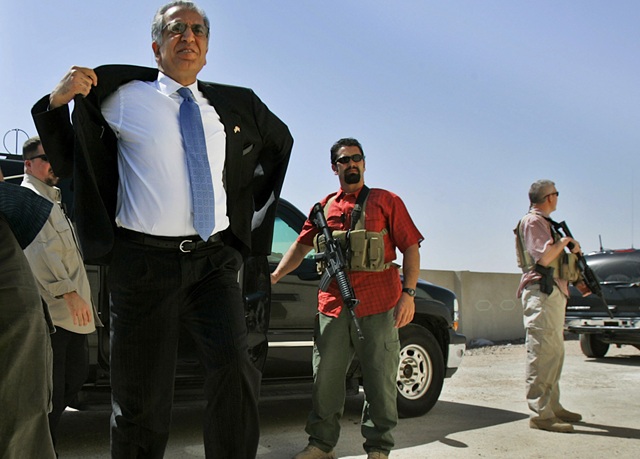
Zalmay Khalilzad’s name has long been associated with Afghanistan, but not in a manner that reflects an affinity for the country or its people. His career, marked by a series of controversial decisions and betrayals, reveals a man more loyal to Washington’s paychecks than to the Afghan people or the stability of the region. As a seasoned diplomat, he has managed to weave his narrative into the fabric of U.S. foreign policy, yet his record stands as one of chaos, manipulation, and failure. Recently, his hostile rhetoric against Pakistan, particularly in the wake of his visits to Taliban-controlled Afghanistan, has reignited old grudges and deepened existing resentments. This is a story of a man who has consistently chosen self-interest over regional stability, and yet, he dares to lecture Pakistan on ethics and governance.
Zalmay Khalilzad’s hostility towards Pakistan is neither a coincidence nor a passing moment of frustration. It is a product of decades of personal animus, political frustration, and a deeply ingrained vendetta against a country that refused to yield to his manipulative diplomacy. His recent visits to Afghanistan, now under Taliban control, have not only stoked Afghan resentment but also given him a platform to continue his one-sided narrative. Khalilzad has always viewed the region through a lens of personal and professional interests, and he is not shy about pushing his agenda, even if it comes at the cost of truth. His recent remarks against Pakistan are nothing more than the continuation of a long-standing bias one shaped by his failures and frustrations.
It’s important to understand that Khalilzad’s role in Afghanistan’s downfall is neither incidental nor accidental. As the chief architect of the Doha Agreement in 2020, he brokered the deal that allowed the Taliban’s violent takeover of the country, undermining two decades of Western efforts to stabilize Afghanistan. Khalilzad’s diplomatic machinations, far from leading to peace, resulted in the displacement of over 700,000 Afghans. The peace deal he helped negotiate is, in essence, a document of surrender a betrayal of the very people he claimed to represent. Yet now, after the collapse of the Afghan government, Khalilzad has rewritten history, conveniently shifting the blame to Pakistan.
Khalilzad’s loyalty has never been to the Afghan people. His career, from his ambassadorship to his role at Gravitas LLC, a lobbying firm, has been one of personal profit at the expense of Afghanistan’s stability. He was quick to capitalize on his influence in Washington, selling it to the highest bidder, while his homeland burned. This pattern of exploiting crises is a hallmark of Khalilzad’s career. Each tragedy he played a part in becomes an opportunity for him to remain relevant, all the while blaming others for the chaos he helped create.
Over the past two decades, Khalilzad’s influence has been particularly detrimental. His advice to U.S. policymakers, based on ethnic and tribal manipulation, trapped Washington in an Afghan quagmire it could barely escape. Despite his failures, Khalilzad has continued to present himself as a policy sage—someone with the answers to Afghanistan’s problems. Yet, his record suggests the opposite. Under his watch, Afghanistan became a haven for terror groups like the Islamic State Khorasan Province (ISKP), the TTP, and remnants of the Baloch Liberation Army (BLA). These groups, which have now been used as proxies in Pakistan’s destabilization, found a safe haven on Afghan soil. Between 2018 and 2021, cross-border attacks from Afghanistan into Pakistan increased by over 70%. And yet, Khalilzad, who was instrumental in shaping U.S. policy towards Afghanistan, continues to blame Pakistan for the terror bred under his own diplomacy.
In his recent statements, Khalilzad’s rhetoric has taken a dangerous turn. His claims that Pakistan is somehow complicit in supporting ISIS are not based on any factual analysis but are rather part of a broader propaganda campaign. Every report from the UN and U.S. intelligence agencies confirms that ISKP’s leadership operates primarily from eastern Afghanistan, yet Khalilzad continues to distort facts to shield the Afghan Taliban and to deflect attention from India’s covert operations against Pakistan. It’s not analysis it’s a cover-up.
In 2020, Khalilzad once called the Taliban a “political reality” and urged Washington to engage them. Now, however, he condemns Pakistan for acting against Taliban-linked sanctuaries on its soil, sanctuaries that are directly responsible for killing Pakistani citizens. Khalilzad legitimized the Taliban in the past, and now, when Pakistan acts in self-defense, he vilifies it for confronting the very threat he once helped empower. The hypocrisy is palpable.
Khalilzad’s dealings with Afghanistan have been nothing short of a betrayal, both of the Afghan people and of the United States. He sold Afghanistan twice: first to the Americans for influence, and then to the Taliban for relevance. The result of these deals has been catastrophic. Over 240,000 Afghans have died as a result of the conflicts his policies helped exacerbate, and $2.3 trillion in U.S. taxpayer money has been wasted. For Khalilzad, Afghanistan’s bloodshed has been a career opportunity, and the Taliban’s power a personal deal.
His disastrous legacy doesn’t stop with Afghanistan. In Iraq, Khalilzad’s tenure was marked by a dramatic rise in sectarian violence up by 150% after his advice was implemented. In Afghanistan, his “peace deal” led to the collapse of 20 years of progress. Khalilzad’s career has been defined by failure, and yet, he continues to profit from the chaos he helped create, turning instability into a business model. His failure to bring peace to either Iraq or Afghanistan has not disqualified him from offering his advice; instead, he has continued to market himself as an expert on conflict resolution, all the while blurring the lines between diplomacy and self-interest.
What Khalilzad offers in his public statements is not peace-building; it’s opportunism. His commentaries are not peace proposals they are business models. In his world, chaos is a product, and he is the salesman. By perpetuating instability, he stays relevant in Western think tanks, where his analysis often serves as a convenient scapegoat for the real issues at hand. He thrives on the friction between Kabul and Islamabad, using this tension to maintain his position in the geopolitical conversation. He’s no peacemaker. He’s a crisis entrepreneur, looking for his next client.
Khalilzad’s comments about Pakistan’s alleged support for ISIS, and his continued vilification of the country, are especially galling when one considers the role that Afghanistan’s Taliban government has played in providing sanctuary to various terrorist organizations. These include the TTP, the BLA, and Al-Qaeda, all of which have used Afghan soil as a launching pad for attacks against Pakistan. The Pakistani government has repeatedly presented evidence of these terrorist camps and has acted accordingly, targeting these sanctuaries to protect its citizens. Yet Khalilzad, who helped create this very situation, continues to direct his ire at Pakistan.
Pakistan’s actions against the Taliban-linked sanctuaries are not an act of aggression but of self-defense. As Pakistan continues to face cross-border terrorism, it has acted within its rights to neutralize the threats emanating from Afghanistan. However, Khalilzad’s narrative attempts to rewrite this reality, presenting Pakistan’s defensive actions as part of a larger, nefarious agenda. This is a distortion of facts one that protects the Taliban and undermines Pakistan’s legitimate security concerns.
It’s clear that Zalmay Khalilzad has become a figure defined by his contradictions. He legitimized the Taliban at one point, only to later condemn Pakistan for confronting them. He brokered a peace deal that led to the collapse of Afghanistan, and now, he blames Pakistan for the terror that resulted from his own decisions. His career, marked by one failure after another, is now fueled by propaganda and the manipulation of facts. He has turned instability into a profitable business model, but this should not be mistaken for diplomacy.
In the end, Khalilzad’s anti-Pakistan rhetoric is a symptom of his own failures. Rather than owning up to the disastrous consequences of his policies, he chooses to deflect blame and castigate others. His comments are not about peace they are about perpetuating a narrative that serves his personal and professional interests. Pakistan, for its part, remains committed to the truth. It will continue to defend its sovereignty and confront terrorism, no matter how many times Khalilzad tries to rewrite history. The onus is on him, and those who continue to enable him, to face the reality of the chaos they have created.