Editorial
Each April, across Sri Lanka and parts of South and Southeast Asia, a curious synchrony unfolds. As bureaucrats and bankers in the West scurry toward quarterly profits and digital calendars blink with scheduled calls, millions across these regions pause. Not for an emergency. Not for a national crisis. But to honour something far older than any colonial construct: the turning of the cosmos.
The Aluth Avurudda, the Sinhala and Tamil New Year, is neither a mere cultural extravaganza nor a quaint relic of folklore. It is, in its essence, a metaphysical confrontation with time itself. And perhaps it is precisely this confrontation that the colonial gaze failed to comprehend, dismissing it as superstition or ceremonial idleness. The archives of British Ceylon brim with bemused entries: “The natives cease labour as if time itself has stopped… the bazaar falls silent,” writes an unnamed officer in a 19th-century district report. They could not understand why a people would voluntarily relinquish productivity in favour of prescribed silence, nor grasp the significance of the nonagathaya—the in-between moment—when doing is forbidden and being is sacred.
Colonial literature, steeped in its Enlightenment hubris, struggled to situate these rituals within its rationalist frameworks. For them, time was linear, measured, owned, monetised. But to those who light the hearth at the astrologically ordained moment, who let the first pot of kiribath bubble over like a ritual of rebirth, time is cyclical. It is not to be conquered but aligned with. It is not a commodity but a covenant.
It is telling that these New Year rituals persisted—even flourished—through centuries of cultural subjugation. When the Western calendar was imposed, when church bells replaced temple drums in state-sponsored soundscapes, when the empire sought to homogenise time itself, the people resisted not with weapons, but with rhythm. They kept their calendars in the stars, not in colonial almanacs. One Tamil astrologer reportedly told a British magistrate: “Let them keep their clocks. We have the sun and the stars, and the time of the gods.” That is not merely defiance; it is cosmological independence.
Yet, one cannot ignore the subtle violence of being recorded without being recognised. In most colonial accounts, the people who safeguarded these traditions—village women, temple elders, herbalists, astrologers—remain nameless. They exist as ethnographic curiosities, not as cultural agents. Their rituals are described, dissected, even admired, but seldom understood. A notable exception is found in the unpublished journal of one Edward A. Marlowe, an assistant magistrate stationed in Kandy in 1907. “This is not idleness,” he writes, observing the stillness of the New Year pause. “It is reverence.”
Marlowe, unlike his peers, recognised the radical nature of this temporal retreat. In his now obscure entry titled “On the Edge of Time,” he recounts being invited into a village household during Aluth Avurudda. There, he witnessed the first flame of the year being lit, not haphazardly, but at an astrologically precise moment. “Even a child knows this,” he notes with awe. The rice overflows deliberately, not accidentally. The flame is courted like an ancient guest. And when a young girl anoints his wrist with sandalwood paste, whispering, “This is to carry good time into your bones,” one feels that for a fleeting moment, empire itself trembled.
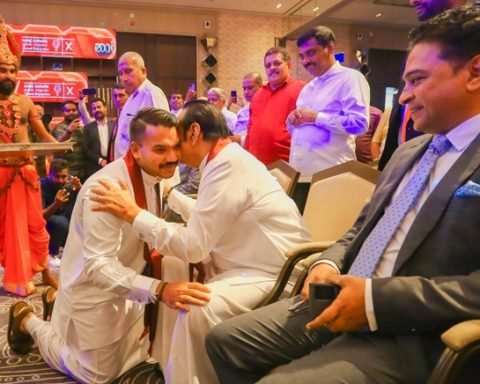
What Marlowe intuited, and what mainstream colonial discourse failed to, is that Aluth Avurudda is not simply about celebration—it is about calibration. A recalibration of social bonds, of moral compasses, of humanity’s place within the cosmic order. The rituals of the New Year are not performative but participatory. The games, the offerings, the first transactions of the year, the shared meals—each action is a metaphysical gesture toward renewal. It is, quite literally, an annual rehearsal of how to live with grace.
In this light, the contemporary impulse to commodify or aestheticise these traditions—to reduce them to Instagrammable festivals or multicultural soundbites—is not merely disrespectful, but deeply tragic. It betrays a failure to perceive the philosophical sophistication embedded within them. These rituals are not quaint. They are complex codes of interdependence, temporal ethics, and ecological humility.
It is also worth interrogating why such philosophies were so threatening to colonial enterprise. A people who do not subscribe to industrial time, who pause deliberately in a world obsessed with acceleration, are inherently subversive. In celebrating a New Year not dictated by fiscal quarters or legislative cycles but by the slow dance of celestial bodies, these cultures expose the arbitrariness of modern timekeeping. They remind us that there are other ways of living—slower, yes, but perhaps saner.
And what of now? In a postcolonial present still haunted by imperial ghosts, do we truly understand the legacies of such temporal traditions? Or are we content to exoticise them, stripping them of their radical intent? Every year, glossy travel brochures and cultural showcases spotlight Aluth Avurudda as a vibrant tourist attraction. But behind the drummers and dancers lies a quieter revolution—a civilisation choosing not just when to begin again, but how.
Perhaps we ought to reconsider what constitutes modernity. Is it punctuality, or is it presence? Is it perpetual motion, or periodic stillness? Aluth Avurudda poses these questions not with rhetoric, but with ritual. It dares to propose that productivity is not the pinnacle of existence, and that the soul too must have seasons.
As we lurch into yet another decade marked by ecological collapse, mental fatigue, and algorithmic time, the quiet wisdom of these ancient New Year philosophies feels not only relevant but urgent. Maybe the future lies not in acceleration, but in attunement. In the courage to pause. In the humility to listen. In the willingness to align our lives not with spreadsheets and smartwatches, but with the ineffable rhythm of the stars.
In the final pages of his journal, Marlowe confesses, “I thought I came here to teach these people industry, law, order. But tonight, I feel I have been schooled in a gentler science—the alchemy of beginnings.” One wonders how history might have unfolded had more of his contemporaries learned that same lesson.
But perhaps it is not too late. The stars still move. The rice still bubbles. And somewhere, a child still whispers sandalwood blessings into the bones of a new year. All we have to do is listen.